
Use case · Workforce Assessment
Map and verify workforce skills
Anthropos builds skills inventories fastest without asking staff to complete forms. It centralises skills, certifications and work history from CVs, HRIS and LinkedIn, then verifies skills in 5 to 30 minute AI Simulations.
“We don't actually know what our 5,000 people can do. We have a Deloitte taxonomy in a spreadsheet.”
CHRO, enterprise financial services
Skills matrix vs verified skills
What changes when a skill is verified
The difference is not the taxonomy. It is where the rating comes from, and how long it stays true.
| A skills matrix in Excel | Anthropos | |
|---|---|---|
| Basis | What somebody typed into a cell | What people demonstrated in a scored scenario |
| Employee effort | A blank form, filled in from memory | A pre-filled profile to review, 10-15 minutes |
| Manager effort | Rating every report on every skill | None. Managers rate nobody |
| Structure | Free text that doesn't aggregate | 4,000+ skills, 700+ roles, 0-5 competency scale |
| Coverage | The teams that had time | Everyone with a CV or an HRIS record |
| Evidence | A number with nothing behind it | A score with the cited moment that earned it |
What verified skills are for
One map, six decisions
The map is not the deliverable. These are, and they all run on the same verified profile.
Mapping
Existing data creates skill profiles
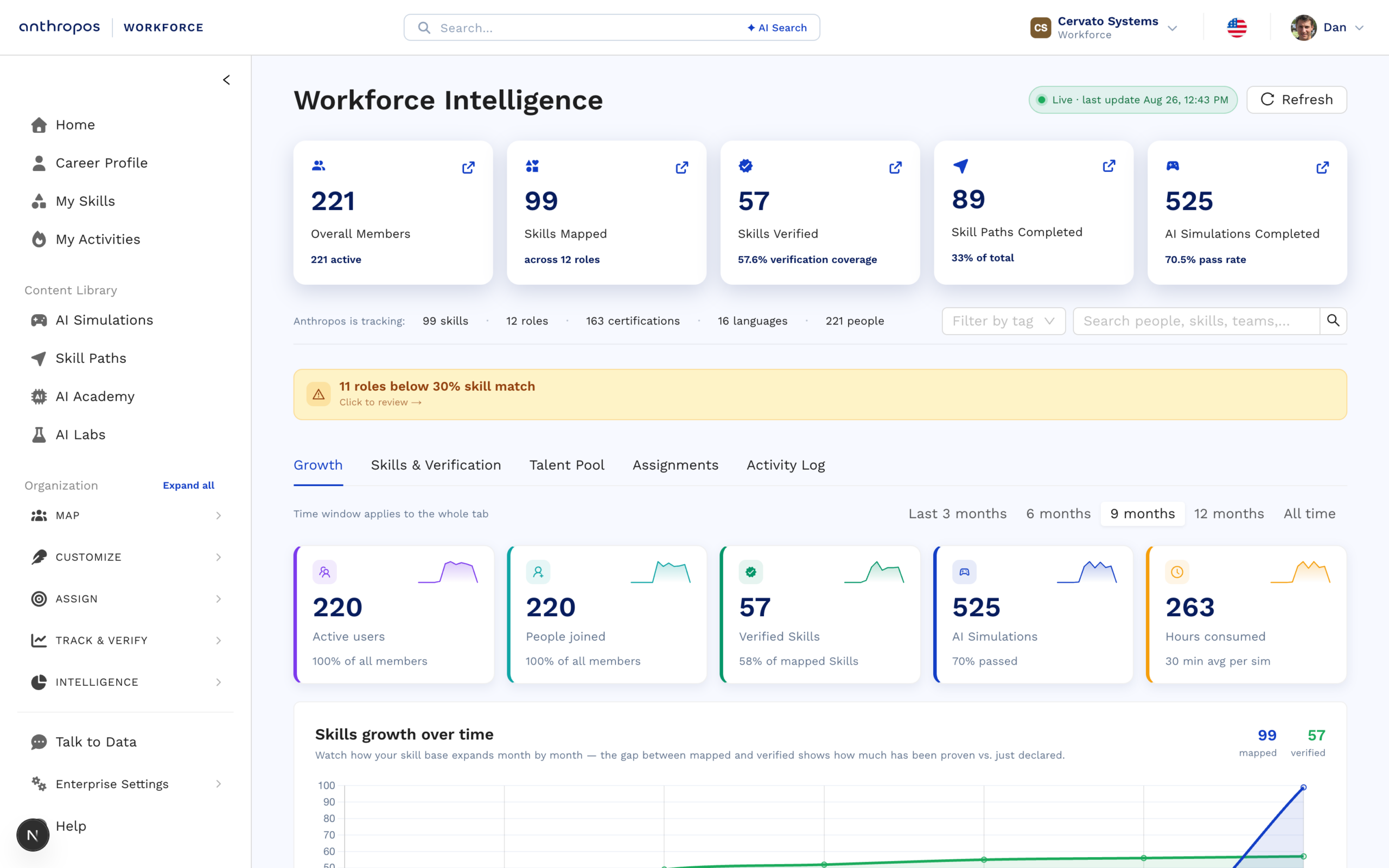
Anthropos maps CVs, HRIS and LinkedIn data to a taxonomy of 4,000+ skills across 700+ roles. Nobody starts with a form. Every simulation, Skill Path and AI Interview updates the same profile, keeping it current between reviews unlike spreadsheets.
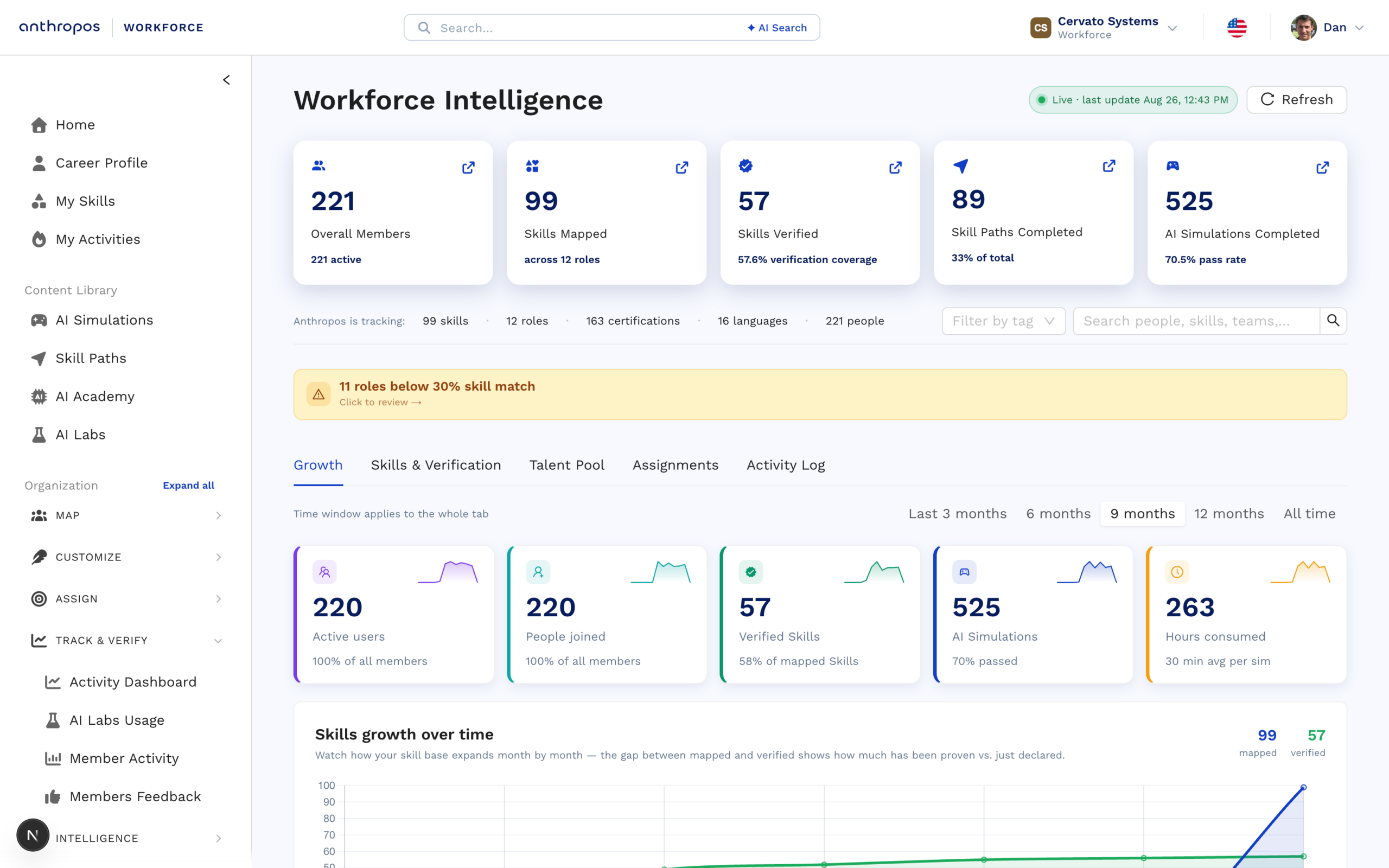
Coverage across the organisation, with the roles below match flagged for review. Cervato Systems, our demo org.
Roles
Roles have skills and target levels
Anthropos defines roles by skills and target levels beyond job titles. Use its 700+ taxonomy roles or import your existing, paid-for competency framework. Anthropos measures each person against their current role and roles they could hold next.
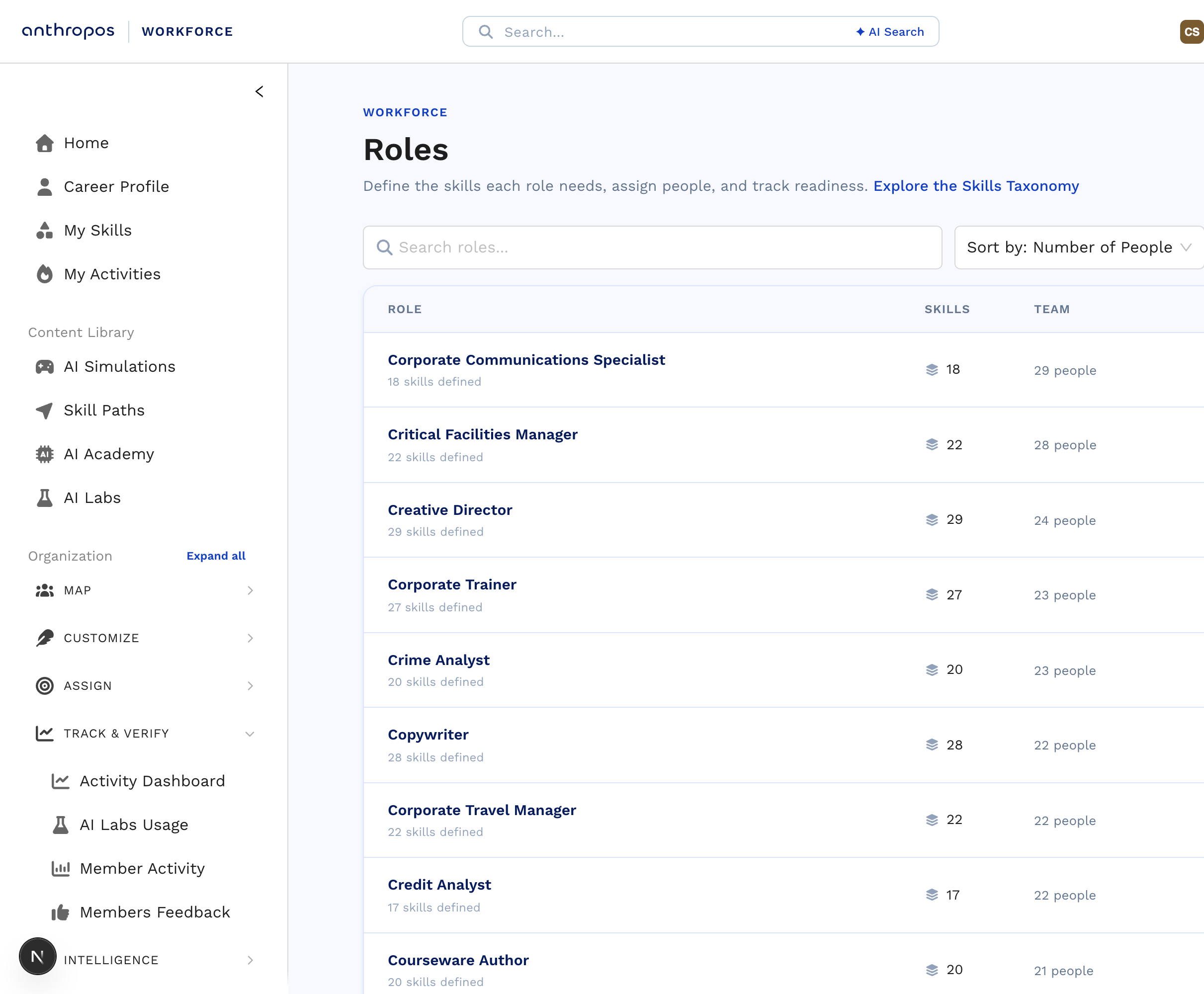
Each role with the skills it defines and the people mapped to it. Cervato Systems, our demo org.
FS Group verified 500+ people in under 2 weeks, then took simulation authoring in-house with its own knowledge owners.
Verification
AI Simulations verify individual skills
Self-ratings conceal overrating and underrating, even when company-wide averages sit close to verified scores. Only verification distinguishes them. AI Simulations score performance in realistic scenarios against required role skills from 0 to 5 in 5 to 30 minutes.
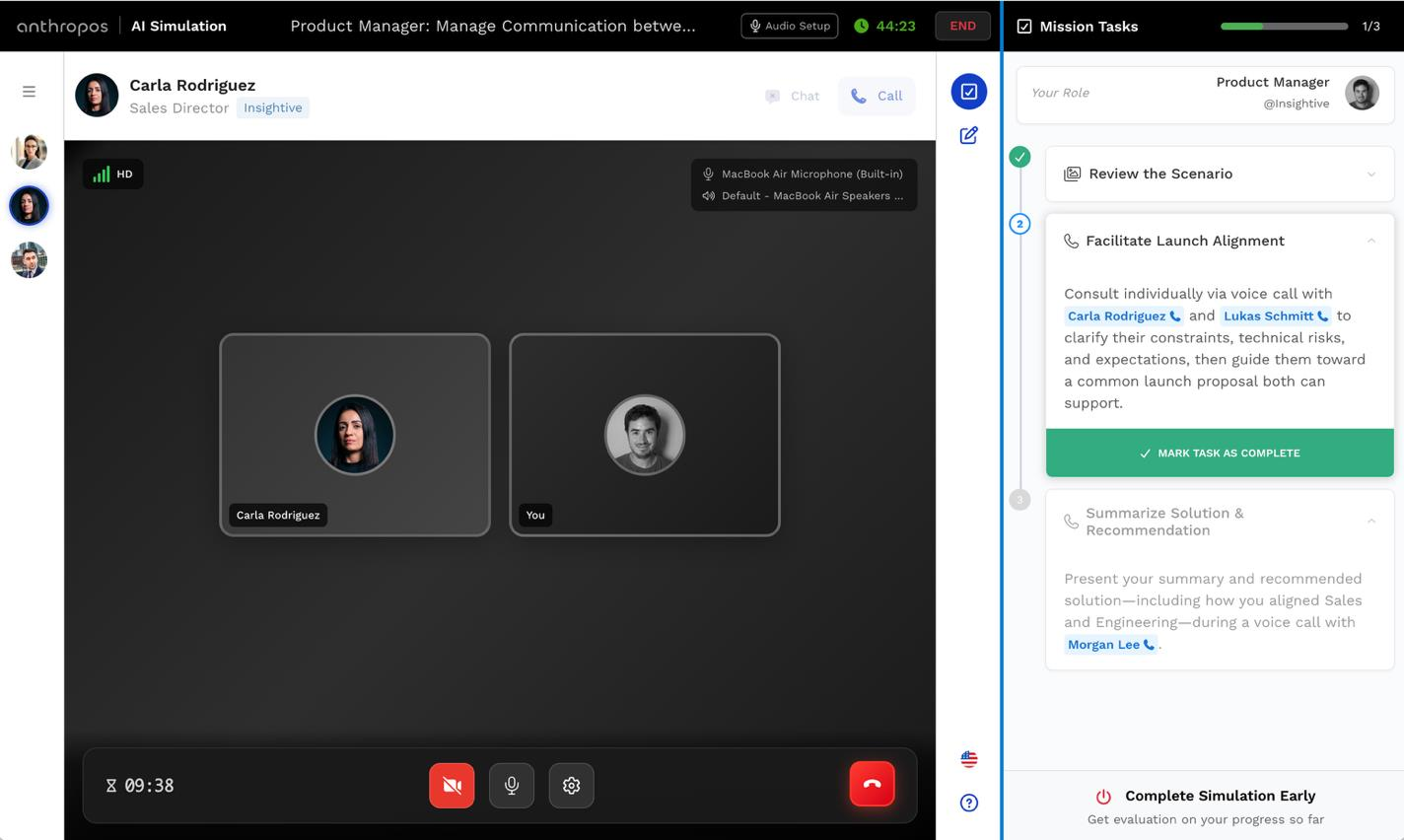
A simulation in progress: a live call with an AI character, with the tasks still to complete on the right.
Personalisation
Experts build the enterprise assessment layer
Anthropos trains one subject-matter expert per role as Knowledge Owner. Owners build role assessments in Studio from your documents and criteria, then train departments. FS Group piloted 12 owner-led roles and now creates its own simulations.
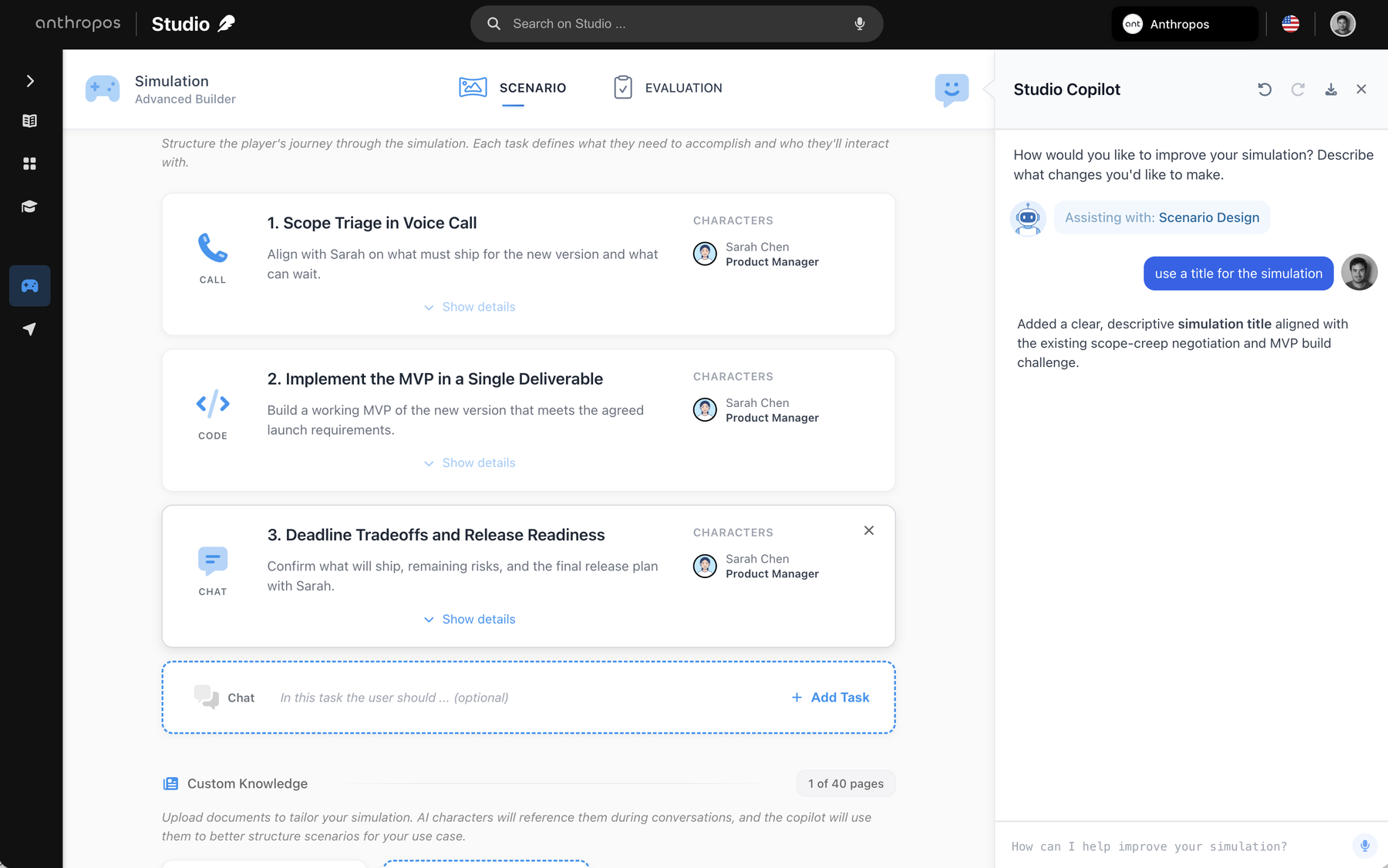
A simulation being authored in Studio: three tasks across voice, code and chat, with the customer's own documents attached.
Coverage
Every role, and both kinds of skill
Most assessment tools pick a side. They test engineers, or they survey everyone else.
Scored on the work, with the tools switched on.
- Software engineering and code review
- Cloud, DevOps and IT architecture
- Data and analytics
- Working with Claude Code and Codex in a real sandbox
Scored on behaviour, against AI characters who push back.
- Sales and negotiation
- Product management
- Customer support and escalation
- Leadership, communication and judgment
And they are scored in the same scenario. One 30-minute session can show how somebody debugs the failing service and how they handle the stakeholder who is pushing back while they do it.
Fairness and transparency
Scoring people is where this gets serious
Assessing employees with AI is a risk you carry personally. Here is exactly what the product does.
Criteria are written before the session runs and applied identically to everyone in the role. Anthropos does not ask a model what it thinks of a person.
Not in AI Simulations and not in AI Interviews. Profiling is limited to skills, and is never used to infer protected characteristics.
Every result goes to a human who holds the decision. An employee who disagrees can request human review through you, and the scoring logic is documented so you can meet your own transparency duties.
Disclosure happens at the start of every simulation, interview and voice call. Assessment data is never used to train models.
ISO 27001 for information security, GDPR for how the data is handled, and an EU AI Act assessment you can read. The DPA and the current sub-processor list are available on request.
Anthropos Workforce supports your decision rather than making it, which is what keeps skills mapping and verification outside the high-risk category the EU AI Act defines for employment decisions.
Rollout
What it takes to start
SSO goes in with SAML 2.0 or OIDC, and the HRIS connection is authorised. Nothing is installed.
Profiles are mapped, people confirm what the system found, and the map is filterable by team, role and skill.
AI Simulations have verified the priority skills, and the gaps come back as assigned Skill Paths.
Your IT team does two things: SSO and the HRIS connection. Anthropos is cloud hosted, so nothing runs on-premise.
Objections
What buyers ask before a pilot
Can we keep the competency framework we already have?
Yes. Import it and Anthropos maps onto it rather than replacing it. The 4,000+ skill taxonomy sits underneath, so the data still aggregates across teams that use different wording.
Do employees have to fill in a survey?
No. Mapping runs from CV, HRIS and LinkedIn first. The guided self-evaluation is a confirmation step on a profile that is already filled in, usually 10 to 15 minutes.
How much work is this for managers?
None in the assessment itself. Managers do not rate their reports on anything. They read the result and decide what to do with it.
Can somebody get through a simulation using AI?
The scenario is interactive and scored on the decisions taken inside it, so a generated answer does not carry it. Every session leaves a transcript you can open and review.
Does the verified score reach our HRIS?
Yes. Verified 0 to 5 scores sync back through the same connection, so your system of record holds the same numbers you see in Anthropos.
Keep reading
Where to go next
Related use cases
Fill roles from the insideKnow your succession benchClose the gaps you found
See it on your own people
Bring a role and a team. We map them, run a simulation, and show you the result on your own data.