
Use case · Career Paths
Generate career paths for every person
Career paths map routes between roles. Learning paths map learning. Anthropos generates each person’s career-path framework from verified skills and role requirements without writing paths by hand.
“We promise people career development. Then the conversation gets improvised, one manager at a time.”
CHRO, 4,000-person enterprise
HRIS framework vs Anthropos
What changes when the path is generated rather than written
A career framework describes levels. It does not tell one person what to do on Monday.
| A career framework in your HRIS | Anthropos | |
|---|---|---|
| What it is | A document describing levels and competencies | A generated gap between a person and a target role |
| Who writes each path | HR and managers, role by role | Calculated per person from verified skills |
| Basis | Tenure, job titles and self-reported profiles | Skills verified in AI Simulations, scored 0-5 |
| Coverage | The roles HR had time to document | Every mapped person, against 700+ roles or your own architecture |
| What the employee sees | A job description one level up | Named skill gaps and the Skill Paths that close them |
| Staying current | A refresh cycle owned by HR | Recomputes after every simulation, interview and Skill Path |
What the path is for
One map, four conversations
A path is only useful if it ends somewhere. These are the places it ends.
Generation
Anthropos computes each person’s career path
Anthropos holds each person’s verified skills and every role’s required skills at each level. It computes each mapped person’s path from the gap between them. Every mapped person gets a path, including those in roles HR has not documented.
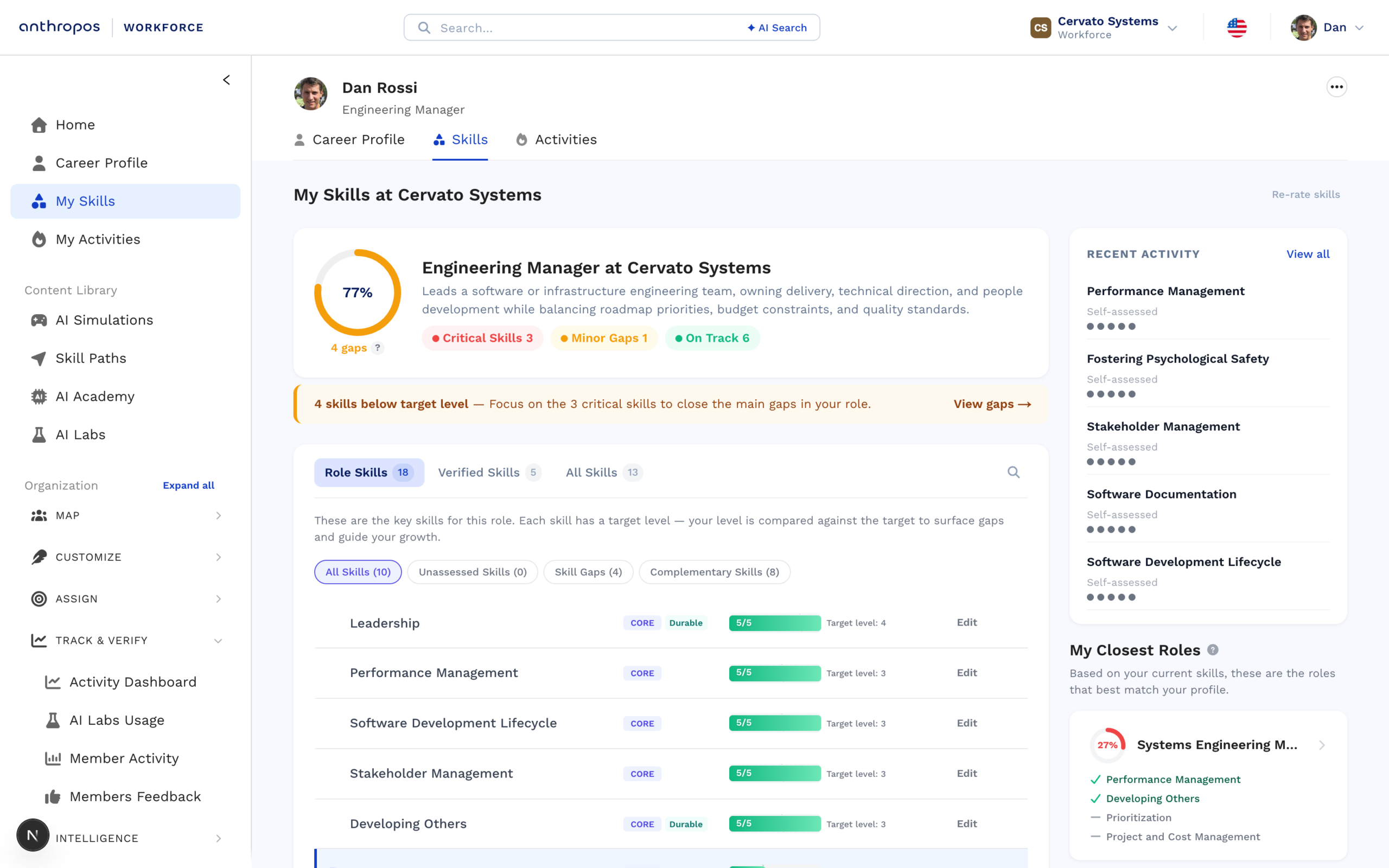
One person against a target role: current level, gap, and what each skill has to reach. Cervato Systems, our demo org.
The employee
Employees see their skills and gaps
Employees see their verified skills on a 0 to 5 scale, roles they already fit and named gaps for roles they want next. Anthropos assigns Skill Paths that close those exact gaps. Employees receive these paths in return for their data.
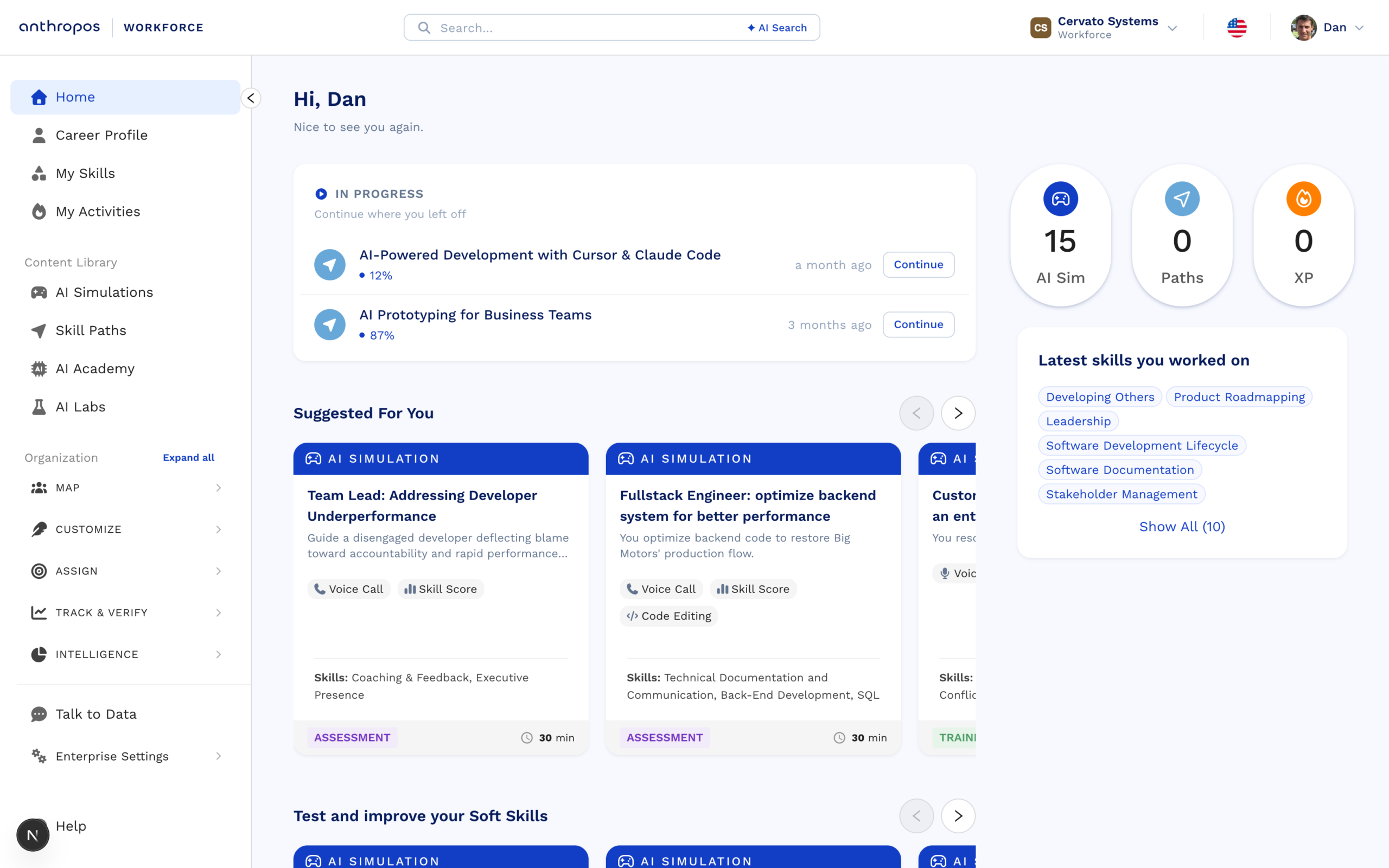
The employee view: skills, activity and what to do next. Cervato Systems, our demo org.
FS Group mapped 500+ people in two weeks with Anthropos. That is the same verified skills map every career path is generated from.

Currency
Career paths update as skills change
Changed role requirements immediately update gaps for everyone targeting them. Higher verified skill levels shrink distance that day. Progress remeasures levels from 2 to 4, citing both sessions without completion records. Per-person generation scales from mid-size firms to 50,000-person enterprises.
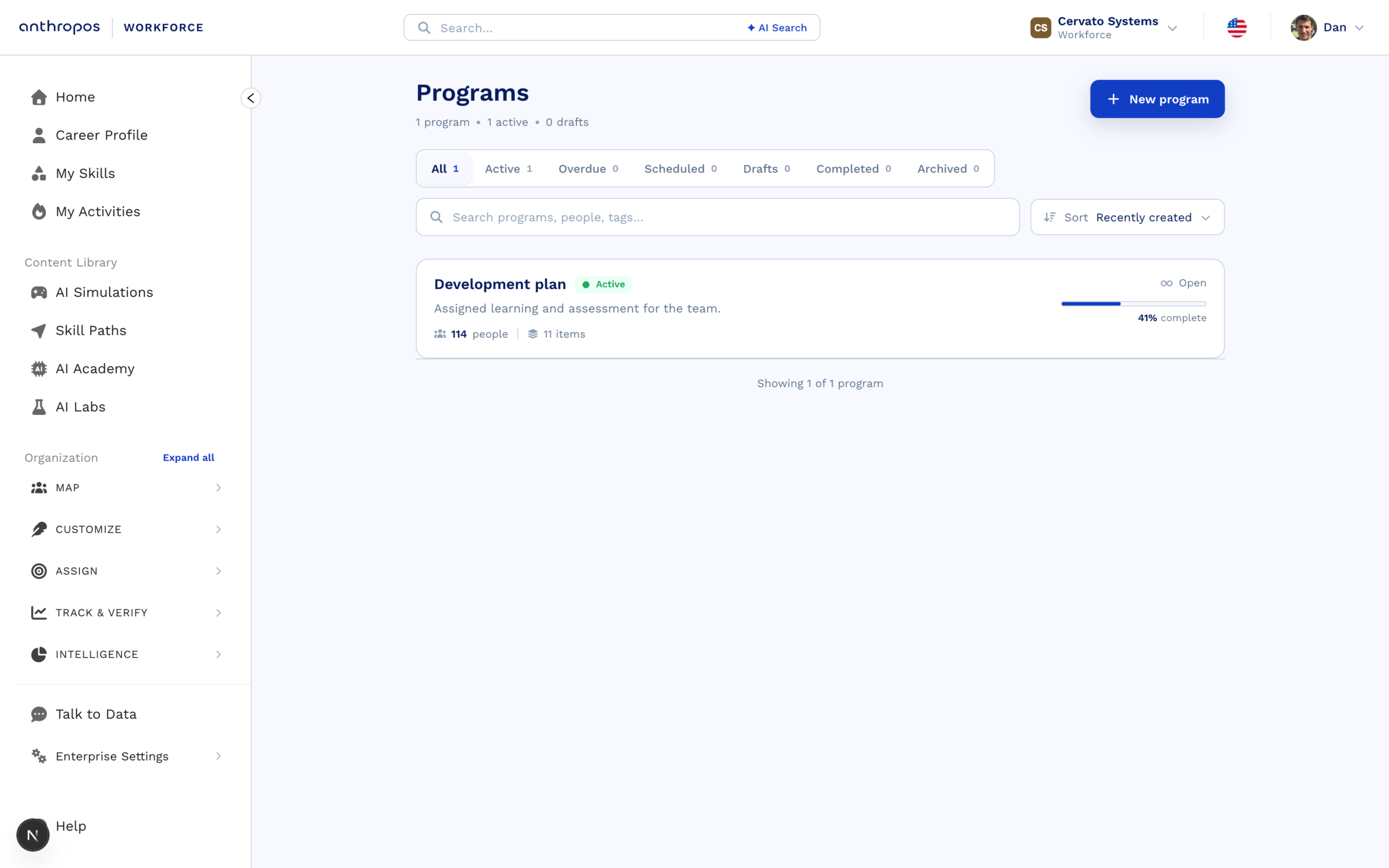
Assigned development across the organisation. Cervato Systems, our demo org.
Fairness and transparency
Measuring people is where this gets serious
People read their own career path, so the way it is produced has to hold up to them.
Criteria are written before the session runs and applied identically to everyone in the role. Anthropos does not ask a model what it thinks of a person.
Not in AI Simulations and not in AI Interviews. Profiling is limited to skills, and is never used to infer protected characteristics.
Every result goes to a human who holds the decision. Someone who disagrees can request human review through you, and the scoring logic is documented so you can meet your own transparency duties.
Disclosure happens at the start of every simulation, interview and voice call. Assessment data is never used to train models.
ISO 27001 for information security, GDPR for how the data is handled, and an EU AI Act risk assessment you can read. The DPA and the current sub-processor list are available on request.
Anthropos supports your decision rather than making it, which is what keeps skills mapping and verification outside the high-risk category the EU AI Act defines for employment decisions.
Rollout
What it takes to start
SSO and the HRIS connection go in. Roles, levels and org structure import automatically.
Auto-mapping produces the first skills map, and AI Simulations verify the skills that matter for the target roles.
Every mapped person has a path: a target role, named gaps and assigned Skill Paths.
There is no separate career module to buy. You can use your own job architecture and levels instead of the 700+ role library.
Objections
What buyers ask before a pilot
Who can see a person's career path: HR, the manager, or the employee?
Access in Anthropos is role-based. Each employee sees their own profile, gaps and target roles. Managers see their own team. HR leadership sees the whole population, with verified skill levels by team, department and role family. Permissions are configured per tenant during implementation, so nobody sees a path they should not.
Can we use our own job architecture and role levels instead of yours?
Yes. Anthropos ships 4,000+ skills mapped to 700+ roles, and maps onto an existing competency framework in Workday, SAP SuccessFactors or another HRIS. HR can also set which skills a role requires, and at which level, so career paths are calculated against your architecture rather than a generic one.
How is a career path different from succession planning?
A career path in Anthropos is the ongoing route any employee is on toward a target role. Succession planning asks a narrower question: for one critical role, who is ready to step in now. Both read the same verified skills and role benchmarks, but succession covers a shortlist and career paths cover everyone.
Do employees choose their own target role, or does HR assign it?
Either. In Anthropos an employee can see gaps against roles they are aspiring to, and Person→Roles matching suggests the roles their verified skills already fit. HR and managers can also set a target role for a person or a whole team, for example when a role is being reshaped.
Does this work for technical roles as well as business roles?
Yes. Anthropos verifies technical and non-technical skills on the same 0-5 scale. Engineers are assessed in AI Labs: secure cloud sandboxes where they build with Claude Code and Codex. Labs are scored by the same engine as AI Simulations, so a technical path is measured on real work.
Do we have to buy content, or can we develop people with our own material?
Both work. Anthropos includes 30+ AI Skill Paths, 300+ training simulations and the AI Academy library. Your own Skill Paths are built from a prompt plus your PDFs, slides or links, in 7 languages. Your own simulations are built in Anthropos Studio by your internal experts.
How does the AI Interview fit into a career path?
The AI Interview is the qualitative layer of a career path. In a chat or voice conversation it records how the person describes the current role, what gets in their way, and where they want to go. That signal joins auto-mapped skills, self-evaluation and simulation scores in the integrated report behind the career conversation.
Do verified skills and completed development sync back to our HRIS?
Yes. Anthropos has 100+ HRIS integrations, including Workday, SAP SuccessFactors, Personio and Factorial. Verified competency levels and completed Skill Paths sync back to your system of record. Career paths are generated inside Anthropos while your HRIS stays the system of record, so nobody maintains a second source.
Keep reading
Where to go next
Generate a path on your own roles
Give us a team and two target roles. We map them, verify a skill, and show you the paths that come out.