Solution · Skills Verification

Replace self-reported skills with verified competencies

Self-reported skills are assumptions. AI Simulations verify them — through realistic 30–45 minute work scenarios that produce objective, evidence-backed scores. Know what your people can actually do.

300+
Verification simulations
60K+
Skills in the taxonomy
0–5
Evidence-backed competency scale
75%
Less assessment time
The gap

The difference between what people claim and what they can do

This is what the same skill looks like in your HRIS — and what it looks like after an AI Simulation. The gap is real. And every talent decision made from the left column is based on a guess.

Before — Self-reported
PythonLevel 3 — claimed
HRIS self-assessment · last updated 2022
“No evidence — employee entered this on their profile during onboarding. Has not been reviewed since.”

Unverified

After — AI Simulation verified
PythonLevel 2 — verified
AI Simulation · scored May 2026
“Completed the refactoring task independently. Did not identify the performance bottleneck or apply optimisation patterns. Demonstrates working knowledge — requires guidance for production-level work.”

Verified with evidence

Why it matters

Three decisions you’re making with unverified data — right now

Unverified skills data isn’t just inaccurate — it’s the foundation for talent decisions that affect retention, performance, and cost.

Internal mobility based on claimed skills

You promote or transfer people based on their HRIS profile — skills they rated themselves years ago. The wrong person moves into a critical role. You find out months later.

L&D investment targeting assumed gaps

If you don’t know what people can actually do, you can’t know what they actually need. Training budgets go to courses employees don’t need — and skip the gaps that matter.

Succession planning from incomplete bench data

The succession candidates you’ve identified may not have the skills required for the role. You won’t know until you need them — which is too late to fix.

How verification works

From self-reported to scored — four steps

Verification sits at Phase 3 of the 5-Phase Methodology — after skills are mapped and self-assessed, before intelligence and development decisions are made.

1
Phase 1–2

Skills mapped & self-assessed

Auto-extracted from CV, HRIS, and LinkedIn. Employee validates and rates their proficiency level.

2
Phase 3 — Verification

AI Simulation assigned

A realistic 30–45 min work scenario. No interviewer. No scheduling. Objective conditions, every time.

3
Phase 3 — Result

Score + cited evidence

Skills rated 0–5. Each criterion shows the specific moment in the simulation that earned the score.

4
Phase 4–5

Verified profile updated

Scores feed Workforce Intelligence, development plans, mobility recommendations, and AI Readiness.

What can be verified

Technical and business skills — in any role

AI Simulations test skills in realistic work contexts — not theory, not quiz answers. Both hard skills and the soft skills that are hardest to assess.
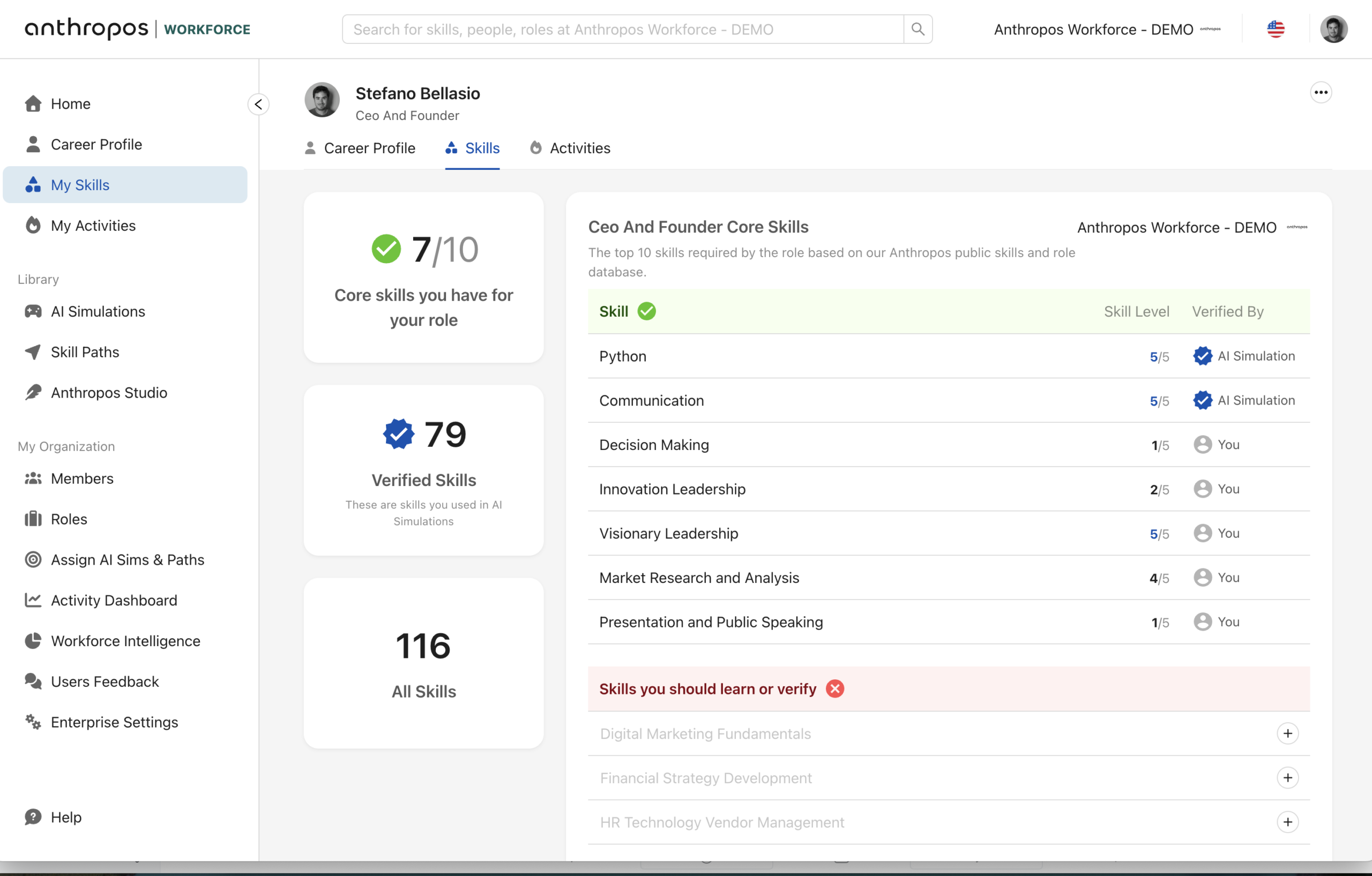
My Skills profile with AI Simulation verified column — Acme Corp demo org

Technical skills

  • Software engineering — all languages and levels
  • Data engineering and ML workflows
  • Cloud architecture and DevOps
  • Code review, debugging, system design
  • AI tooling: Claude Code, Copilot, prompt engineering
  • Financial analysis, data modelling, SQL

Business & soft skills

  • Sales — discovery, negotiation, objection handling
  • Stakeholder management and escalation handling
  • Structured thinking and analytical reasoning
  • Leadership — coaching, feedback, decision-making
  • Customer success and account management
  • Communication under pressure and in complex contexts
What changes

What verified skills data makes possible

Verification is the foundation. Everything downstream — mobility, succession, development, AI readiness — becomes more accurate the moment skills are confirmed rather than claimed.

Accurate gap analysis — not assumed gaps
See the actual distance between where people are and where their role requires them to be. Not based on what they said — based on what they demonstrated.

Internal mobility based on real capability
Match people to open roles using verified skill profiles. The best internal candidate is the one who can actually do the job — not the one with the best self-assessment.

L&D investment targeted to real gaps
Stop spending on training for skills people already have. Start closing gaps that are confirmed — with Skill Paths and simulations tied directly to what the assessment revealed.

Succession planning backed by evidence
For every critical role, know exactly how ready each successor is — and what they’d need to close the gap. Not based on gut feel. Based on a scored simulation.
Where it fits

Phase 3 of the 5-Phase Workforce Methodology

Verification is the pivot point. Before it: claims. After it: evidence. Every phase downstream depends on getting Phase 3 right.

Phase 1
Auto-map skills
Phase 2
Guided self-evaluation
Phase 3
AI Simulation verification
Phase 4
AI Interview
Phase 5
Analysis & reporting

Trusted by leading enterprises

ItalgasDatrixBytekTogether AIFides
Common questions

Frequently asked

What HR and talent leaders ask before rolling out skills verification.

How does skills verification differ from a traditional technical assessment?
Traditional assessments test knowledge — can you answer questions about Python? AI Simulations test application — can you debug a real codebase, under realistic conditions, in the way you would on the job? The score reflects what someone can do in practice, not what they know in theory. This distinction matters especially for business and soft skills, where knowledge-based tests have almost no predictive power.
How long does a verification simulation take?
Most skills verification simulations are designed for 30 minutes. Complex multi-skill scenarios can run up to 45 minutes. Employees complete the simulation in their own time — they receive a link and choose when to start. No scheduling, no invigilator.
What happens when the verified score is lower than the self-assessed level?
This is common — and it’s exactly the insight verification is designed to surface. The verified score replaces the self-assessed level in the person’s skill profile. HR and managers receive the result with cited evidence, so the conversation is grounded in specific, observable behaviour rather than a number. Most employees find the feedback valuable even when it’s a lower score.
Can we verify skills for large populations at once?
Yes. Skills verification is designed to scale — no interviewer time, no scheduling coordination. Simulations are assigned via link and completed asynchronously. You can run verification across hundreds or thousands of employees simultaneously, with results available as each person completes their session.
How does the scoring work? Who defines what a Level 3 looks like?
Each skill has a defined competency framework — 0 to 5 — built into the 60K+ taxonomy. Evaluation criteria for each simulation are set by Anthropos content designers or your own team using Studio. Scoring is rubric-based: deterministic rules applied to specific observable behaviours from the simulation. No AI subjectivity in the scoring — EU AI Act compliant by design.
Skills Verification

See what your team’s skills actually look like

Book a demo and run a simulation as a participant yourself. The fastest way to understand what verified skills data looks like — and what it changes.