
 vs
vs 
Anthropos vs CodeSignal
The assessment and practice engine meets the platform that maps, proves and grows skills. What each one actually does, where each wins, and how to choose.
Anthropos is the skills intelligence platform for workforce assessment and upskilling: automatic skills mapping, verification through AI Simulations, AI Interviews and AI Labs, AI Readiness scoring, and development with courses created from your own material, for hiring and the workforce you have. CodeSignal is an assessment-centric skills platform: certified hiring assessments, single-modality practice simulations and a consumer-scale learning suite. Choose CodeSignal to standardize candidate assessment and individual practice. Choose Anthropos to run the whole loop, for the workforce you already have and the people you hire next.
Every capability that matters
Both platforms are strong, and they answer different questions. Every CodeSignal capability listed here is verified against public sources.
|
|
|
|---|---|---|
| Map | ||
| Automatic skills mapping |
From CV, HRIS and LinkedIn
Every employee auto-mapped into the curated taxonomy of 4,000+ skills across 700+ roles. No surveys.
|
Assessment-derived only
Skills Intelligence benchmarks people who take assessments; no published HRIS or CV auto-mapping.
|
| Skills taxonomy |
4,000+ skills, 700+ roles
25 categories, tech and non-tech.
|
Internal Skills Engine
Evaluation frameworks powering its assessments, built from 3M+ assessment data points.
|
| Workforce intelligence |
Live skills map + Talk to Data
Gaps, AI readiness, internal mobility and succession in one view; ask questions in plain language.
|
Assessment analytics
Benchmarking and org dashboards over assessment results.
|
| Verify | ||
| Assessment format |
Immersive AI Simulations
Real work scenarios, 30 to 45 minutes.
|
Certified assessments + exercises
1,000+ certified assessments, live IDE interviews, role-based practice across six modalities.
|
| Voice interaction |
Live calls with AI characters
Inside the scenario, scored in real time.
|
AI role-plays and interviews
Voice conversations with one AI persona per exercise.
|
| Voice, chat, code and documents together |
All four, scored simultaneously
The way real work actually happens.
|
One modality per exercise
Simulations run as separate coding, voice, whiteboard, spreadsheet or writing exercises.
|
| AI actor characters |
Up to 4 per simulation
Each with a role, personality and agenda, in one scenario.
|
One persona per role-play
A variety of AI personas across exercises, one conversation partner at a time.
|
| Soft and hard skills |
One assessment, in context
|
Separate exercises
Behavioral assessments and technical assessments run as distinct instruments.
|
| AI Interviews for the workforce |
For any role, at scale
Qualitative signal feeding one integrated report per person.
|
Hiring only
Interviewer Agents and AI phone screens qualify candidates; no employee-development interview.
|
| Hands-on AI tool assessment |
AI Labs: Claude Code and Codex
Persistent sandboxes for the whole workforce’s practice and development, scored like a simulation and metered for ongoing use.
|
Agentic Coding Assessments
Candidates build with real Claude Code, Cursor and Codex inside hiring screens.
|
| Pre-hire assessment |
Anthropos Hiring
Tech and soft-skill scenarios in AI Simulations, plus AI Labs sessions where candidates prove how they build with AI; screen and video recorded as anti-cheating.
|
A core strength
Standardized coding scores trusted by Netflix, Capital One and Meta; agentic interviewers in 20+ languages.
|
| AI readiness scoring |
0–100 verified score
From skills mapping, AI Simulation and AI Interview, per person and org.
|
Not offered
No org-level AI-readiness score.
|
| Develop | ||
| Skill development |
Built into the platform
Skill Paths, training simulations, Development Programs and AI Academy courses, driven by verified gaps.
|
Learn suite
Courses, practice and the Cosmo AI tutor at consumer scale: 1M+ learners, 3.5M enrollments.
|
| Course creation |
Full courses from scratch
Complete curricula from your own material, multi-language, assigned where verified gaps appear.
|
Practice from your material
AI-Native Authoring turns decks and docs into practice exercises; Learn Academies blend your material with assessments.
|
| Custom authoring |
Anthropos Studio
Fully custom multi-channel scenarios and courses from your documents.
|
Cosmo agentic authoring
Generates assessments and single-modality practice from a job description or document.
|
| Platform | ||
| Use case coverage |
Six enterprise use cases
Hiring, onboarding, reskilling, internal mobility, compliance, AI transformation.
|
Hiring, practice, academies
Candidate assessment plus individual and team skill practice.
|
| Integrations |
100+ HRIS, APIs and MCP
Auto-mapping from your existing systems; open by design.
|
ATS integrations
Greenhouse, Ashby and other recruiting-stack integrations with scorecard sync.
|
CodeSignal capabilities verified against codesignal.com, the Agentic Coding Assessments launch (April 2026), the AI-Native Authoring launch (May 2026) and the Learn Academies launch (January 2026). Spotted something outdated? Tell us and we will correct it.
An assessment engine and a skills loop
Both platforms believe skills should be demonstrated, not declared. They build very different systems around that belief.
CodeSignal built its name standardizing technical hiring: 1,000+ certified assessments, live IDE interviews and coding scores trusted by Netflix, Capital One, Meta, Dropbox and Uber. It has moved fast into the AI era: Agentic Coding Assessments where candidates build with real Claude Code, Cursor and Codex, agentic interviewers in 20+ languages, and role-based practice simulations spanning coding, voice role-plays, whiteboards, spreadsheets and writing. Its Learn suite, with the Cosmo AI tutor and mobile app, now counts over a million learners, and Learn Academies bring custom practice to L&D teams.
The DNA is the exercise: each simulation runs one modality with one AI persona, skills are measured for the people who take the tests, and there is no published workforce auto-mapping, qualitative employee interview or org-level readiness score.
Source: codesignal.com and CodeSignal press releases
Anthropos is the AI-native platform companies use to manage talent at scale. It runs the full cycle: map every role against a curated taxonomy of 4,000+ skills across 700+ roles, collect everything you know about your people from CV, HRIS and LinkedIn, confirm it with guided self-assessment, verify it in AI Simulations, AI Interviews and hands-on AI Labs, then upskill against the verified gaps.
Coverage comes with depth. Anthropos Studio turns your documents into custom simulations, complete courses are created from your material, and both roll out to thousands of people. The same engine verifies candidates in hiring, so one platform runs everything from pre-hire to reskilling.
And it stays open and personal: full APIs and MCP, Talk to Data for plain-language answers from your skills data, Workforce Intelligence and a 0–100 AI Readiness score, with an experience that adapts to each employee: their profile, their gaps, their next role.
Customers include FS Group, Italgas, Together AI, Datrix and Orbyta Tech · adopted in weeks
Six modalities, one at a time. Or everything at once.
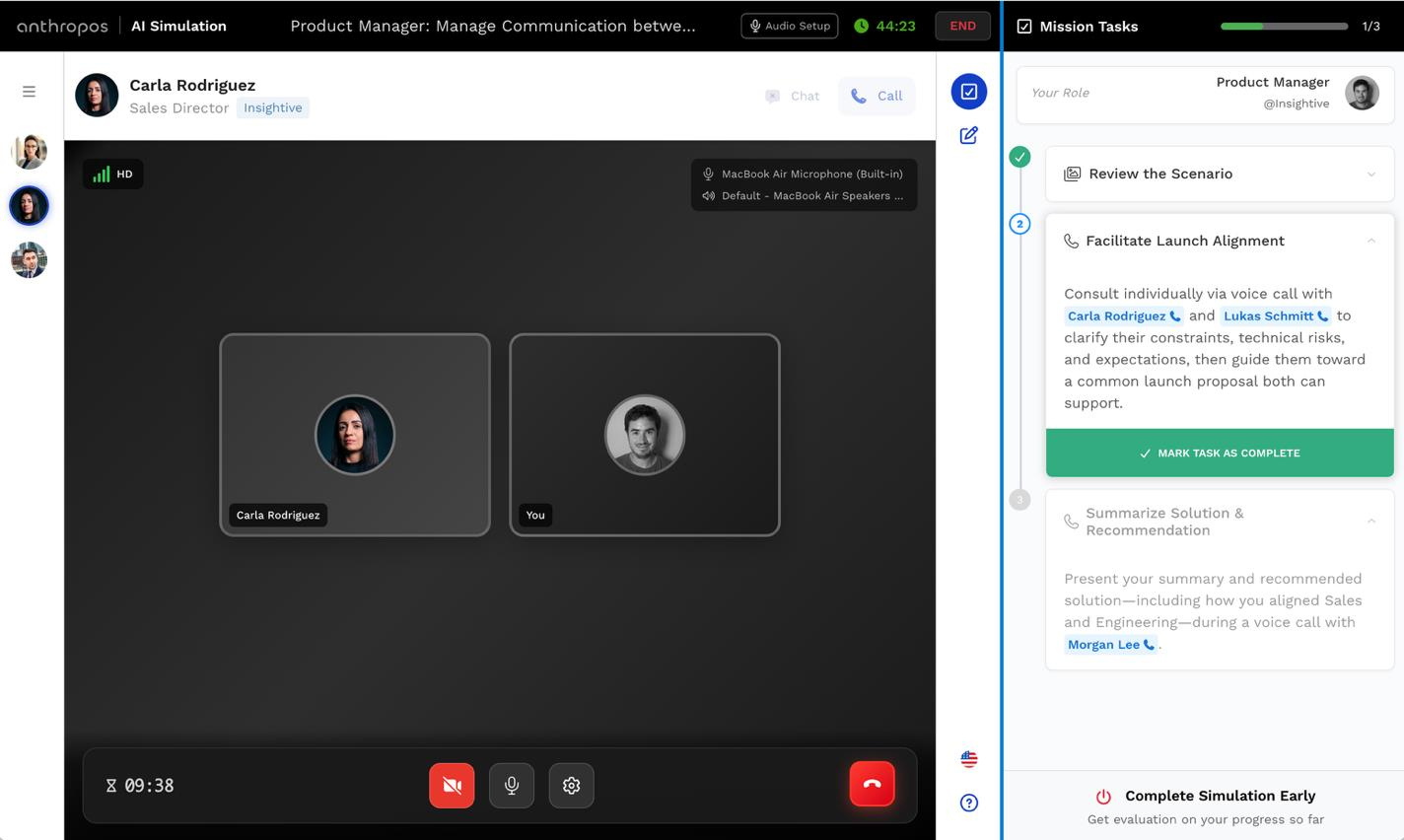
CodeSignal’s simulations genuinely span the modalities of modern work: a coding IDE, voice role-plays, whiteboards, spreadsheets, writing. Each exercise runs one of them, with one AI persona. An Anthropos AI Simulation runs them together: a live voice call with an AI character pushing back, chat from a colleague with new constraints, the document and the code open on screen, one continuous 30 to 45 minute scenario, one score.
Context switching is the skill
Real work rarely arrives one channel at a time. Handling the call, the chat and the document at once is precisely what senior work looks like, and what single-modality exercises cannot observe.
A cast, not a partner
Up to four AI characters share one scenario, each with a role, personality and agenda, so collaboration and conflict get scored, not just performance in a dialogue.
Soft and hard skills in the same evidence
Negotiating while editing the contract is one observation, not a behavioral test plus a technical test.
Both assess with real AI tools. For different purposes.
Credit where due: CodeSignal’s Agentic Coding Assessments put real Claude Code, Cursor and Codex in candidates’ hands and ask them to build, then defend their decisions. For hiring screens, that is the state of the art catching up to how engineers actually work.
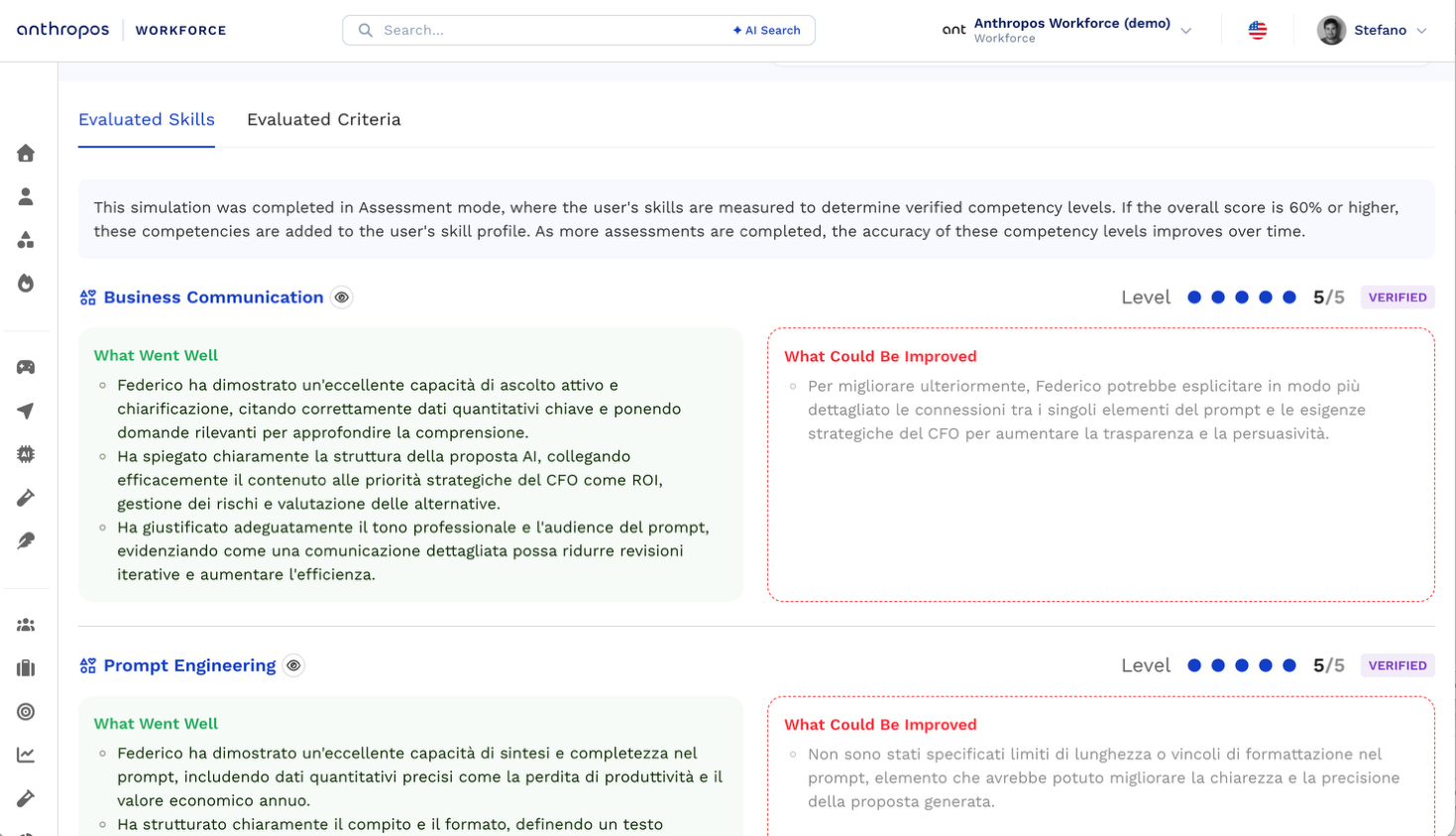
Anthropos AI Labs use real AI tools for the other 95% of the population and the other 95% of the timeline: persistent, secure sandboxes where your existing workforce practises and is assessed with Claude Code and Codex, session after session, metered for ongoing use, scored by the same engine as simulations, and feeding each person’s AI Readiness score and development program. Not a screen. A gym.
The question that separates the two: can your people use it next quarter, or only your candidates this week?
A score tells you who passed. A map tells you who is ready.
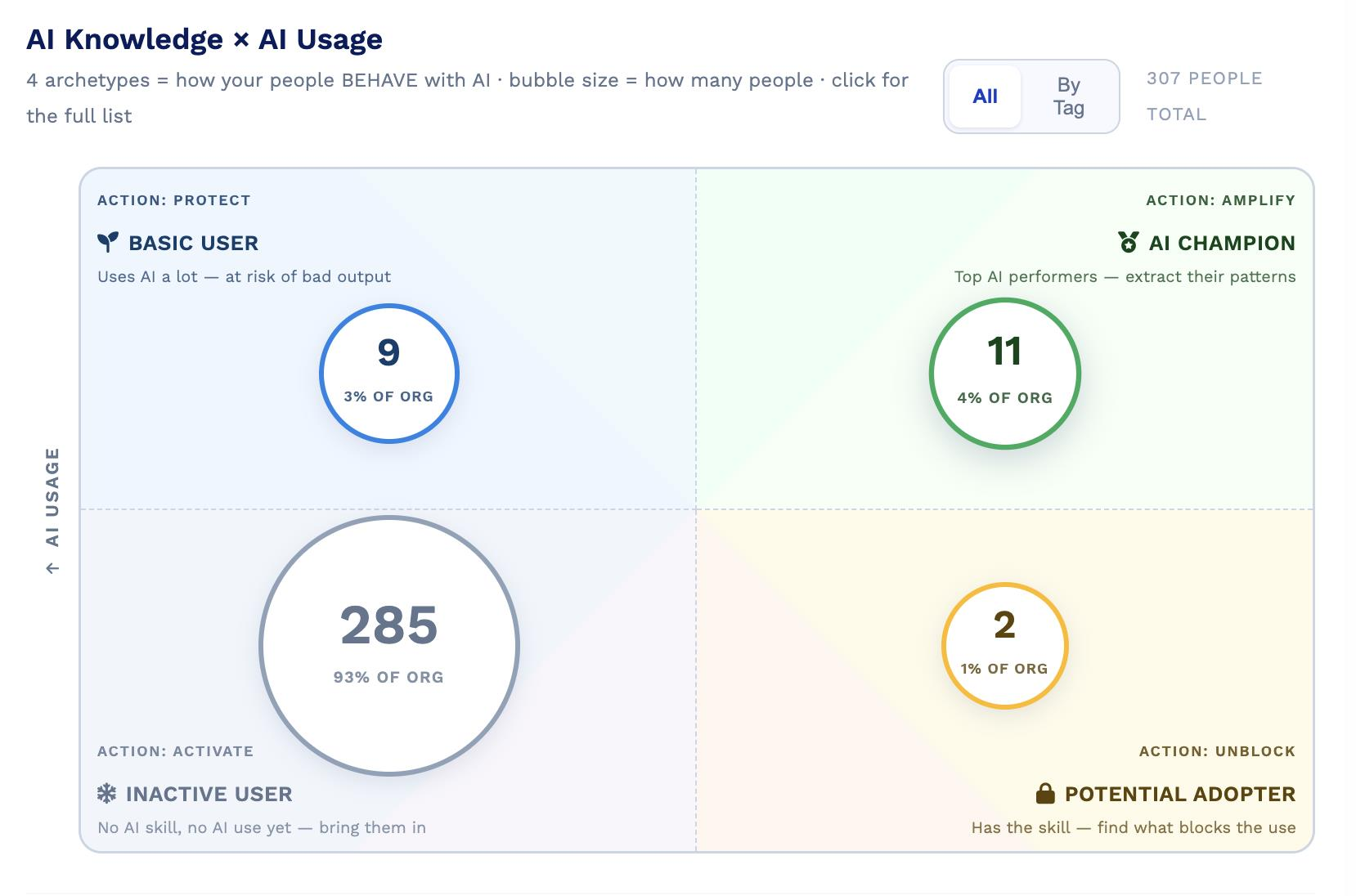
CodeSignal’s Skills Intelligence benchmarks everyone who takes its assessments, and its authoring tools now generate practice from your own material. What it cannot see is the workforce that never took a test. Anthropos starts there: every employee auto-mapped from CV, HRIS and LinkedIn into the curated taxonomy of 4,000+ skills across 700+ roles, verified where decisions demand it, and developed with complete courses built from your material, wired to the verified gaps and closed with reassessment.
The org, not the test-takers
Mapping covers everyone from day one; verification then goes deep exactly where promotions, staffing and AI transformation need proof.
Courses, not only exercises
Full curricula from your material, in multiple languages, assigned per verified gap, with reassessment proving the growth.
CodeSignal measures test-takers. Anthropos runs the whole skills loop.
Assessment is one step. Anthropos covers what comes before and after it, for every role in the company.
Full skills mapping
Every employee auto-mapped from CV, HRIS and LinkedIn into a curated taxonomy of 4,000+ skills across 700+ roles. No surveys to launch, no spreadsheet to maintain.
AI Interviews
Qualitative interviews at scale for any role: context, aspiration and how people actually work with AI, feeding one integrated report.
AI Labs
Secure sandboxes where people build with Claude Code and Codex: structured, hands-on sessions scored like a simulation. Built for deeply technical roles, including AI engineering.
Course creation
Create complete courses and Skill Paths from scratch, from your own material, and assign them exactly where verified gaps appear.
The same verified skills data powers every use case
AI transformation
Score AI Readiness for every person and team, then drive adoption of Claude Code and Codex with verified progress.
Hiring
Assess candidates in the job, not a quiz: verified tech and business skills before the offer, with Anthropos Hiring.
Onboarding
Day-one skills maps and simulations that let new hires experience the real job, safely.
Reskilling and internal mobility
Surface hidden capability, match people to open roles, and retrain into the roles AI is changing.
Compliance and safety
Practice high-stakes procedures in simulation, with verified evidence of who can do what.
Training ROI and succession
Prove programs moved real capability, and know who is ready next for every critical role.
Which platform is right for you?
Different needs, different strengths. This is how we would advise a buyer who could pick either.



Anthropos vs CodeSignal: FAQ
Is Anthropos a good alternative to CodeSignal?
For workforce-wide skills verification and development, yes. Certified hiring assessments and consumer-scale practice are CodeSignal’s home ground, and some teams run both: screen candidates with CodeSignal, then map, verify and develop the workforce with Anthropos.
What is the main difference between Anthropos and CodeSignal?
An assessment engine versus a skills loop. CodeSignal measures the people who take its tests and practice in its exercises. Anthropos starts from the whole organization: every employee auto-mapped from CV, HRIS and LinkedIn, verified in immersive multi-channel simulations, and developed against the verified gaps on the same platform.
Does CodeSignal offer simulations like Anthropos?
CodeSignal markets role-based simulations across six modalities, from a coding IDE to voice role-plays, whiteboards and spreadsheets. Each exercise runs one modality with one AI conversation partner. An Anthropos AI Simulation combines voice, chat, code and documents in one continuous 30 to 45 minute scenario with up to four AI characters.
Can CodeSignal assess AI-assisted coding?
Yes. CodeSignal’s Agentic Coding Assessments have candidates build with real tools like Claude Code, Cursor and Codex inside hiring screens. Anthropos AI Labs use real AI tools for a different job: persistent sandboxes where the whole workforce practises and is assessed over time, feeding AI Readiness scores and development programs rather than a one-time screen.
Does CodeSignal map workforce skills?
CodeSignal’s Skills Intelligence is assessment-derived: it benchmarks the people who complete its assessments. There is no published auto-mapping of a workforce from HRIS, CV or LinkedIn data. Anthropos builds the full map first, for every employee, then verifies it.
Can CodeSignal create courses from our material like Anthropos?
CodeSignal’s AI-Native Authoring and Learn Academies generate practice exercises and custom academies from your material, a genuine capability. Anthropos goes further on structure: complete courses and Skill Paths built from your documents, in multiple languages, assigned against verified gaps and closed with reassessment.
Does CodeSignal offer qualitative interviews for employees?
CodeSignal’s interviewing products screen candidates. Anthropos AI Interviews are for the workforce: qualitative conversations at scale capturing context, aspiration and how people actually work with AI, feeding one integrated report per person.
See a real AI Simulation, live
30 minutes, no commitment. Watch an AI actor push back on one of your scenarios and see what single-modality exercises cannot show you.
Information about CodeSignal is compiled from codesignal.com and other public sources and is accurate to the best of our knowledge as of July 28, 2026. Features change; verify details with each vendor. If you work at CodeSignal and something here is out of date, contact us and we will fix it promptly.
The CodeSignal name and logo are trademarks of CodeSignal, Inc. All third-party trademarks are the property of their respective owners, are used for identification purposes only, and do not imply affiliation or endorsement.