
Use case · Role Onboarding
Onboard people and verify role-readiness
Anthropos verifies new hires and internal transfers through a 5 to 30 minute AI Simulation of real work. Both take the same check against their new role's benchmark. A completed onboarding checklist does not prove performance.
“Everyone completed onboarding on time. Nobody could tell me who was actually ready.”
Head of L&D, global manufacturing group
LMS onboarding vs Anthropos
What changes when readiness is demonstrated
Finishing the checklist and being able to do the job are two different facts. Only one of them is usually measured.
| Onboarding in an LMS | Anthropos | |
|---|---|---|
| Output | A completion percentage | A verified 0-5 level against the role benchmark |
| What the new hire does | Watches, reads, passes a quiz | Runs the actual task with AI actors who respond |
| When a gap shows up | On the first real customer, weeks later | In week one, inside a 5-30 minute simulation |
| Behind a score | A pass mark | The moment in the session that earned it |
| What gets assigned | The same catalogue for the whole cohort | Skill Paths and AI Academy courses for the named gap |
| Who authors it | Whoever owns the content contract | Your own experts, in Anthropos Studio |
What readiness is for
One profile, four uses
Verified readiness is not only a new-hire question. The same check works wherever somebody changes role.
Baseline
Gaps appear in week one
New hires run a 5 to 30 minute simulation of a role task before onboarding content is chosen. Results show existing skills, prevent unnecessary training and expose gaps in week one, before the first real customer or month three.
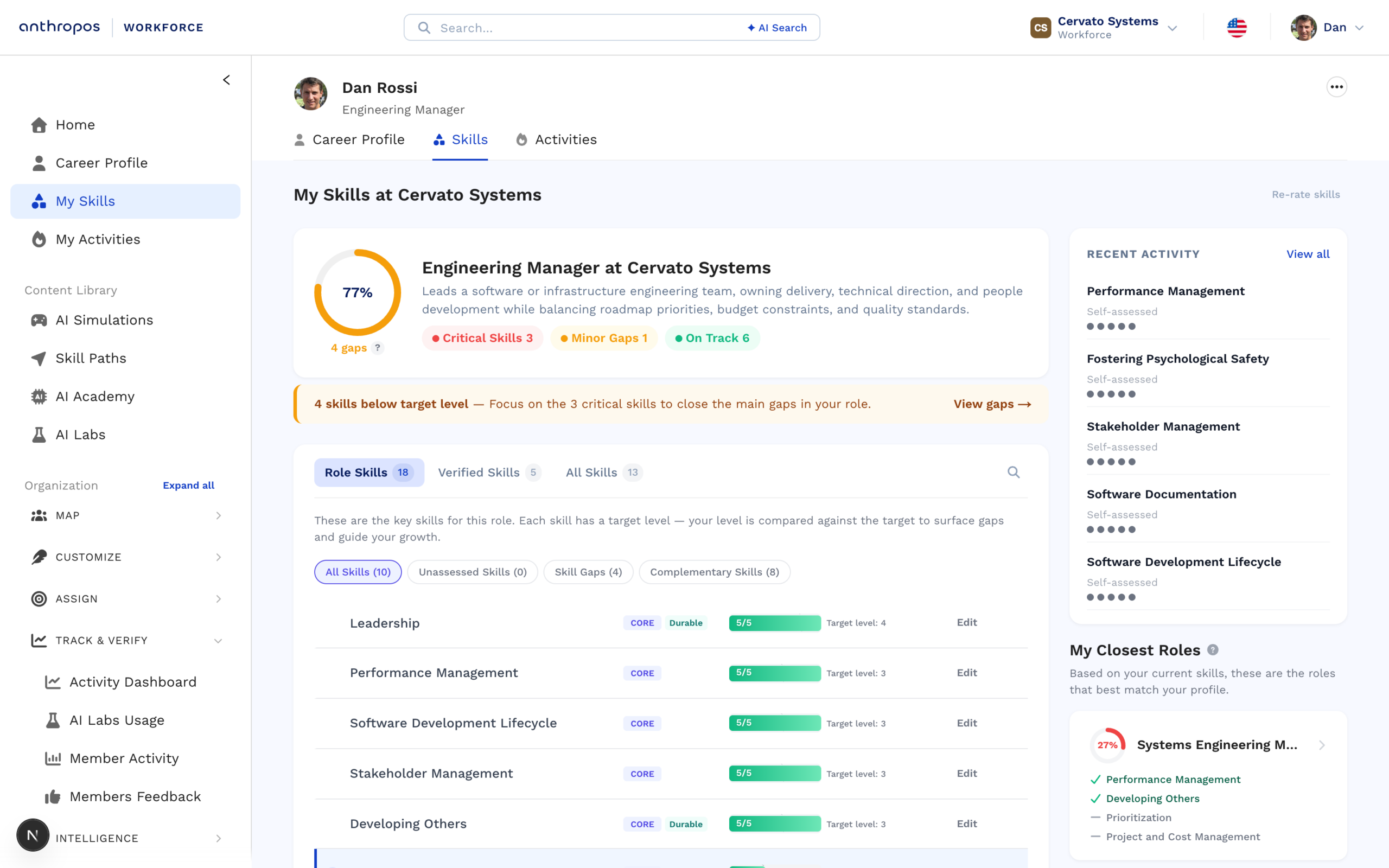
A new hire against the role benchmark: verified level, gaps, and what is still open. Cervato Systems, our demo org.
Practice
People practise real tasks safely
All 300+ library scenarios run in training and assessment modes. In training mode, AI actors coach, hints are available and people can retry. Mistakes in simulated customer calls, production incidents and design reviews cost nothing.
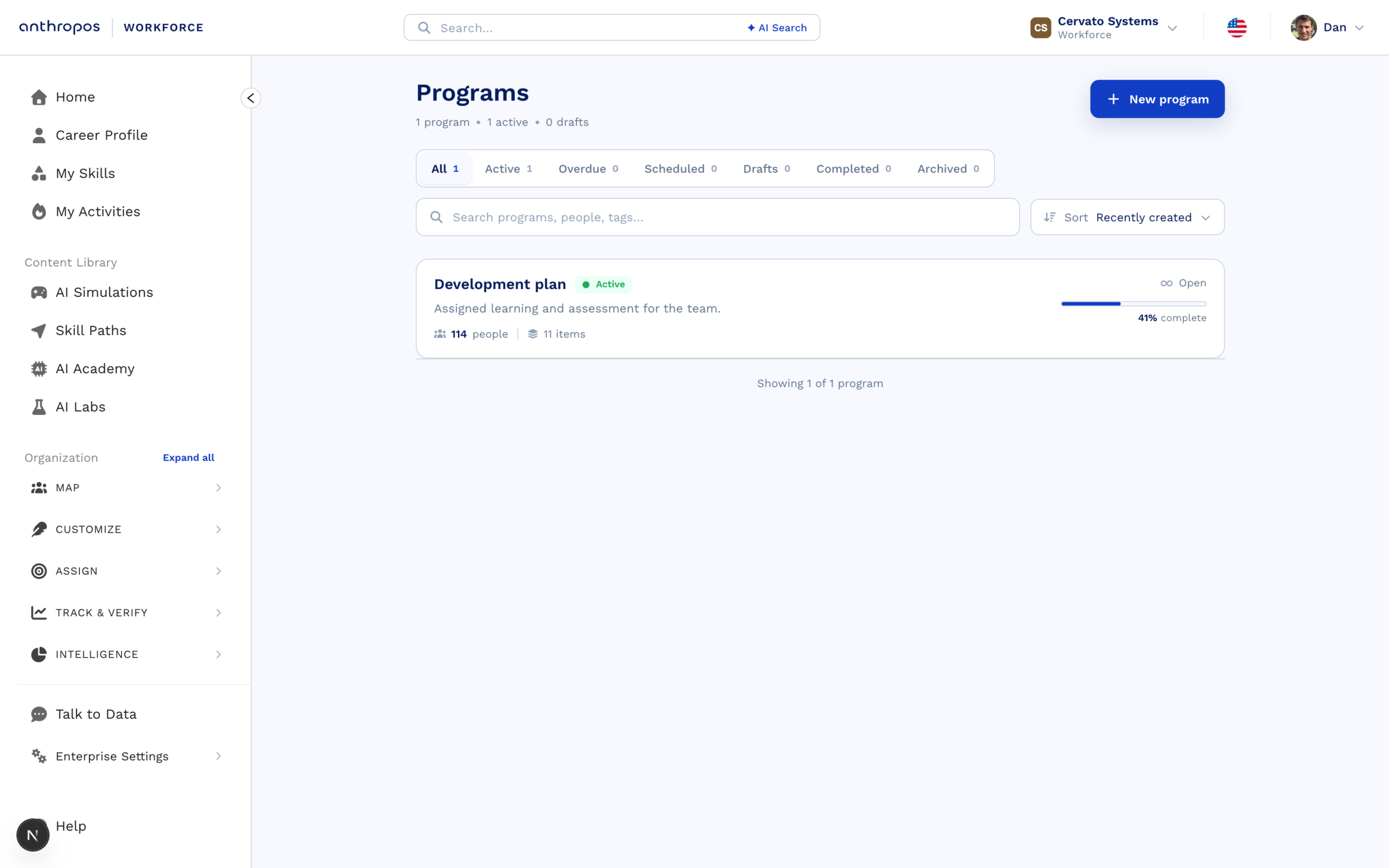
Assigned onboarding programmes across a cohort. Cervato Systems, our demo org.
Anthropos runs role-based practice and skills verification in production at FS Group, Italgas, Datrix and Orbyta. At FS Group, 500+ people were verified in two weeks.
Readiness
Managers see verified skills and gaps
The same scenario runs again in assessment mode. Managers receive verified 0 to 5 levels for each role-benchmark skill, the session moment behind each score and remaining gaps. Anthropos handles no onboarding admin, paperwork, equipment or access provisioning.
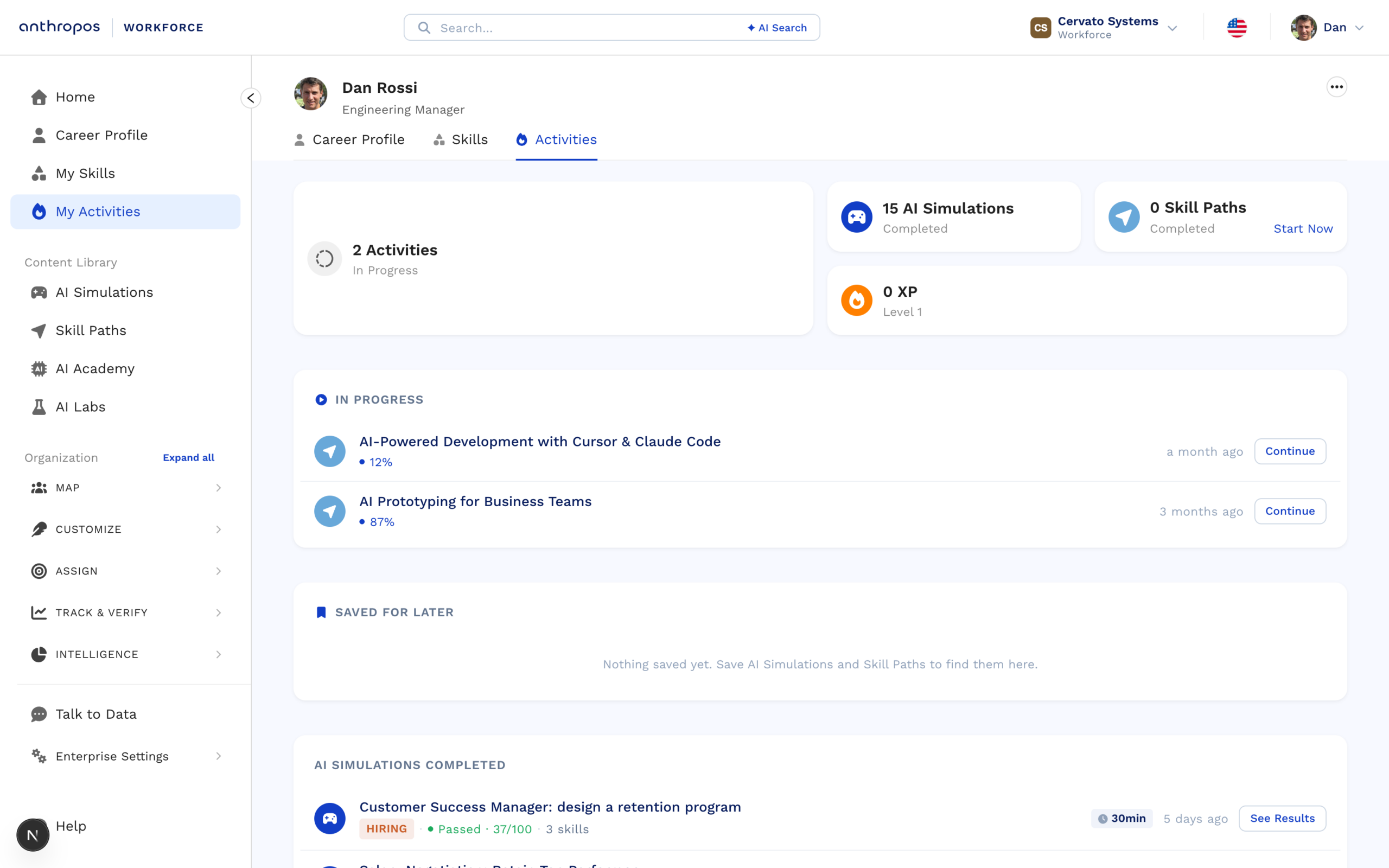
What one person actually completed, session by session. Cervato Systems, our demo org.
Fairness and transparency
Measuring people is where this gets serious
A new hire is being measured in their first weeks, which is exactly when it has to be fair.
Criteria are written before the session runs and applied identically to everyone in the role. Anthropos does not ask a model what it thinks of a person.
Not in AI Simulations and not in AI Interviews. Profiling is limited to skills, and is never used to infer protected characteristics.
Every result goes to a human who holds the decision. Someone who disagrees can request human review through you, and the scoring logic is documented so you can meet your own transparency duties.
Disclosure happens at the start of every simulation, interview and voice call. Assessment data is never used to train models.
ISO 27001 for information security, GDPR for how the data is handled, and an EU AI Act risk assessment you can read. The DPA and the current sub-processor list are available on request.
Anthropos supports your decision rather than making it, which is what keeps skills mapping and verification outside the high-risk category the EU AI Act defines for employment decisions.
Rollout
What it takes to start
Choose the role and its competency benchmark from the 700+ library, or define your own.
A baseline simulation sets verified levels and names the gaps. Practice is assigned against those gaps only.
The same scenario runs again in assessment mode, and the manager reads the verified result.
Your IT team configures SSO and, if you want profiles to auto-map, authorises one HRIS connection. Existing onboarding content imports into Skill Paths: PDFs, links, video and SCORM.
Objections
What buyers ask before a pilot
How long does an onboarding simulation take?
An Anthropos AI Simulation runs 5 to 30 minutes with a maximum of four AI actors. It runs in the browser, asynchronously. A new hire fits it around the rest of their first weeks, and nobody has to schedule a room, a role-play partner or a senior colleague's afternoon.
Can we use the onboarding content we already have?
Yes. Anthropos Skill Paths accept the content you already own (PDFs, external course links, videos and SCORM packages) and add structure, deadlines and a simulation where hands-on practice matters. You are not rebuilding a content library; you are wrapping the material you have in practice and verification.
Does this work for non-technical roles?
Yes. The Anthropos library of 300+ training simulations covers sales, customer support, project and product management, leadership, compliance and soft skills as well as engineering. Voice calls, chat and document work carry the non-technical scenarios; the live code editor and AI Labs cover the technical ones.
Can we use this when someone moves into a new role internally?
Yes, and the mechanics are the same as for a new hire. Anthropos compares the person's verified skills against the benchmark for the role they are moving into, names the gaps, assigns practice and content, then re-verifies before the move. Internal moves are covered on the internal mobility page.
What happens if someone scores badly on the first simulation?
The first run is a baseline, not a verdict. Anthropos gives immediate feedback on what went well and what to change, and names the specific skills below the role benchmark. Skill Paths and AI Academy courses are assigned against those gaps, then the scenario is re-run in assessment mode to show whether the level moved.
Who sees a new hire's results?
The new hire sees their own feedback and verified profile immediately after each simulation. Managers and HR see verified 0-5 levels against the role benchmark with the supporting evidence, within the permissions you configure. Anthropos is a readiness signal for development decisions, not a hidden file.
What languages does onboarding content run in?
Anthropos AI Simulations are multilingual: a scenario is authored once and played in the languages your teams work in, scored on the same criteria and the same 0-5 scale. AI Academy courses are available in seven languages: English, Italian, Spanish, French, German, Dutch and Japanese.
Does Anthropos handle onboarding paperwork, equipment or system access?
No. Anthropos does not process contracts, benefits enrolment, equipment requests or account provisioning, and it does not maintain your org chart. Those stay in your HRIS and IT service desk. Anthropos covers role-readiness: assessing what a new hire can do, training the gaps, and verifying they can do the job.
Keep reading
Where to go next
Run it on a role you hire for often
Pick the role and the benchmark. We build the baseline simulation and you see what a real new hire would score.