
Use case · Internal Mobility
Identify internal candidates before hiring externally
Anthropos uses verified skills to identify people who could fill open roles and shows employees opportunities they qualify for. Check internally before posting externally to avoid external hiring costs.
“We hire externally for roles our own people could fill.”
CHRO, 6,000-person industrial group
Talent marketplace vs Anthropos
What changes when the match is based on verified skill
A marketplace matches the people who built a profile. That is not the same as matching your workforce.
| A talent marketplace | Anthropos | |
|---|---|---|
| Basis for the match | Self-reported and inferred skills | Skills verified in AI Simulations, scored 0-5 |
| Who is in scope | Only employees who opted in and built a profile | The whole mapped population, from CV, HRIS and LinkedIn |
| Direction of search | Usually role → applicants who apply | Role→People and Person→Roles, from one map |
| A near-match gets | A rejection, or nothing | Named gaps plus Skill Paths and training simulations |
| Freshness | Updated when an employee edits their profile | Updates after every simulation, interview and Skill Path |
| Defensibility | A score you cannot open up | Every match traces to a named skill and its evidence |
What the match is for
One map, four moves
Matching is the first use. The same verified profile drives everything that follows.
Matching
Role to People ranks employees by skills
Role to People ranks every mapped employee against required role skills, level by level on a 0–5 scale. CV, HRIS and LinkedIn build the map without opt-in or profiles. Checks take minutes instead of manual talent reviews.
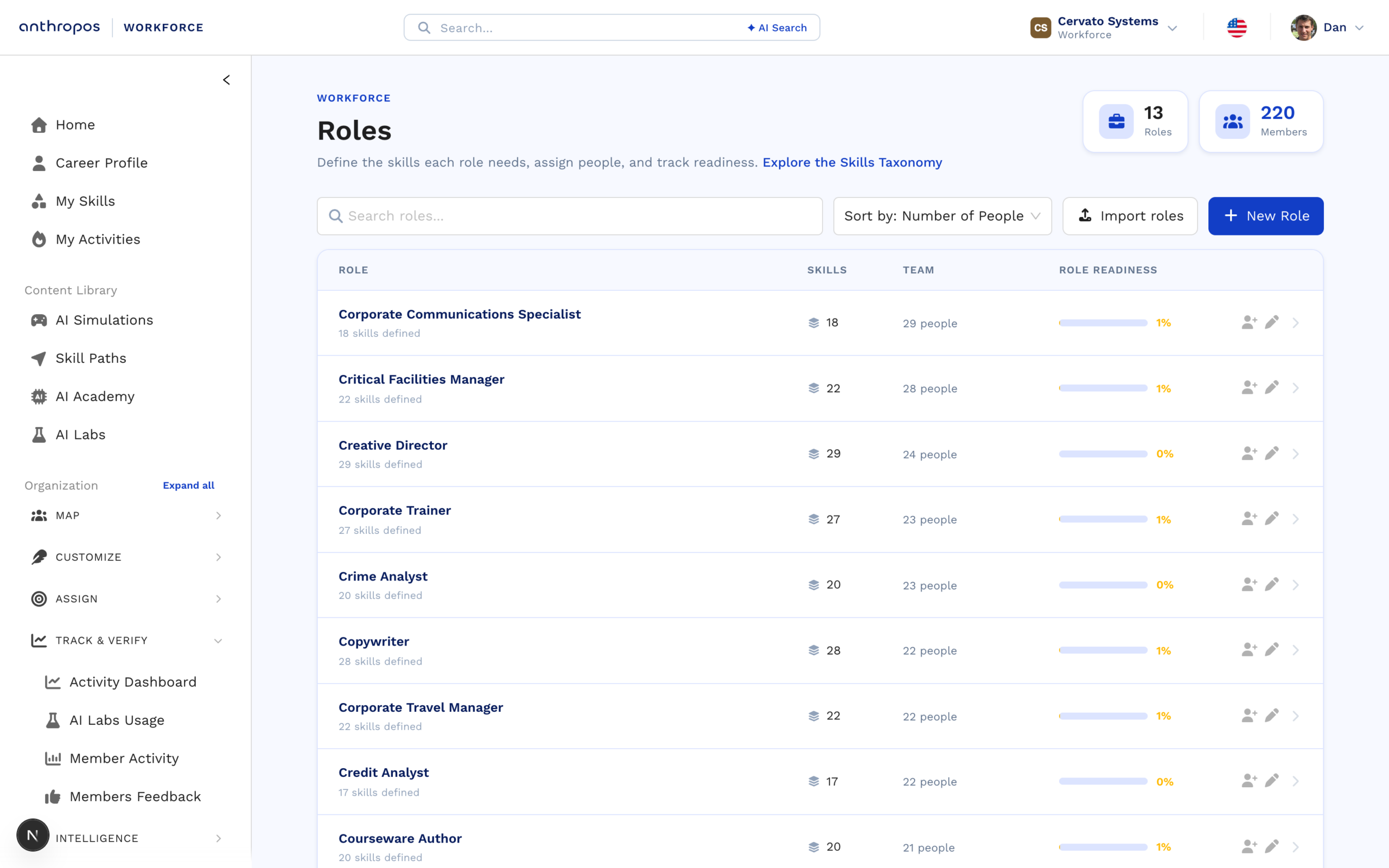
Roles with the skills each one requires, and the people assigned. Cervato Systems, our demo org.
Both directions
Person to Roles finds closest roles
Person to Roles shows the roles closest to one employee for a manager’s development review. It reads the same map and verified scores from the other end. Each match traces to a named skill and the session that scored it.
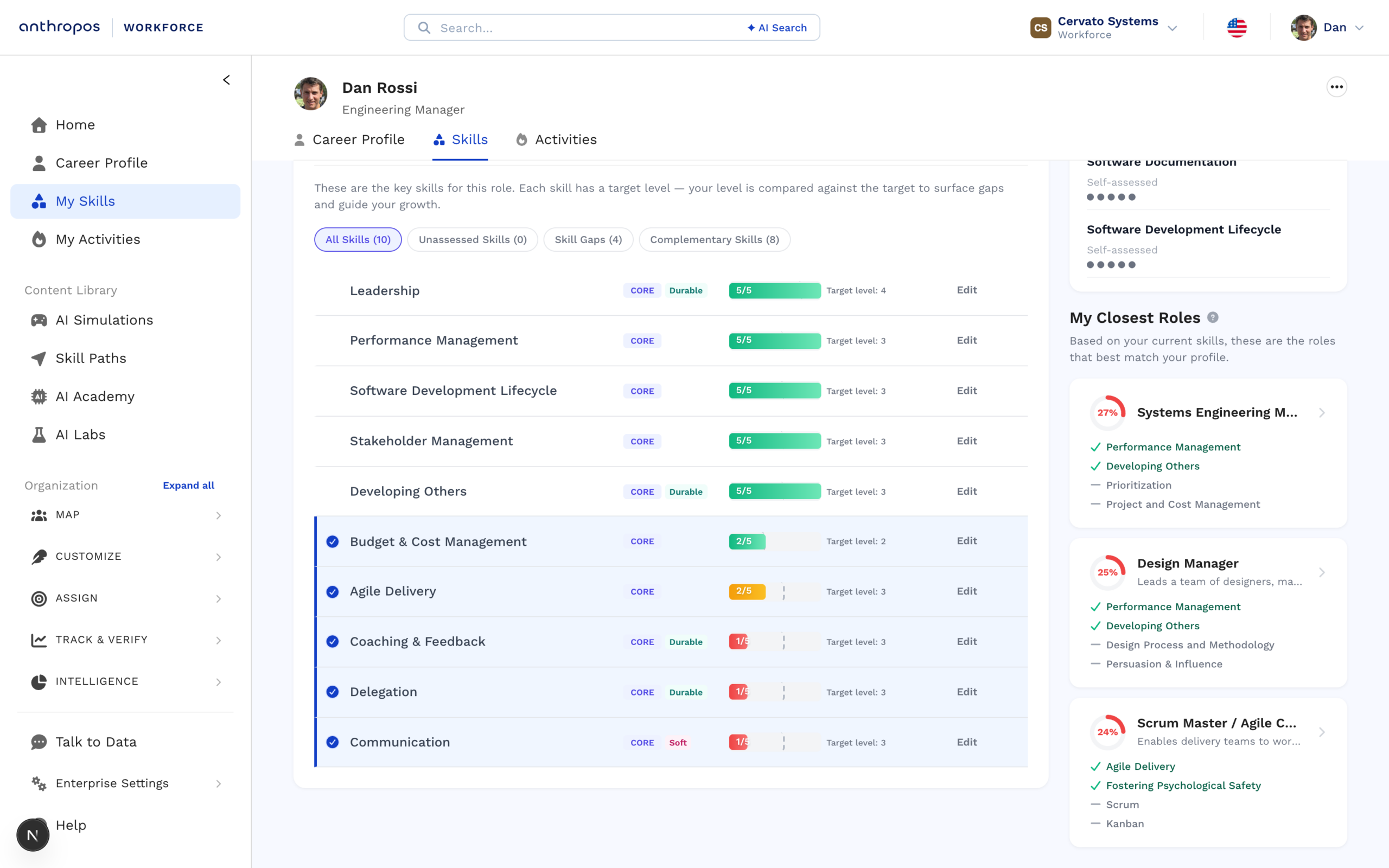
One person's skills against a target role, gap by gap. Cervato Systems, our demo org.
FS Group mapped 500+ people in two weeks with Anthropos. That is the same verified skills map internal mobility matching runs on.
Near matches
Employees see gaps and development paths
Profiles show qualified opportunities without anyone remembering employees. Near-match views list each missing skill and gap size. Assign training simulations and Skill Paths targeting those gaps. Re-verification repeats the initial process and dates readiness.
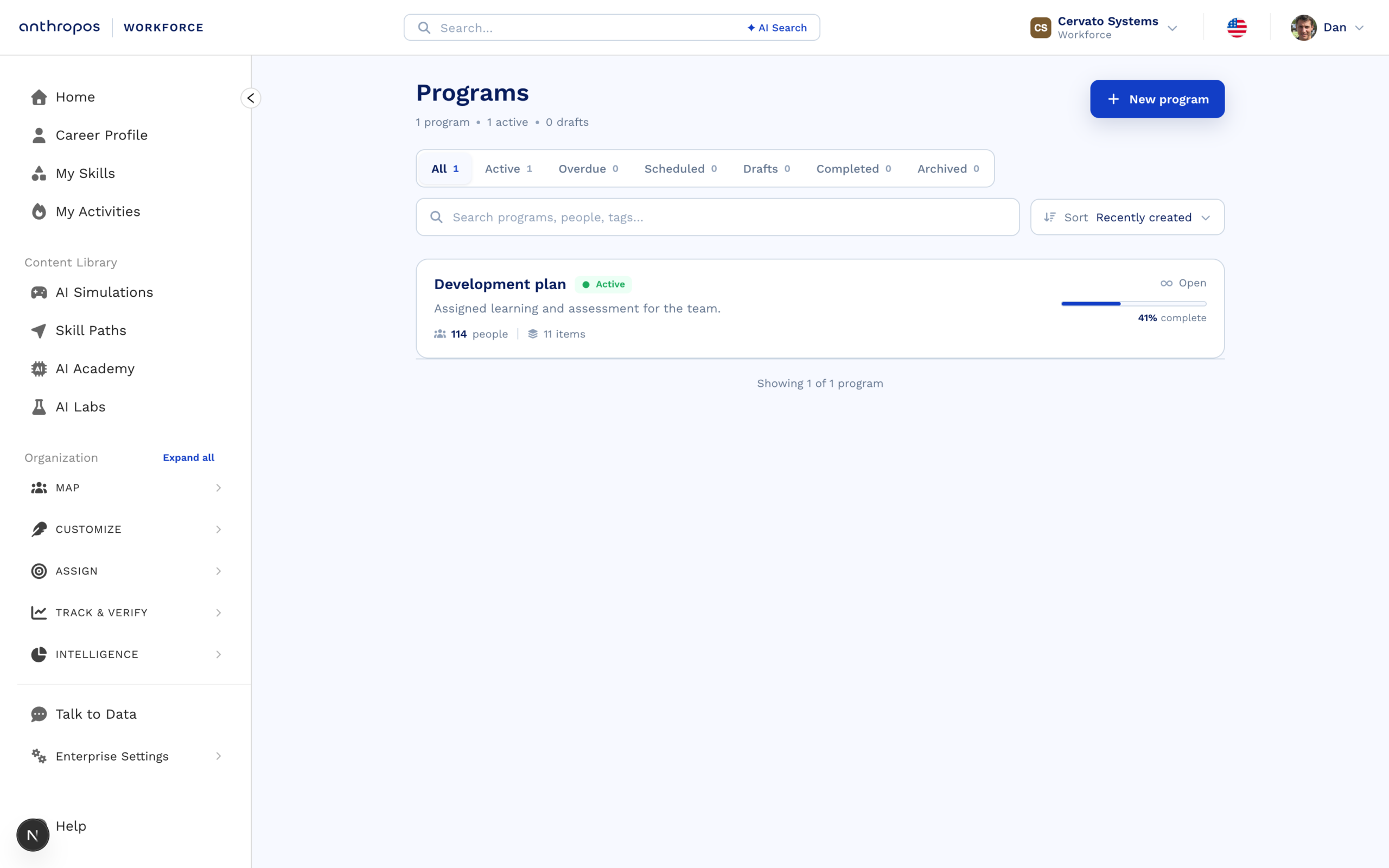
Development assigned against the named gaps. Cervato Systems, our demo org.
Fairness and transparency
Measuring people is where this gets serious
Telling someone they did not get an internal role is a moment that has to be defensible.
Criteria are written before the session runs and applied identically to everyone in the role. Anthropos does not ask a model what it thinks of a person.
Not in AI Simulations and not in AI Interviews. Profiling is limited to skills, and is never used to infer protected characteristics.
Every result goes to a human who holds the decision. Someone who disagrees can request human review through you, and the scoring logic is documented so you can meet your own transparency duties.
Disclosure happens at the start of every simulation, interview and voice call. Assessment data is never used to train models.
ISO 27001 for information security, GDPR for how the data is handled, and an EU AI Act risk assessment you can read. The DPA and the current sub-processor list are available on request.
Anthropos supports your decision rather than making it, which is what keeps skills mapping and verification outside the high-risk category the EU AI Act defines for employment decisions.
Rollout
What it takes to start
SSO and the HRIS connection go in. Role assignments and org structure import automatically.
Auto-mapping produces the first skills map and guided self-evaluation opens.
Matching is live, with Role to People shortlists and Person to Roles matches on verified data.
There is no separate matching product to buy. Anthropos maps its taxonomy onto the job architecture you already run in Workday, SAP SuccessFactors or another HRIS.
Objections
What buyers ask before a pilot
Who can see the internal mobility matches: HR only, or managers and employees too?
Access in Anthropos is role-based. HR leadership sees matching across the organisation, managers see their own team, and each employee sees their own profile, gaps and the roles they are working toward. Permissions are configured per tenant during implementation, so a match is never visible to someone who should not see it.
Can Anthropos match against the roles and competency framework we already have?
Yes. Anthropos ships 4,000+ skills mapped to 700+ roles, and maps onto an existing competency framework in Workday, SAP SuccessFactors or another HRIS. You can also define your own roles and required skill levels in Anthropos Studio, and matching then runs against your role architecture rather than a generic one.
Do verified skills flow back into our HRIS?
Yes. Anthropos reads role assignments and org structure from your HRIS through 100+ integrations, and writes verified competency scores back to Workday, SAP SuccessFactors or your system of record. Internal mobility decisions stay in the tools your HR team already uses, with no second set of skills data to maintain by hand.
How is internal mobility different from succession planning?
Internal mobility in Anthropos answers who could move into an open role now. Succession planning answers who replaces a specific person if they leave. Both run on the same verified skills map: for a critical role, Anthropos shows the most-ready successors ranked by verified skills, readiness gap and interviewed motivation.
What happens to the matches when a role changes?
When a job family needs new skills, an HR team or manager updates the skills required for that role in Anthropos, and the system immediately surfaces new gaps across everyone mapped to it. Because matching reads the same role definition, the shortlists for that role reflect the change without a new mapping exercise.
Can we ask questions about internal candidates in plain language?
Yes. Talk to Data answers workforce questions in natural language, in seconds, with no SQL and no analyst request. Ask "Who can step into the VP of Engineering role?" or "Which teams have the deepest bench for project management?" The answers come from the same verified skills map that powers internal mobility matching.
Does Anthropos replace our HRIS, ATS or internal job board?
No. Anthropos is the verification and matching layer, not a system of record. Your HRIS keeps org structure and employment data, your ATS keeps requisitions, your job board keeps postings. Anthropos supplies what none of them can produce: the verified skills profile and the match, in both directions (Role→People and Person→Roles).
How long does implementation take before matching is usable?
Most Anthropos customers are live within 2-4 weeks: SSO and the HRIS connection in week 1, auto-mapping and role configuration in week 2, then AI Simulations on the critical roles. Large enterprise deployments with custom simulations and deeper integration requirements typically take 6-8 weeks.
Keep reading
Where to go next
Run a match on a role you are about to post
Give us one open role and a team. We map them, rank them against it, and you see who you already have.