
Use case · Workforce Answers
Answer workforce questions from verified data
Ask Anthropos in natural language without building a report. Its data assistant finds everyone with a specific skill or certification in seconds, using verified skills for accurate answers without relying on self-reports.
“Who should I put on a role with these technical needs?”
VP Engineering, industrial technology group
BI tool vs Anthropos
What changes when the data underneath is verified
The question is the easy part. What makes the answer worth acting on is what sits beneath it.
| An HR report or BI tool | Anthropos | |
|---|---|---|
| Who asks | The analytics team, on your behalf | You, in your own words |
| Turnaround | Days, waiting behind a ticket | Seconds, in the same conversation |
| Data underneath | Self-declared skills in the HRIS | Skills verified in AI Simulations, scored 0-5 |
| What comes back | A chart of what is true | A ranked recommendation of what to do |
| Follow-up question | A second request, a second wait | Asked immediately, narrows the same answer |
| Evidence | A number with no trail behind it | Every name links to the session that scored it |
What you can ask
Six questions, all answerable today
These are the product's own suggestions and the ones customers ask most. The answer always carries its evidence.
Asking
Anthropos answers natural-language questions in seconds
Ask aloud without a query builder, schema or analytics team request. Anthropos suggests questions about this month’s simulation completions, the organisation’s top five skills by average level, members’ skill gaps to target roles, and Python developers above level 4.
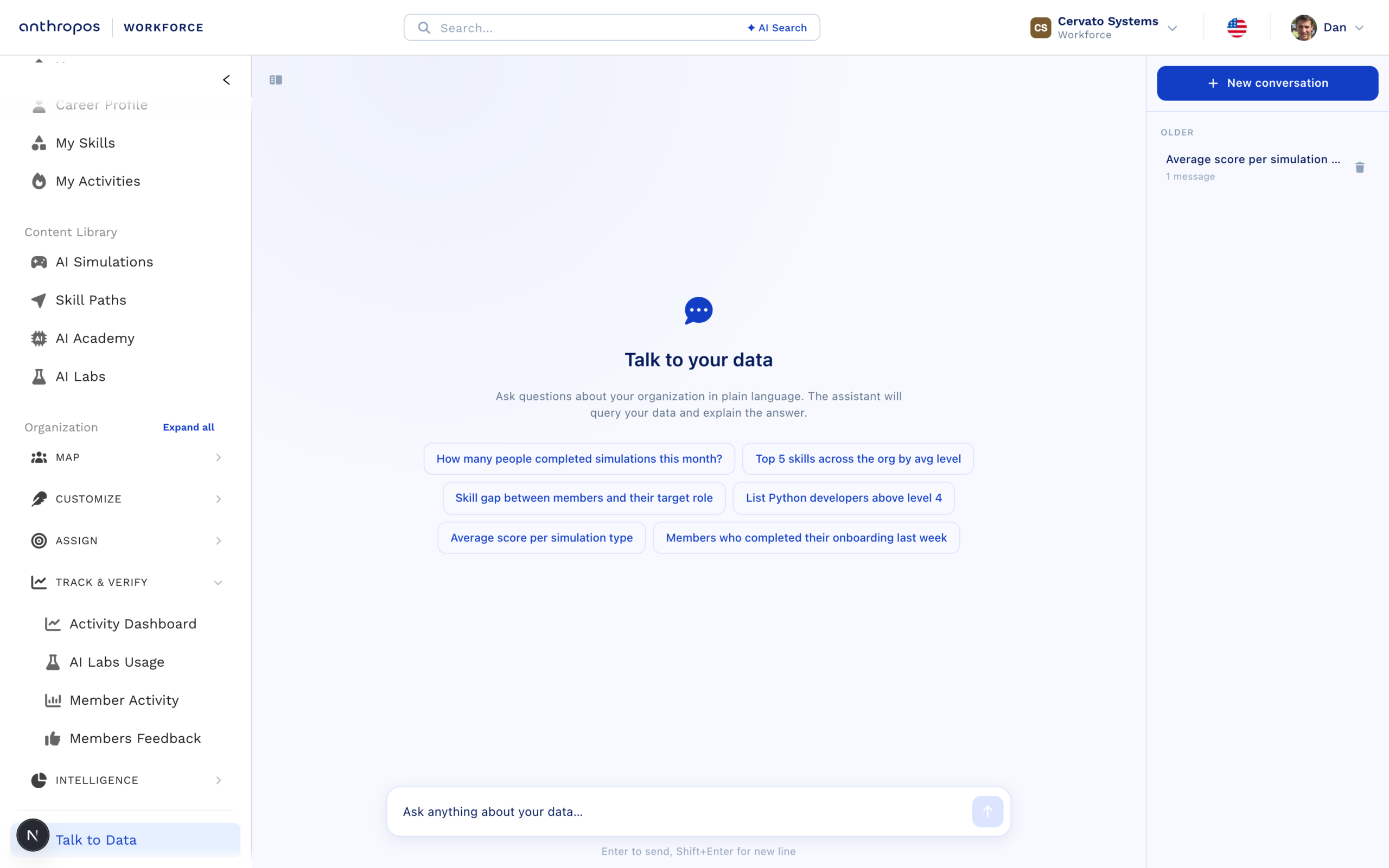
Talk to Data, with the questions it suggests you start from. Cervato Systems, our demo org.
The answer
Ranked recommendations show their evidence
Ask who is best placed to adopt AI in their workflow. Anthropos ranks people. Each row shows AI skill count, average level, verified skill count, simulations passed and average score. Export the recommendation with its evidence.
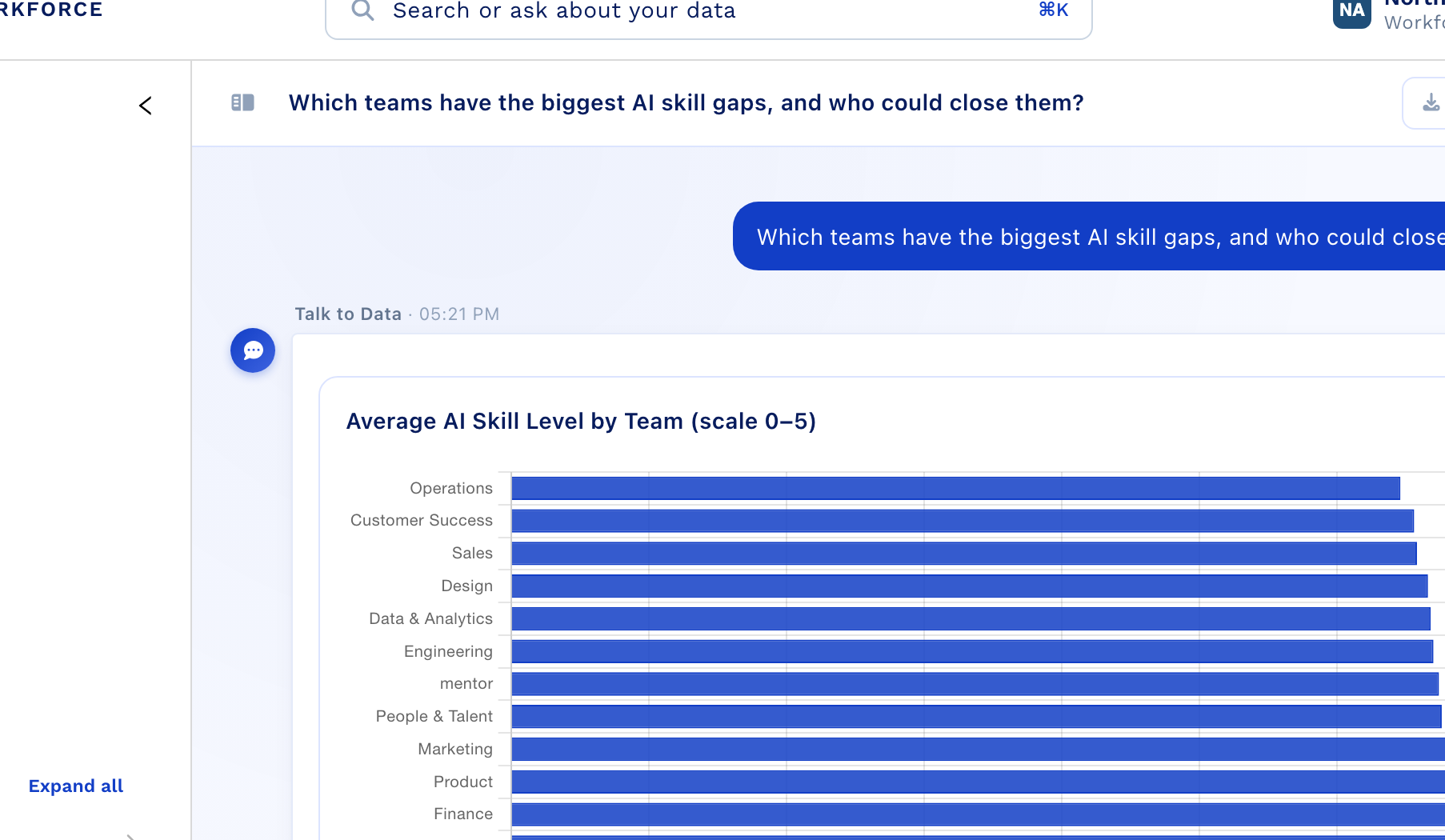
A real question, asked in plain language, answered from the organisation own data: average AI skill level for every team, with the analysis underneath. Northwind Aviation, our demo org.
Careers
Career answers cite recorded sessions
Anthropos records each person’s completed and passed simulations, in-progress Skill Paths, certifications, roles and employers. Ask about their career history or skills. Answers cite the sessions used.
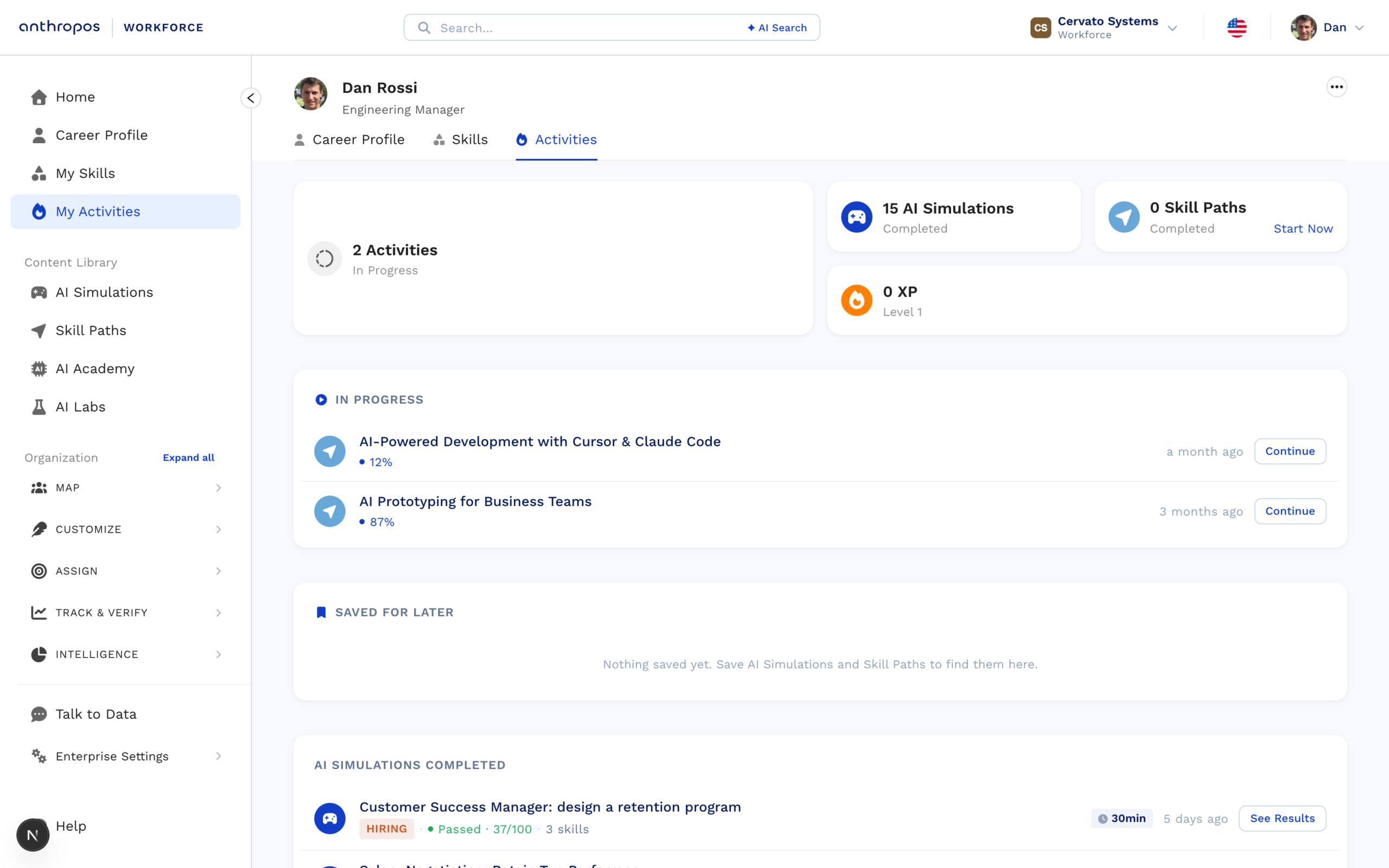
One person's record: simulations completed and passed, learning in progress, activity over time. Cervato Systems, our demo org.
An answer is only as good as the map beneath it. FS Group mapped 500+ people in two weeks, and that map is what every question runs against.



Your own data
Anthropos combines your records with verified data
Anthropos combines its verified skills, assessments and learning with your performance reviews, existing competency framework, project and staffing records, and policies. Questions draw on both sources. BI tools have your records but lack verified skills to weigh them against.
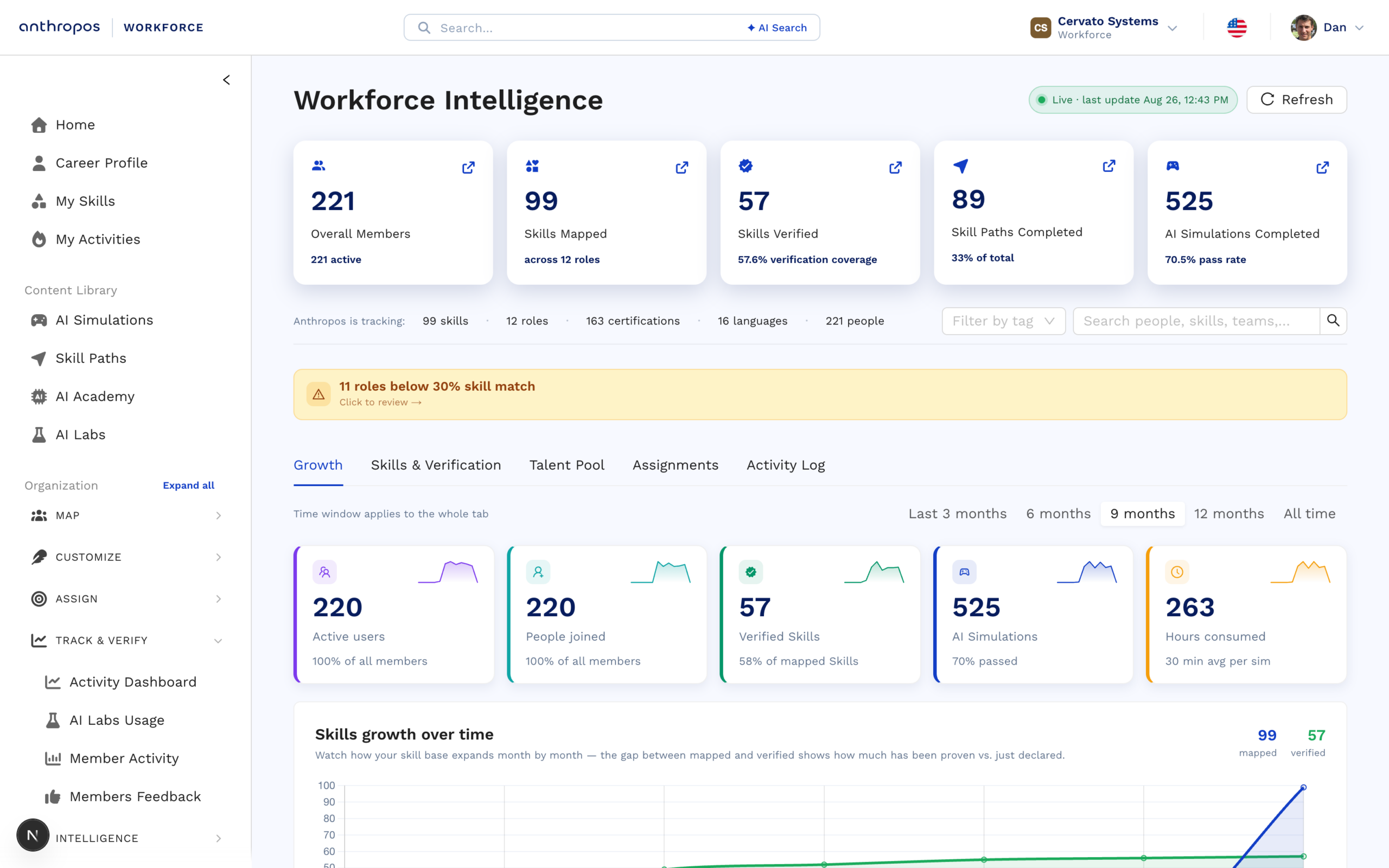
Everything a single question can draw on: people, skills, roles, certifications and languages. Cervato Systems, our demo org.
Access
Access follows each person’s role
Everyone uses the same question interface with role-based access. Line managers ask about their own people, HR leadership asks across the organisation, and employees see their own profiles. Nobody waits for an analytics ticket or sees people outside their access.
Trust and access
An answer you can act on, and nobody seeing what they should not
Two things decide whether a workforce answer is usable: who was allowed to ask, and what the answer rests on.
Access is role-based and configured per tenant. A line manager's question returns their own team, HR leadership sees the organisation, and each employee sees only their own profile.
Anthropos separates a skill verified in an AI Simulation from one auto-mapped or self-declared, so a recommendation shows you which part rests on evidence and which does not.
A result is not a number with nothing behind it. Each person links to the simulation that scored them, the skills it verified and the level each reached.
Nothing you connect or anything your people produce is used to train, retrain or fine-tune any model, ours or a sub-processor's. That is contractual in the DPA.
Hosted in the EU, ISO 27001 and GDPR, with the EU AI Act assessment available to read.
Rollout
What it takes to start
SSO and the HRIS connection go live. Roles, org structure and people import automatically.
Auto-mapping from CV, HRIS and LinkedIn produces the first skills map, and the first questions run against it.
Guided self-evaluation and the first AI Simulations land, moving answers from claimed skills to verified ones.
Your IT team configures SSO, connects the HRIS through one of 100+ integrations, and sets the permission rules.
Objections
What buyers ask before a pilot
Do I need to know SQL or be technical to use it?
No. Talk to Data in Anthropos takes plain-language questions, the way you would ask a colleague who knows the team. There is no query builder, no schema to learn and no request to the analytics team. Line managers, business leaders and HR all ask in the same place, each within their own permissions.
Can it answer using our own project and staffing data?
Yes. On top of the skills, assessments and learning Anthropos already holds, you can add your own material: performance reviews, your competency framework, project and staffing records, policies. Questions then blend both sources, so a staffing question can weigh who is available alongside who is verified capable.
Will a manager see people they are not supposed to see?
No. Access in Anthropos is role-based and configured per tenant during implementation. A team manager's question returns their own team, HR leadership sees the organization, and each employee sees only their own profile. Every answer respects the same permissions as the rest of the platform, including through the API.
What happens if we have not verified everyone yet?
You still get answers, labelled by source. Anthropos separates skills verified in an AI Simulation on the 0-5 scale from auto-mapped and self-declared ones, so a recommendation shows which part rests on evidence. Coverage deepens as more people complete simulations, and re-running the same question gives a sharper answer.
How current is the data behind an answer?
It updates continuously. Anthropos rewrites a person's profile after every AI Simulation, AI Interview and completed Skill Path, and syncs roles and org changes from your HRIS through 100+ integrations. There is no quarterly refresh cycle, so an answer reflects the workforce as it stands today.
Can I export the list of people behind an answer?
Yes. Every Anthropos answer comes with the actual records, not only a number. Open a person's profile from the result, export the list, or act on it directly: assign a Skill Path, invite someone to an AI Simulation, or shortlist them for the role you were staffing.
Can we ask these questions from our own tools?
Yes. Anthropos exposes a modern API and native MCP, so your own systems and AI assistants can query people, skills, roles, assessments and readiness with the same permissions a person would have. Teams use it to put workforce answers inside the tools their managers already work in.
Does this replace our people analytics team?
No. Anthropos absorbs the routine queue that consumes most analyst time: who holds this skill, who fits this role, where the gaps sit. Your analytics team keeps the modelling and forecasting work, and managers stop waiting three days for what is really a lookup.
Keep reading
Where to go next
Ask it about your own workforce
Bring a role you are trying to fill. We map the team, run a simulation, and you ask the question on your own data.