
Use case · Succession Planning
Succession planning based on demonstrated readiness
Anthropos bases succession plans on demonstrated skills. See who can fill each critical role, which skills they lack and how long closing each gap takes.
“If our top performers leave tomorrow, we're stuck.”
CHRO, enterprise industrial group
9-box grid vs Anthropos
What changes when readiness is demonstrated
A box colour is an opinion that has been agreed in a meeting. It is not evidence that somebody can do the job.
| A 9-box grid | Anthropos | |
|---|---|---|
| Readiness axis | Manager opinion, agreed in calibration | Demonstrated skill, scored in an AI Simulation |
| Evidence behind a name | A rating with no artefact behind it | A scored scenario on a 0-5 competency scale |
| The gap | A box colour, with no named reason | Named missing skills, measured against the target role |
| Coverage | The top 20 roles, once a year | Every role in the taxonomy, 700+ role profiles |
| Freshness | A snapshot from the last talent review | Updates after every simulation, interview and Skill Path |
| Next action | Revisit the person next cycle | Assign a Skill Path or simulation, with a date |
What the bench is for
One map, four decisions
A succession plan that is only a list of names is a document. These are the decisions it should drive.
The bench
Anthropos ranks candidates for critical roles
Select a critical role. Anthropos ranks internal candidates level by level against its required competencies. Each candidate has a readiness percentage, specific missing skills and dates for closing gaps. Anthropos turns the succession plan into a dated gap list.
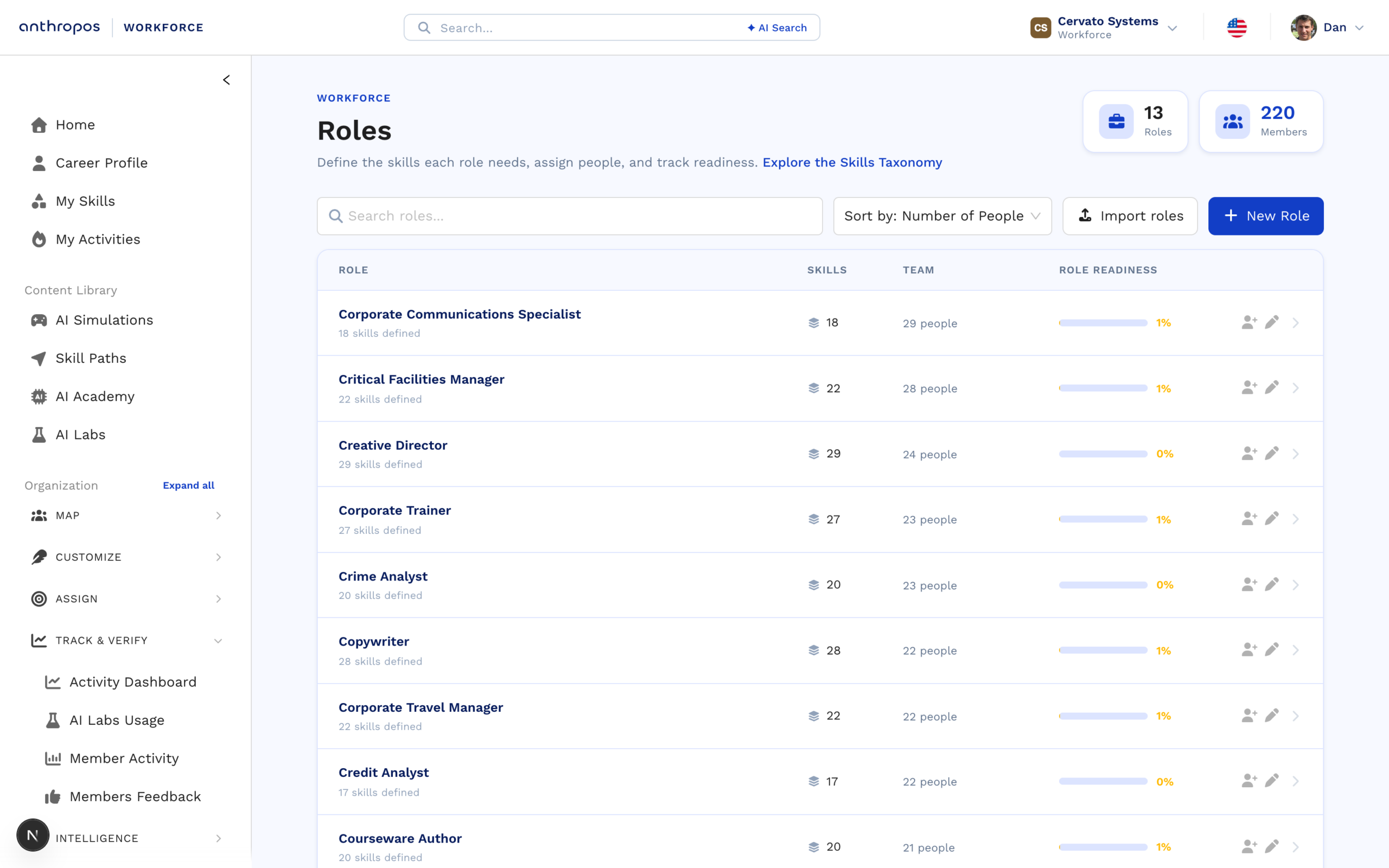
Roles with their required skills and the people mapped to them. Cervato Systems, our demo org.
Coverage
Anthropos flags roles without ready successors
Manual talent reviews stop at twenty roles because they cannot scale, but risk extends beyond the top. Anthropos tracks readiness across every role in the taxonomy and flags those without a ready successor, where a single unexpected resignation usually hurts.
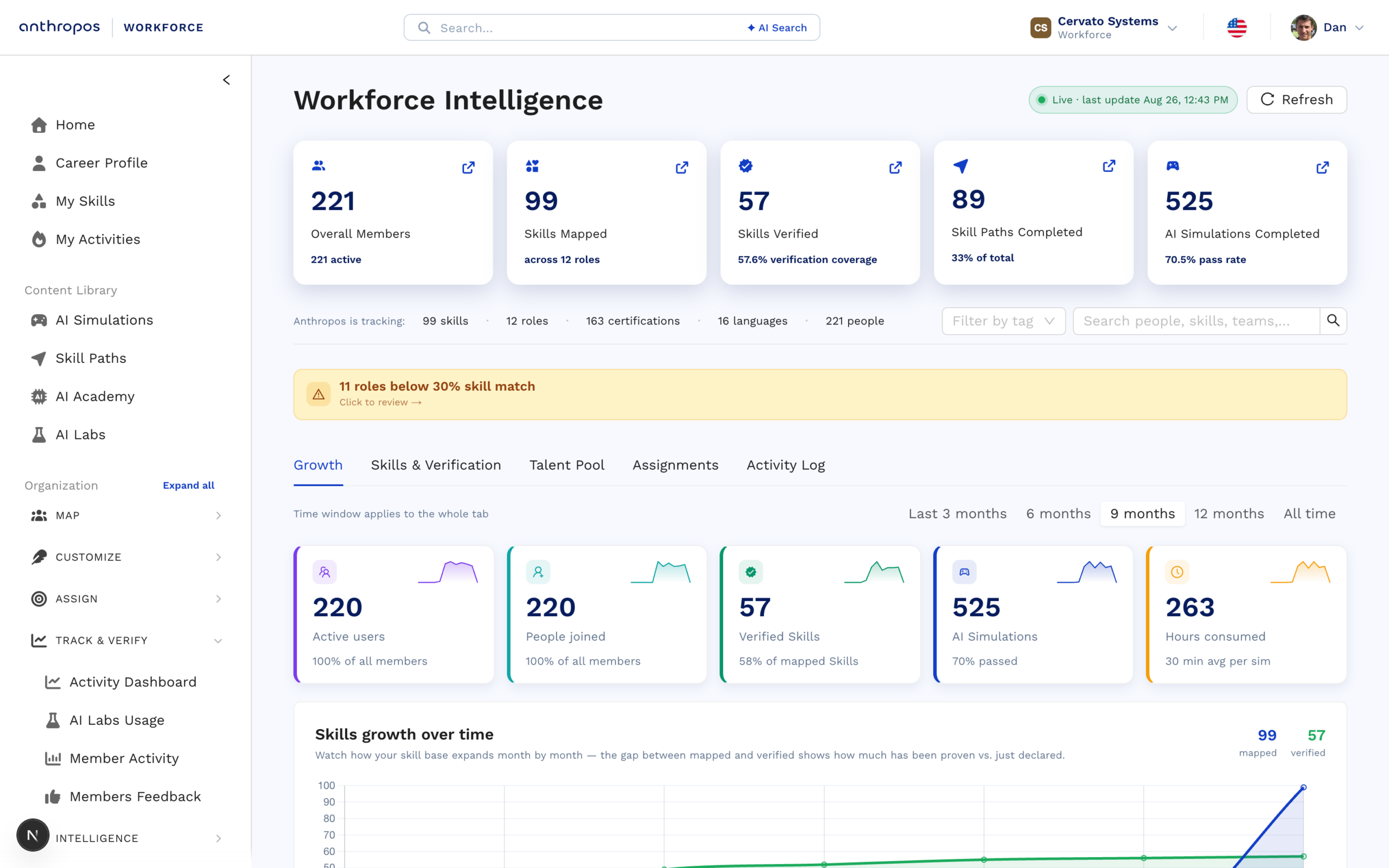
Organisation coverage, with the roles below match flagged. Cervato Systems, our demo org.
FS Group mapped and verified 500+ people in two weeks, the same verified skills foundation a succession bench is built on.

Freshness
Anthropos updates profiles and role scores
Talent review lists reflect the meeting date. People move and roles change before those lists are needed. Anthropos updates profiles as people complete simulations and Skill Paths. When HR changes a role's requirements, Anthropos re-scores everyone measured against it.
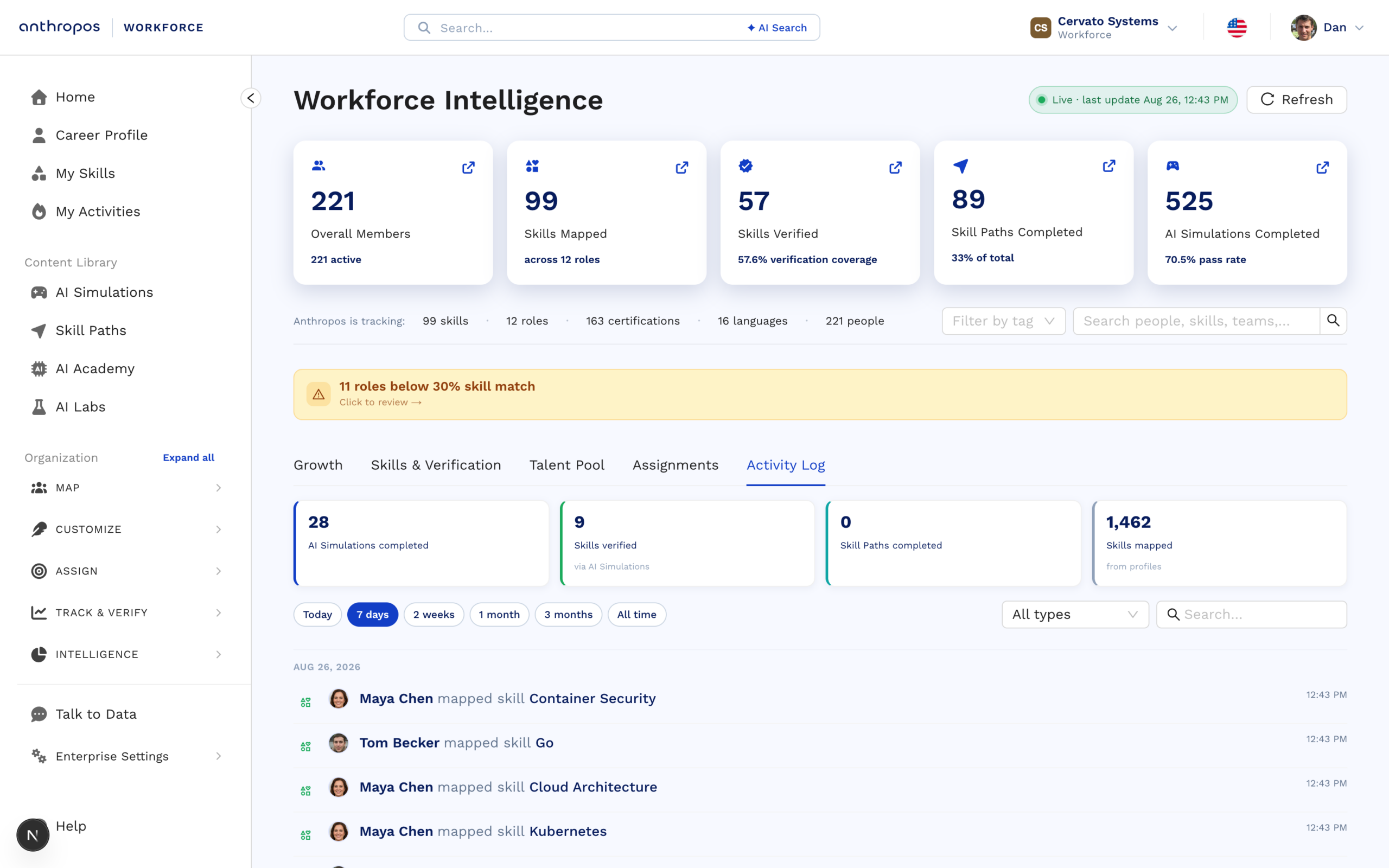
The activity log behind a bench: what was completed, and when. Cervato Systems, our demo org.
Fairness and transparency
Measuring people is where this gets serious
Naming who replaces whom is a judgement people contest. It has to rest on something.
Criteria are written before the session runs and applied identically to everyone in the role. Anthropos does not ask a model what it thinks of a person.
Not in AI Simulations and not in AI Interviews. Profiling is limited to skills, and is never used to infer protected characteristics.
Every result goes to a human who holds the decision. Someone who disagrees can request human review through you, and the scoring logic is documented so you can meet your own transparency duties.
Disclosure happens at the start of every simulation, interview and voice call. Assessment data is never used to train models.
ISO 27001 for information security, GDPR for how the data is handled, and an EU AI Act risk assessment you can read. The DPA and the current sub-processor list are available on request.
Anthropos supports your decision rather than making it, which is what keeps skills mapping and verification outside the high-risk category the EU AI Act defines for employment decisions.
Rollout
What it takes to start
SSO and the HRIS connection go in, and you select the critical roles from the taxonomy.
Auto-mapping produces the first candidate pool per role, then verifying simulations go to the shortlist.
Verified readiness ranking is live per critical role, with named gaps and high-risk roles flagged.
Minimal IT: SSO via SAML 2.0 or OIDC plus the HRIS connection, with nothing installed on-premise.
Objections
What buyers ask before a pilot
We already have a skills framework in our HRIS. Can Anthropos work with it?
Yes. If you hold a competency framework in Workday, SAP SuccessFactors or another HRIS, Anthropos maps its taxonomy to your framework and syncs verified competency scores back, so your system of record stays current without parallel data entry. Organisations without a framework can use the curated Anthropos taxonomy of 4,000+ skills as the succession baseline.
Can we run succession planning for technical and specialist roles, not just leadership?
Yes. Anthropos covers 700+ roles with required competencies across technical and non-technical work, so a principal engineer, a lead underwriter or a maintenance specialist is tracked the same way as an executive role. Key-person risk in specialist roles is often harder to fill than leadership risk, and the readiness calculation runs identically.
Can we use Anthropos to identify who is ready for internal mobility?
Yes. This is one of the highest-value uses of Anthropos, and it runs on the same verified data as succession. Internal Mobility provides Person→Role and Role→People matching with gap analysis, based on skills demonstrated in AI Simulations rather than CV claims. It answers both directions: who could step into this role, and which roles this person is ready for.
What happens when a critical role has no ready successor?
Anthropos flags the role as high risk and names the competencies missing across the closest internal candidates. From there you assign the Skill Path or training simulation that addresses each named gap, and track readiness as it moves. The alternative, discovering the gap when the resignation arrives, is what the high-risk view exists to prevent.
How often should succession readiness be re-verified?
Skills profiles in Anthropos update automatically whenever someone completes a simulation or Skill Path, so readiness moves continuously rather than annually. For critical roles, most customers re-run the verifying AI Simulation on a defined cadence, commonly annually or tied to the performance review cycle, because a competency demonstrated two years ago is weak evidence today.
Do employees find out they are on a succession bench?
Not unless you choose to tell them. Access in Anthropos is role-based and configured at tenant level during implementation: HR leadership typically sees full succession views, managers see their own team, and employees see their own profile (mapped skills, competency levels and gaps) without visibility of bench rankings for any role.
Can Anthropos work alongside our existing LMS?
Yes. Anthropos is commonly deployed alongside LMS platforms including Docebo, Cornerstone and SAP LMS. The LMS handles content delivery and compliance tracking; Anthropos handles skills verification and the readiness scoring succession decisions need. Competency scores from Anthropos can feed back into your LMS or HRIS to update learner profiles.
Does Anthropos support SSO?
Yes. Anthropos supports SSO via SAML 2.0 and OIDC, so HR leaders and employees authenticate with existing corporate credentials. SSO setup is part of standard onboarding and is typically completed in week one, alongside the HRIS connection that feeds role assignments and org structure into the succession view.
Keep reading
Where to go next
See the bench for one critical role
Name a role you would struggle to backfill. We map the population, verify the shortlist, and show you who is actually close.