
Use case · Performance Reviews
Performance reviews use demonstrated skills
Skills-based reviews ask different questions from traditional performance reviews. Anthropos supplies evidence of skill demonstrated in a real scenario, scored 0 to 5 against the role benchmark.
“Reviews are subjective and don't drive any action.”
CHRO, enterprise financial services
HRIS module vs Anthropos
What changes when the review has evidence under it
Anthropos is the evidence layer, not a replacement for your performance process. It feeds your HRIS rather than competing with it.
| An HRIS performance module | Anthropos | |
|---|---|---|
| What it records | Goals, ratings, review forms and sign-off | Verified skill evidence from a completed AI Simulation |
| Where the skill score comes from | Self-rating, peer endorsement and manager assessment | Behaviour scored against a rubric you define, mapped to a 0-5 level |
| Consistency across managers | Varies by manager; corrected afterwards in calibration meetings | One rubric and one 0-5 scale for every person in the role |
| What follows the review | The rating is stored on the record | The gap to the role benchmark assigns a Skill Path |
| Scope | The whole process, including compensation | The skills evidence layer only: it feeds your HRIS, it does not replace it |
What the evidence is for
One cycle, four outcomes
A review that ends in a number changes nothing. These are the things the evidence should start.
Evidence
Employees and managers review the same evidence
Employees complete a guided self-evaluation, an AI Simulation and an AI Interview before the meeting. Managers and employees open the same artefact and see verified 0 to 5 skill levels, each traceable to the session moment that produced it.
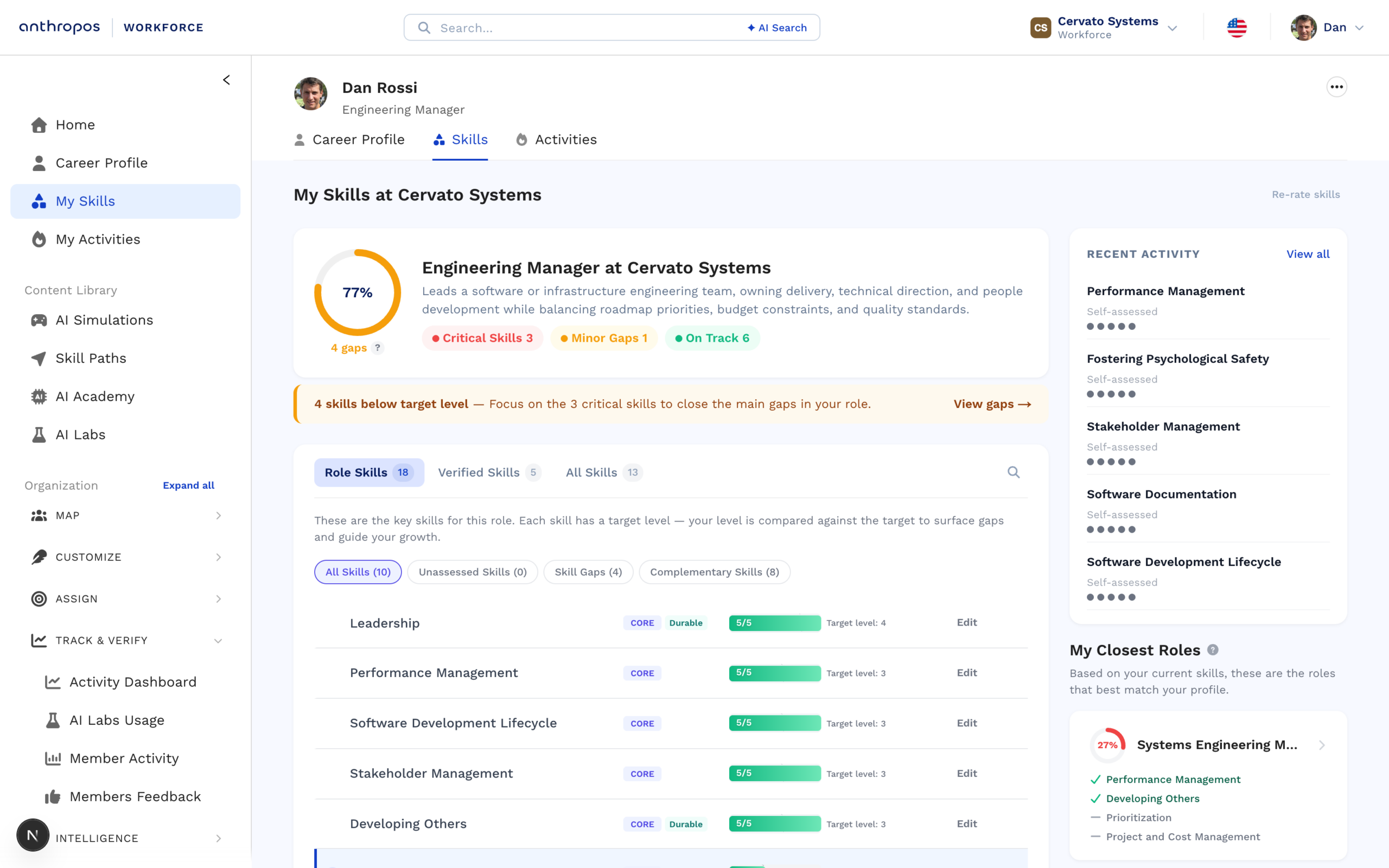
The evidence both sides read: verified levels against the role benchmark. Cervato Systems, our demo org.
Consistency
Role criteria apply consistently to everyone
Calibration meetings correct manager-to-manager drift after the fact. Anthropos defines criteria once per role and applies them identically to everyone in it. Evidence is time-stamped when produced, before review season, removing recency bias from the annual cycle.
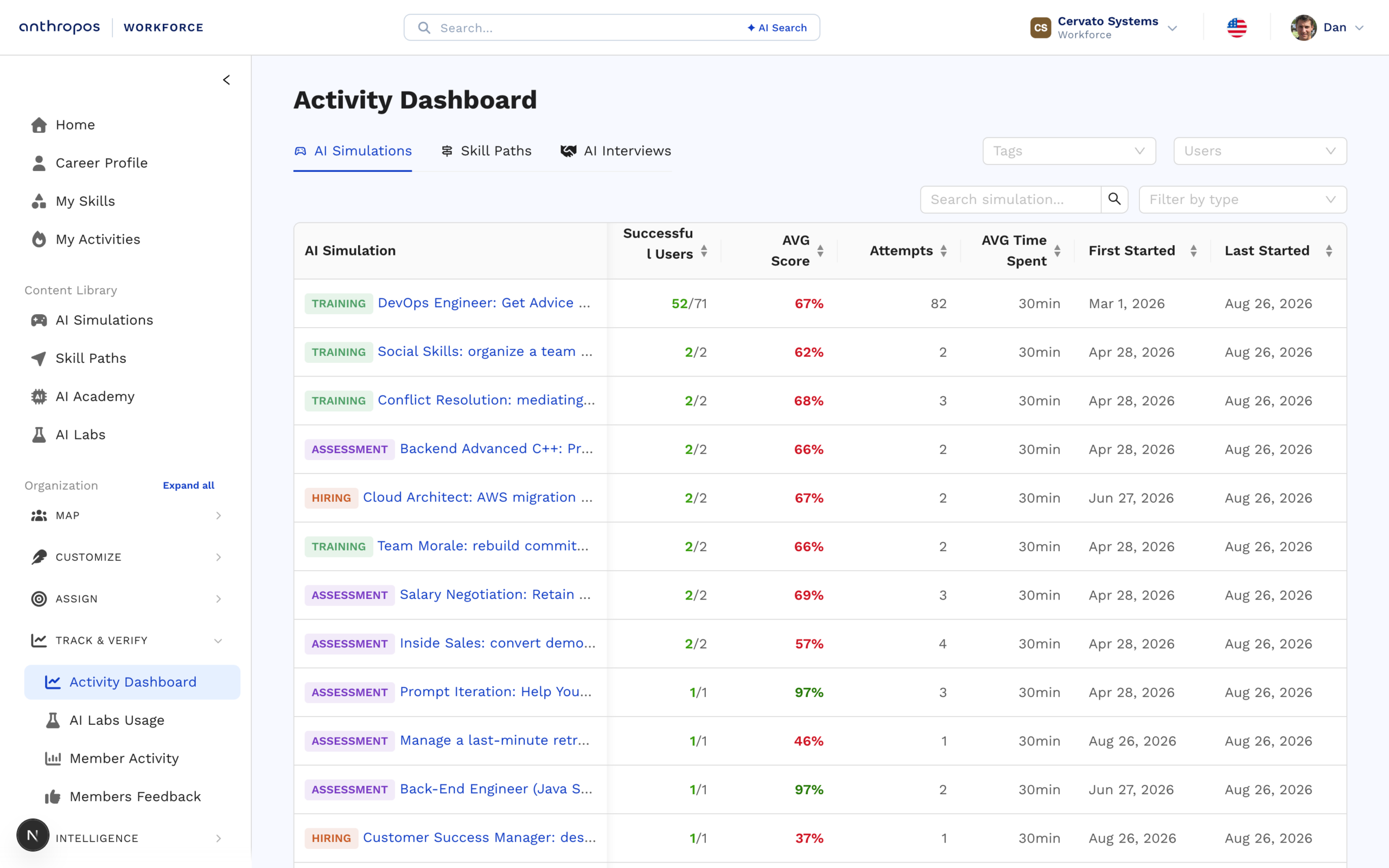
Verified activity across the organisation, dated as it happened. Cervato Systems, our demo org.
Anthropos runs verified skills assessment in production at FS Group, Italgas and Datrix. At FS Group, 500+ people were assessed in two weeks.
Output
Each review produces a development plan
Anthropos creates a development plan by comparing verified levels with the role benchmark, naming each skill shortfall and assigning a Skill Path. The evidence cycle takes roughly 60 to 90 minutes per employee, runs asynchronously and requires no scheduling.
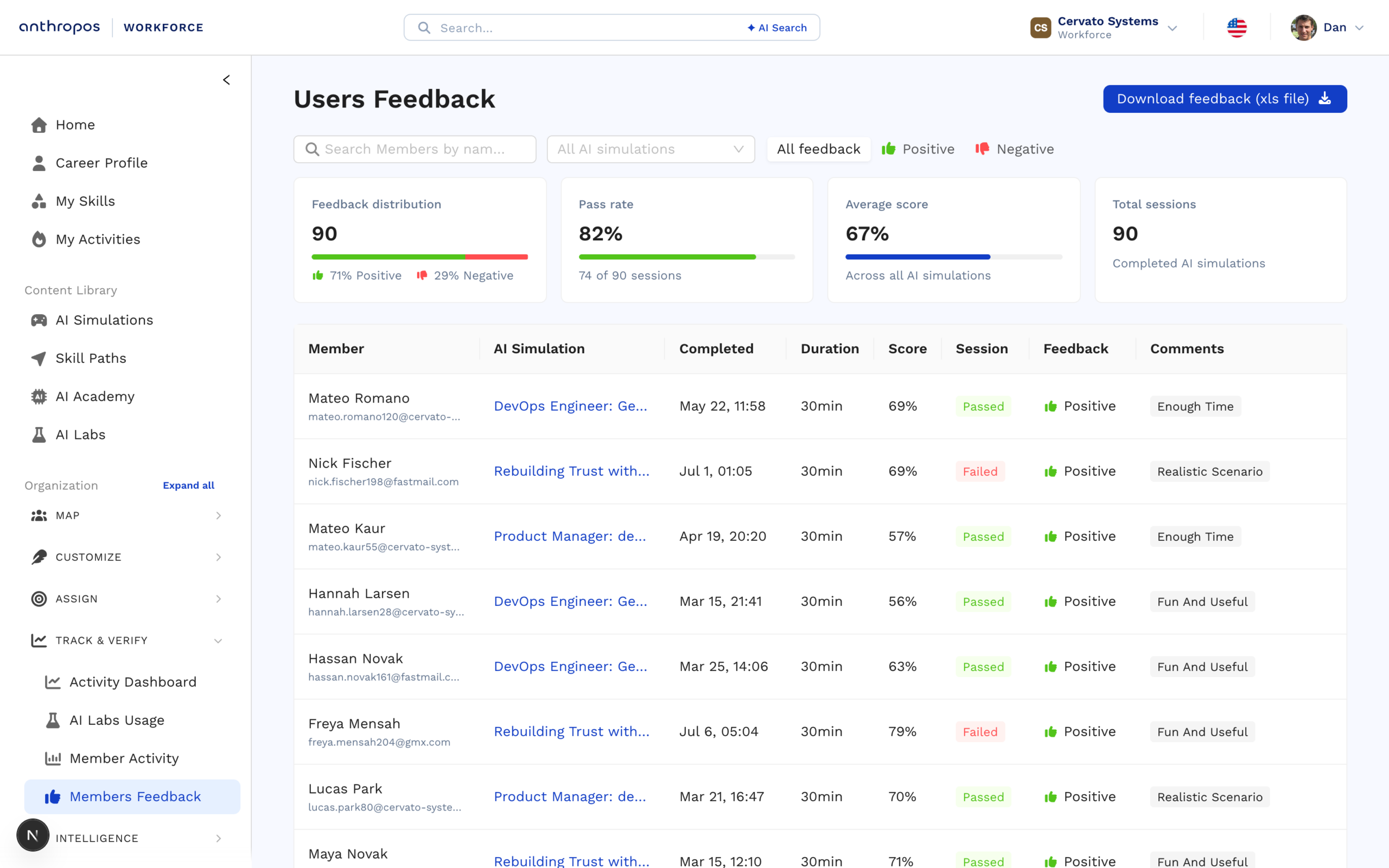
Feedback collected across the organisation. Cervato Systems, our demo org.
Fairness and transparency
Measuring people is where this gets serious
A review decides pay, promotion and sometimes a job. The evidence under it has to be defensible.
Criteria are written before the session runs and applied identically to everyone in the role. Anthropos does not ask a model what it thinks of a person.
Not in AI Simulations and not in AI Interviews. Profiling is limited to skills, and is never used to infer protected characteristics.
It does not run goal-setting, review workflows, calibration or compensation, and it does not watch people work. Your HRIS keeps the process. Anthropos supplies the skill evidence the conversation is missing.
Every result goes to a human who holds the decision. Someone who disagrees can request human review through you, and the scoring logic is documented so you can meet your own transparency duties.
Disclosure happens at the start of every simulation, interview and voice call. Assessment data is never used to train models.
ISO 27001 for information security, GDPR for how the data is handled, and an EU AI Act risk assessment you can read. The DPA and the current sub-processor list are available on request.
Anthropos supports your decision rather than making it, which is what keeps skills mapping and verification outside the high-risk category the EU AI Act defines for employment decisions.
Rollout
What it takes to start
Connect the HRIS, choose the roles in scope, and let Anthropos auto-map skills from the data you hold.
Employees complete the guided self-evaluation, then a simulation and a structured AI Interview, both asynchronous.
The integrated report lands: verified levels, named gaps and an assigned Skill Path per person.
IT configures one HRIS connector and SSO. There is no data warehouse project and no infrastructure to stand up. Anthropos does not run goal-setting, review workflows, calibration or compensation: your HRIS keeps all of that.
Objections
What buyers ask before a pilot
How is this different from 360-degree feedback?
360-degree feedback collects more opinions; Anthropos collects evidence. A 360 asks colleagues to rate someone from memory, which multiplies the subjectivity rather than removing it. Anthropos scores what the person actually did in an AI Simulation against a rubric you define, then adds a structured AI Interview for the qualitative context no rating scale reaches.
Can employees see their own results before the review conversation?
Yes. Every Anthropos employee has a profile showing mapped skills, verified 0-5 competency levels and gaps against their current or aspirational role. Employees normally see simulation results before the review meeting, so the conversation starts from shared information. This visibility consistently increases engagement with development, because people can see exactly what they are working toward.
Can we run this quarterly instead of once a year?
Yes. Anthropos verification is not tied to an annual cycle. Automatic reassessment reminders can be configured quarterly, annually, or aligned to your existing review calendar, and every verified skill carries a date. Because a 5-30 minute simulation is short and asynchronous, quarterly re-verification of a few critical skills is realistic.
Do simulation scores decide compensation?
No. Anthropos does not run compensation. Simulation scores are skill evidence: a verified 0-5 competency level against a role benchmark. How that evidence informs pay sits with you and your HRIS. Many customers deliberately keep verification separate from compensation at first, so employees engage with simulations as development rather than a pay gate.
What stops someone getting help from an AI assistant during the simulation?
Anthropos runs integrity checks on every session: detection of external LLM use, copy-paste detection, typing-pattern analysis and session monitoring. Just as importantly, most simulation tasks are conversational, and a live voice call with an AI actor playing a difficult client cannot be outsourced to a chat window while the call is running.
Can we use our own competency framework instead of the Anthropos taxonomy?
Yes. If you already have a competency framework in Workday, SAP SuccessFactors or another HRIS, Anthropos maps its taxonomy of 4,000+ skills across 700+ roles onto yours, and verified competency scores sync back so your system of record stays current without parallel data entry. Organizations without a framework can adopt the Anthropos taxonomy as the baseline.
Where is review and simulation data stored?
All Anthropos customer data is processed and stored in the EU, and employee data is never used to train AI models. Anthropos is GDPR and CCPA compliant under a Data Processing Agreement covering its approved sub-processors, and is classified as Limited Risk under the EU AI Act because scoring is rubric-based rather than black-box inference.
How do we get started with an evidence-based review cycle?
Most customers start with a proof-of-concept on one role family or one review population, typically eight to twelve weeks. The proof-of-concept delivers mapped skills for the selected group, simulations designed and run, AI Interviews completed, and an integrated report per person you can put in front of leadership before committing to a wider rollout.
Keep reading
Where to go next
Run one cycle on one role family
Pick a team and a role. We produce the evidence file both sides would read, on your own people.