
Beyond Coding 2026 is out: what 106,582 job postings say about tech roles
Read Beyond Coding 2026, our report with Orbyta Tech on how AI is changing IT and tech roles: 106,582 job postings, 47 roles, what changed since 2022, free download.
We published a report today. It is called Beyond Coding, we wrote it with Orbyta Tech, and it tries to answer a question I have been asked on almost every call this year, by CTOs and by CHROs alike: what does a tech role actually ask for now that half the team works with an AI agent?
Everyone I talk to has an opinion on this. Nobody had the data. So we went and got it. We took 106,582 public job postings for 47 IT roles, from 28,385 companies in 202 countries, mapped every requirement to the same skills dictionary we use in the Anthropos platform, and compared what companies wrote in 2022 with what they wrote in the first half of 2026. The report is free to download here. This post is what I took from it, and where I think it should change how you hire and train.
Beyond Coding 2026, the full report
106,582 job postings, 47 IT roles, 2022 against 2026, five role deep dives and the takeaways for HR, L&D and IT leaders. 40 pages, free, sent to your work email.
Job descriptions are still from 2022
Most companies I talk to have changed the product, the stack and the way engineers work, and have not changed the job description. It is the one from three years ago with a line about AI tools added at the bottom. The screening test is the same language quiz. The interview loop has the same rounds.
I don’t think anyone is being lazy about it. A job description gets copied from the last one because the hiring manager has a backlog and nobody has data on what the market is asking for this year. That is the gap we wanted to close. Not with an opinion piece, with the postings themselves.
Reading them, two things surprised me. I have been selling skills assessment for a long time and I still did not expect the size of either.
Communication is now asked for more often than Java
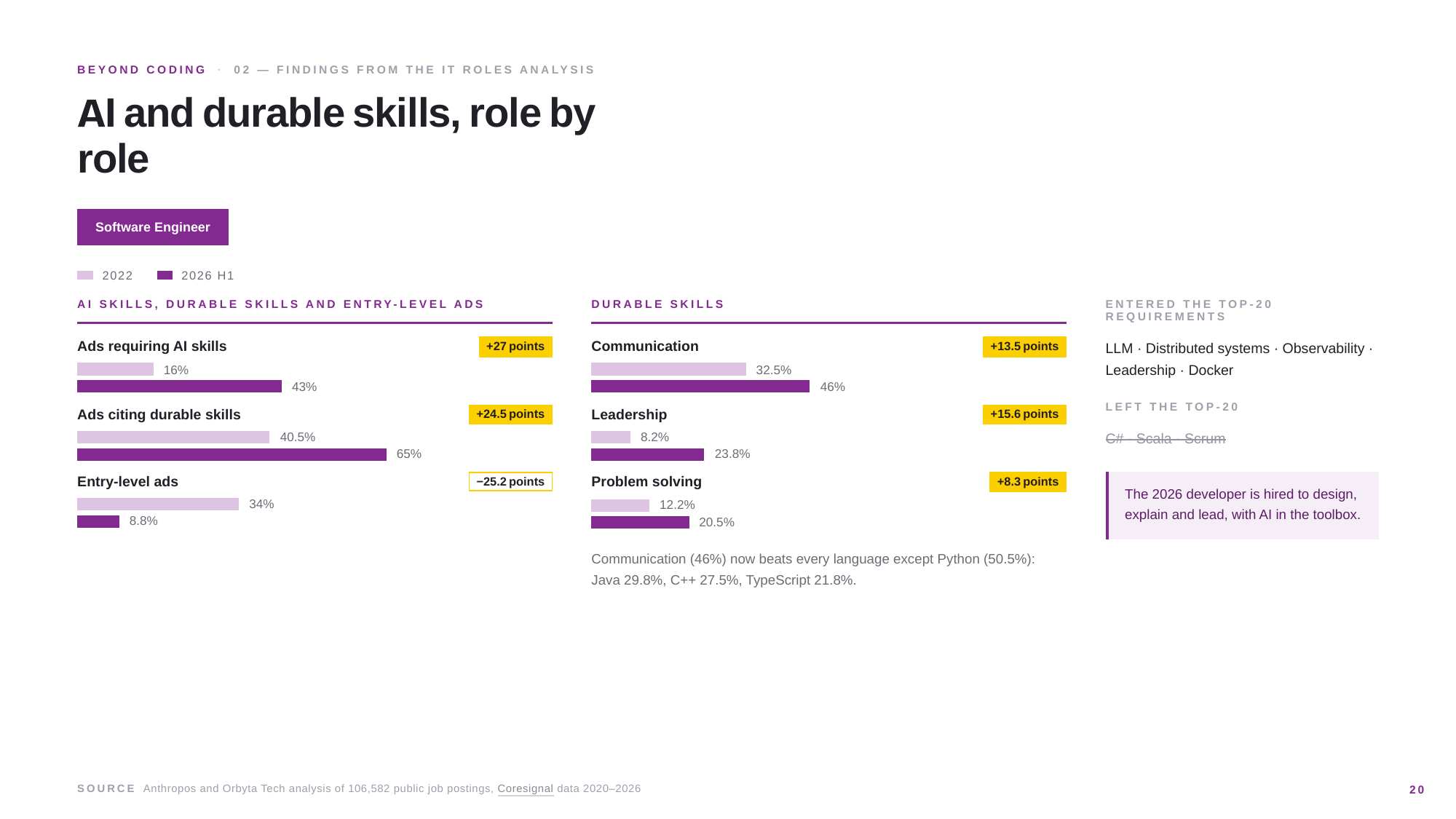
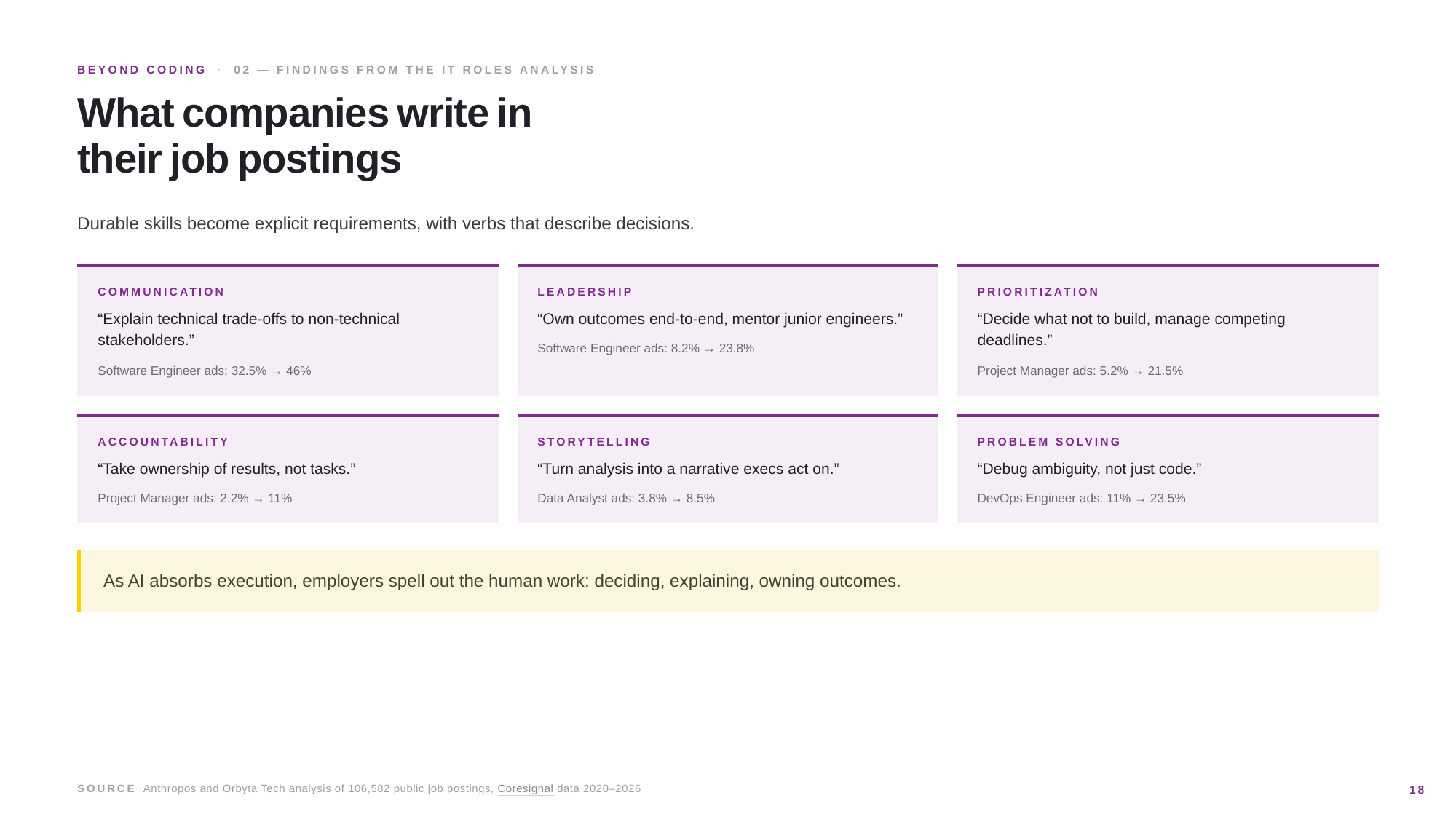
In 2022, about a third of Software Engineer postings mentioned communication. In the first half of 2026 it is 46%, and the only skill asked for more often is Python. Java, C++ and TypeScript all sit below it. A company writing a posting for a software engineer today is more likely to ask for the ability to explain technical trade-offs to people who do not write code than to ask for Java.
Communication is not the only one moving. The share of Software Engineer postings citing at least one soft skill went from 40.5% to 65% in four years. Every one of the 47 roles we measured is now above 60% on that count, and across all roles together communication alone appears in more than half of the postings.
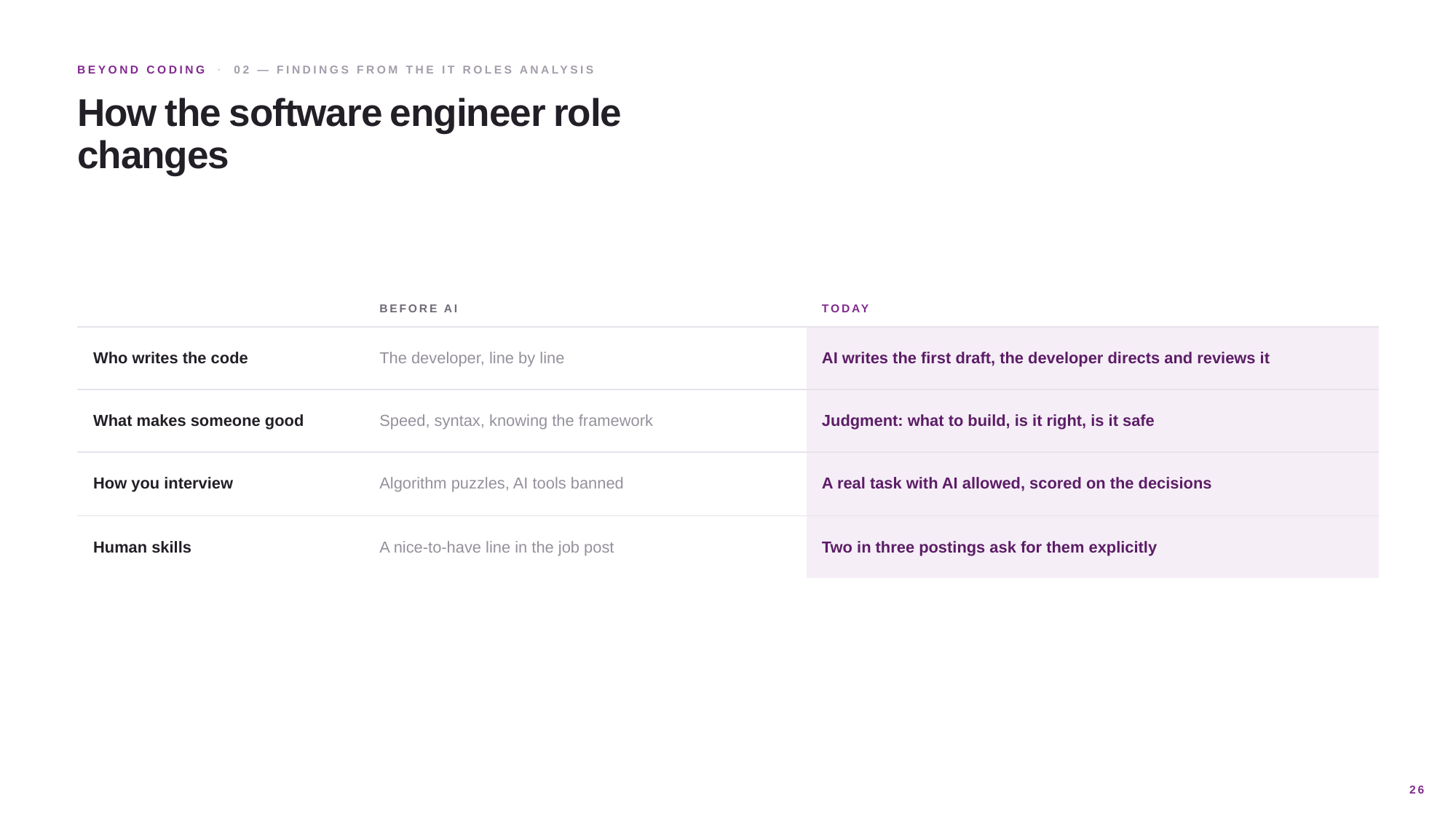
My reading is that when an agent writes a good part of the code, what is left for the person is deciding what to build, explaining why, and catching what the agent got wrong. Companies noticed this before their hiring processes did. A few other human skills grew even faster than communication, and the report goes through them role by role. I will not spoil which ones.
AI skills stopped being a bonus somewhere in 2024
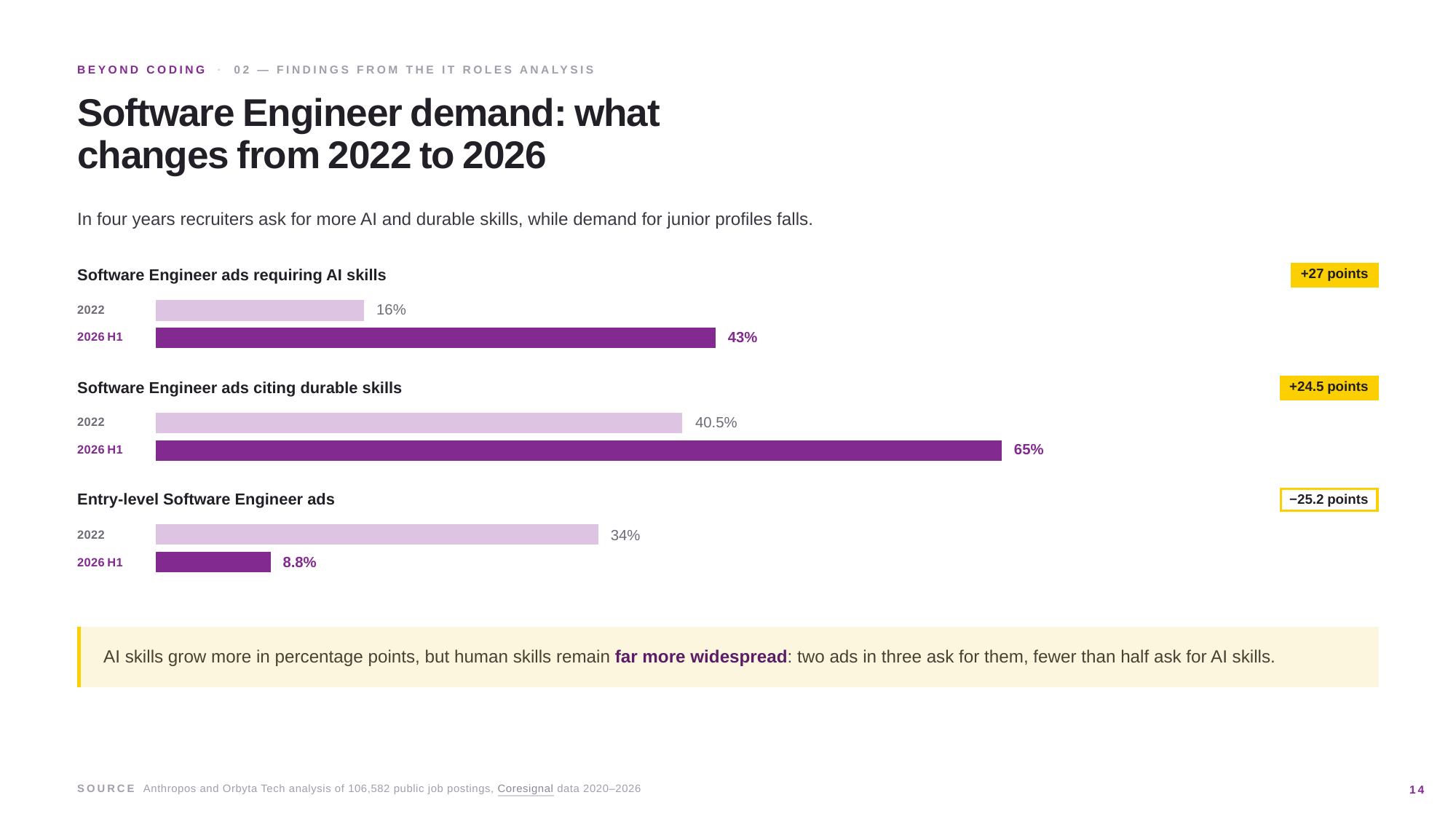
Sixteen percent of Software Engineer postings required an AI skill in 2022. Now 43% do. Most of that move happened in the last two years, and it shows up as a list of tools that did not exist in a job description before and now sit next to the programming languages. Some tools that were everywhere in 2022 are quietly leaving.
The part I find most useful for leaders is that the Software Engineer is not the role that changed fastest. One role in the study, and it is not a technical one, saw AI skills in its postings grow more than eight times, and Excel fell out of its top twenty requirements. If you own an L&D budget, that chapter is probably worth your afternoon.
What this does to assessment is uncomfortable, and I say that as someone who sells assessment. You cannot measure AI skills by banning AI from the test. If the job is building with an agent, the test has to be building with an agent, on a real task, and the score has to come from the decisions the person made rather than from whether the code compiled. That is how we assess engineers on AI now, and I expect most technical hiring processes to get there within a couple of years whether they use us or not.
Almost nobody is hiring juniors, and that is a 2029 problem
This is the number I keep coming back to. In 2022, 34% of Software Engineer postings were open to entry-level candidates. In the first half of 2026 it is 8.8%. One posting in eleven.
I understand the reasoning inside each company. An agent does most of what a junior used to do in year one, so why pay for the junior. The problem is that the arithmetic does not stop there. If almost nobody hires juniors in 2026, there are almost no four-year engineers in 2030, and the companies that skipped them will be bidding against each other for a small pool of seniors. The cheapest senior engineer you will ever have is the junior you hire now and grow with the tools.
So on this one I would go against the market. Keep hiring juniors, give them the agent on day one, and measure them on judgment rather than typing speed. Assessing technical and soft skills together is how you find the junior who becomes that senior, and it is the thing I would change first in a hiring process.
What I would actually do with the report
Four things, none of which needs a consultant.
Take the five tech roles you hire most, open the chapter on each, and compare your posting with what the market asks for in 2026. In my experience the gap is three or four requirements that are stale and one or two that are missing entirely.
Then look at the people you already have. The report tells you what the market wants. A workforce assessment on tech, AI and soft skills tells you where your own team stands, and most companies find more AI capability than the org chart suggests, usually in seats nobody was looking at.
Decide the junior question on purpose, not by default. If you hire juniors, change what you measure. If you don’t, write down where your seniors will come from in 2029 and see if you like the answer.
And move at least part of the training budget from courses to practice. The skills that grew in the postings are the ones people build by doing something and getting feedback on it. Video courses never moved communication or judgment, and they are not going to start now.
What we are building for this
What we are trying to do at Anthropos is close the loop the report opens. We map the skills your people have, technical and soft, including the ones a job title never mentions. A support lead who explains an incident to a customer better than anyone on the engineering team has a skill the postings now pay for, and you would not know it from your HRIS. Then we verify those skills where it counts, in AI Simulations for the human side and in AI Labs for engineers, with Claude Code or Codex in the terminal and a real task to finish. And then we develop the gaps with hands-on practice in the AI Academy and with content built from your own material.
Beyond Coding 2026 is free. We ask for a work email and send the download link there, so that the copy reaches a real person and not a scraper.
Beyond Coding 2026, the full report
106,582 job postings, 47 IT roles, 2022 against 2026, five role deep dives and the takeaways for HR, L&D and IT leaders. 40 pages, free, sent to your work email.
If you read it and think I have a piece of this wrong, I want to hear it. The junior question is the one I would most like to be argued with on. I am on LinkedIn most days, and the half-formed versions of these ideas usually land there first.
