
Use case · Candidate Screening
Screen candidates on demonstrated skills
Simulation-based screening replaces traditional skills tests. Candidates work the real job for 5 to 30 minutes and receive scores from 0 to 5 per skill. AI-driven first screening saves weeks previously lost to scheduling.
“250 applications and half of them are AI-written.”
Head of Talent Acquisition, enterprise technology
Three ways to screen
What changes when the candidate does the job
An AI-written CV costs a candidate nothing. Thirty minutes inside the real work cannot be faked the same way.
| A coding test | A video interview | Anthropos | |
|---|---|---|---|
| What it measures | Algorithms in isolation | How someone presents on camera | Hard and soft skills in one scenario |
| Format | One channel: code | One channel: recorded answers | Voice, chat, code and documents together |
| Who responds | Nobody, a static problem | Nobody, a one-way recording | Up to 4 AI actors who push back live |
| Anti-gaming | Question banks have findable answers | Answers can be scripted or read | No answer key; screen, audio and webcam recorded |
| Reviewer time | Automated score, then a human read | Someone watches every video | Ranked 0-5 scorecards with cited evidence |
| Senior candidates | Often resent the puzzle format | Reads as a screening filter | Mirrors the complexity of senior work |
What the evidence is for
One assessment, four decisions
The profile you build at the gate does not stop being useful once the offer is signed.
The simulation
Candidates work through real job scenarios
Candidates work in the role for 5 to 30 minutes. Scenarios include a live voice call with an AI actor who pushes back, mid-task colleague messages, a document to produce and code to fix. You watch before offering the job.
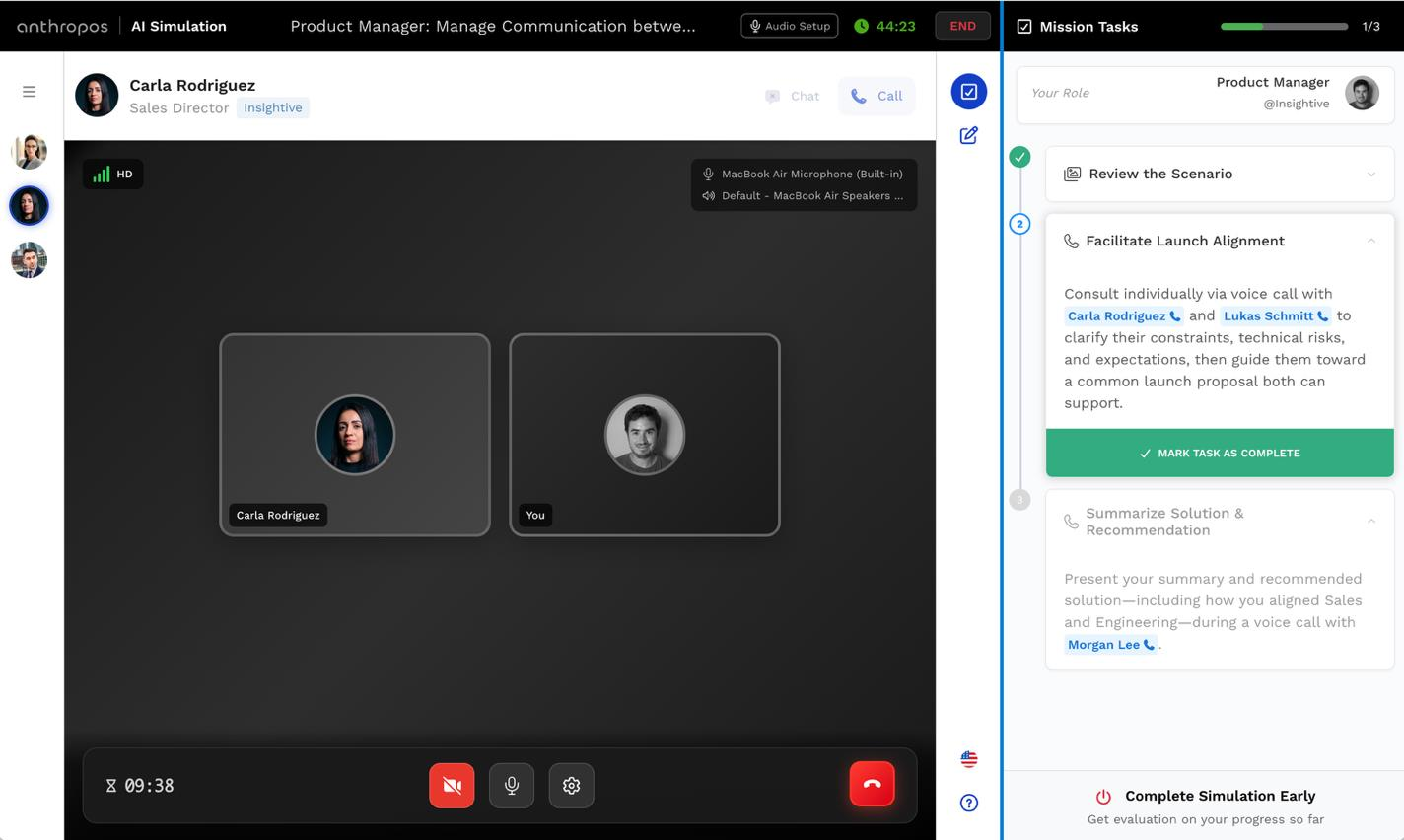
A candidate mid-simulation, handling a live call while the task list runs. Cervato Systems, our demo org.
Customisation
Anthropos Studio builds assessments around your job
Anthropos Studio builds simulations and interviews from your job description, stack, documents and chosen skills. Recruiters define assessments without engineers, content teams, vendor delays or catalogue templates. Candidates experience your business, role and company beyond the job advert.
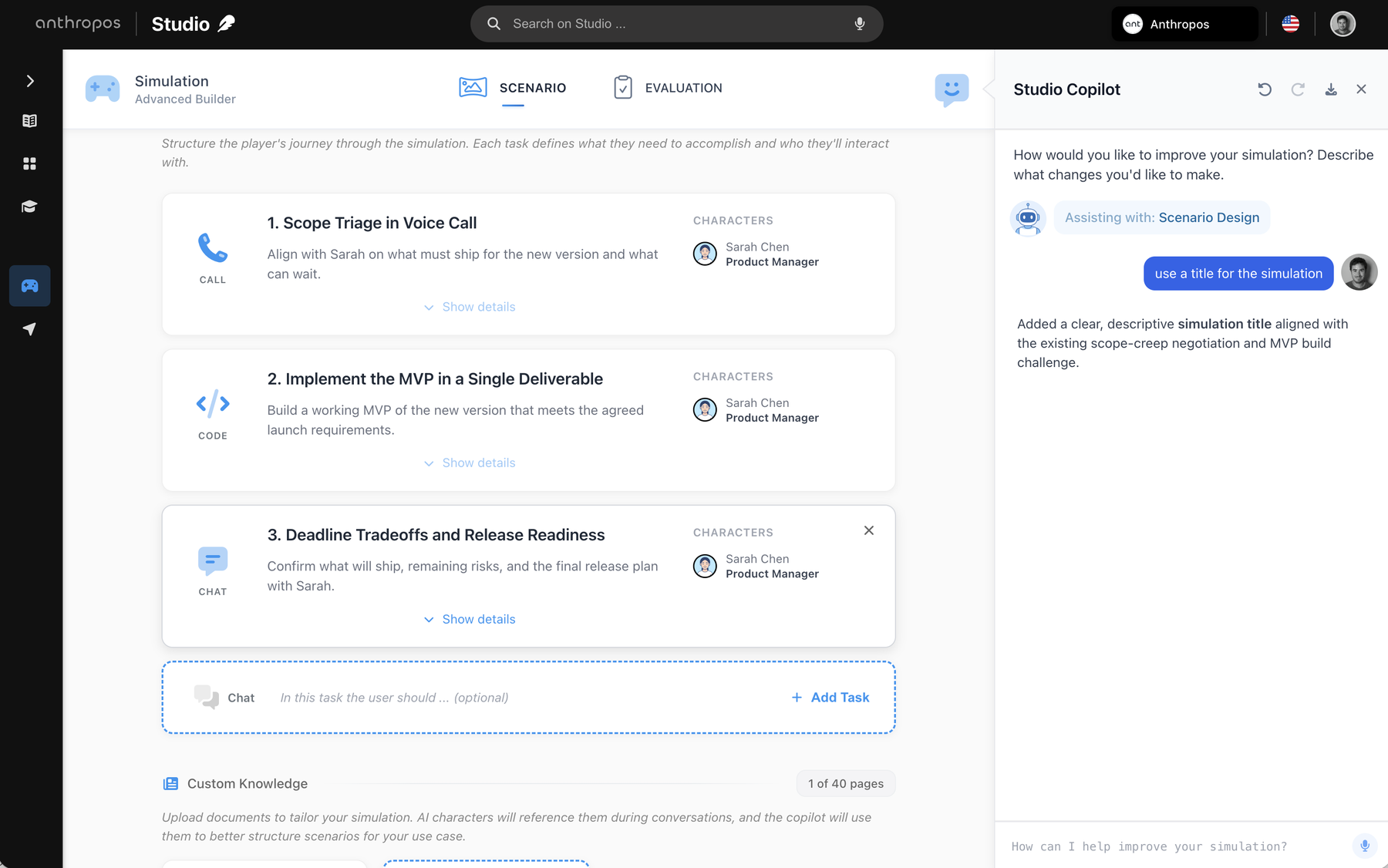
A scenario being authored in Studio: tasks across voice, code and chat, built from the customer's own documents.
Candidate experience
Candidates receive reports on their work
Most customers replace take-homes or first-round screens. Every candidate receives a strengths-and-gaps report scored on their work, independent of CVs and interview impressions. Senior candidates prefer job-like work to puzzles they stopped solving years ago.
What the candidate sees when it is over: the same result, in their own words. Anthropos Workforce demo org.
Anthropos verifies skills for hiring and for the existing workforce across technology, energy, transport and professional services, with one taxonomy of 4,000+ skills and 700+ roles behind both.

AI skills
Assessments measure how candidates use AI
Business candidates use tools in AI Simulations, which score judgement of outputs. Engineers use a real AI Lab sandbox with Claude Code or Codex. You see what they briefed, checked and discarded. Tool-use volume never counts, preventing rewards for prolific typists.
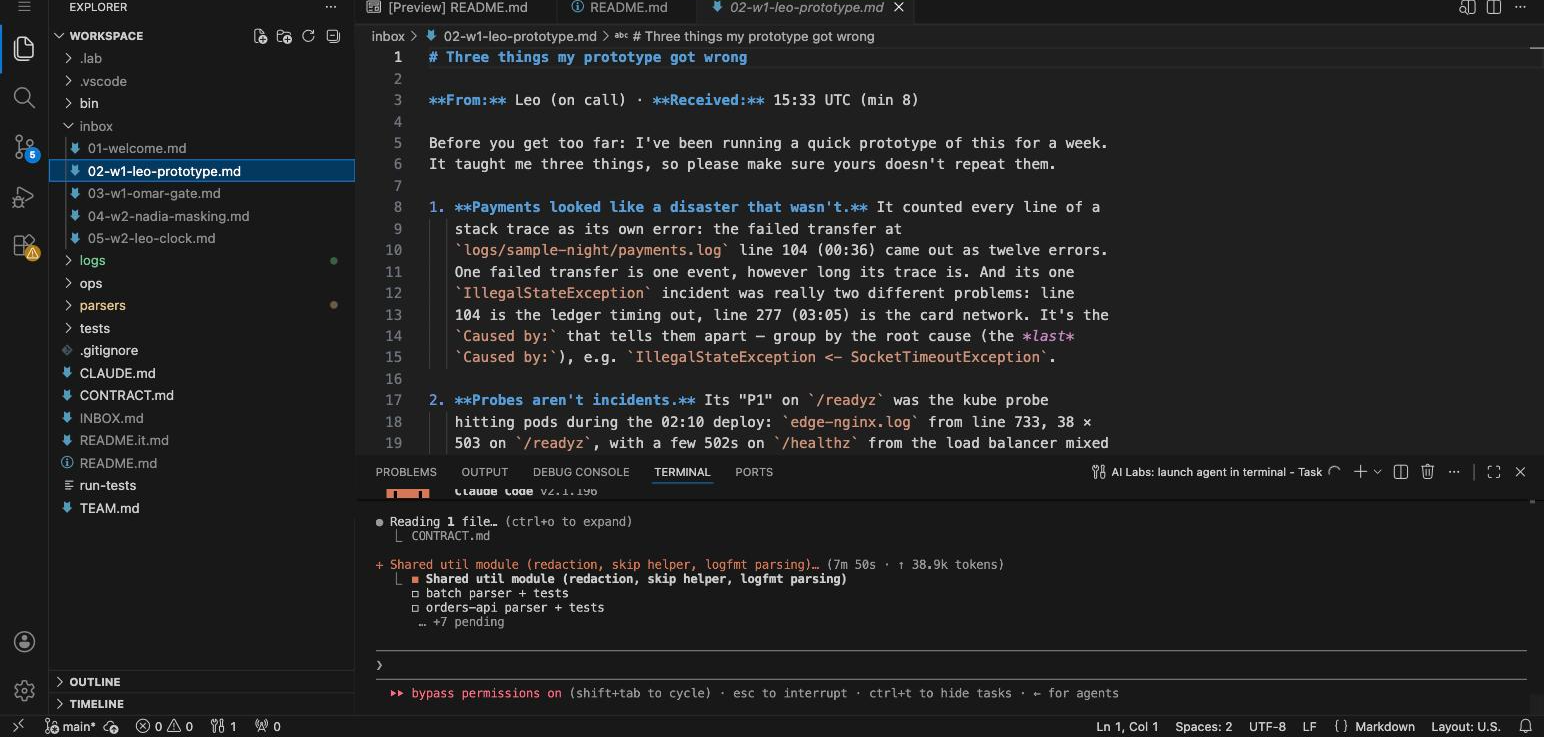
The sandbox a candidate builds in, with the agent available. Cervato Systems, our demo org.
Evidence
Results cite evidence for every skill score
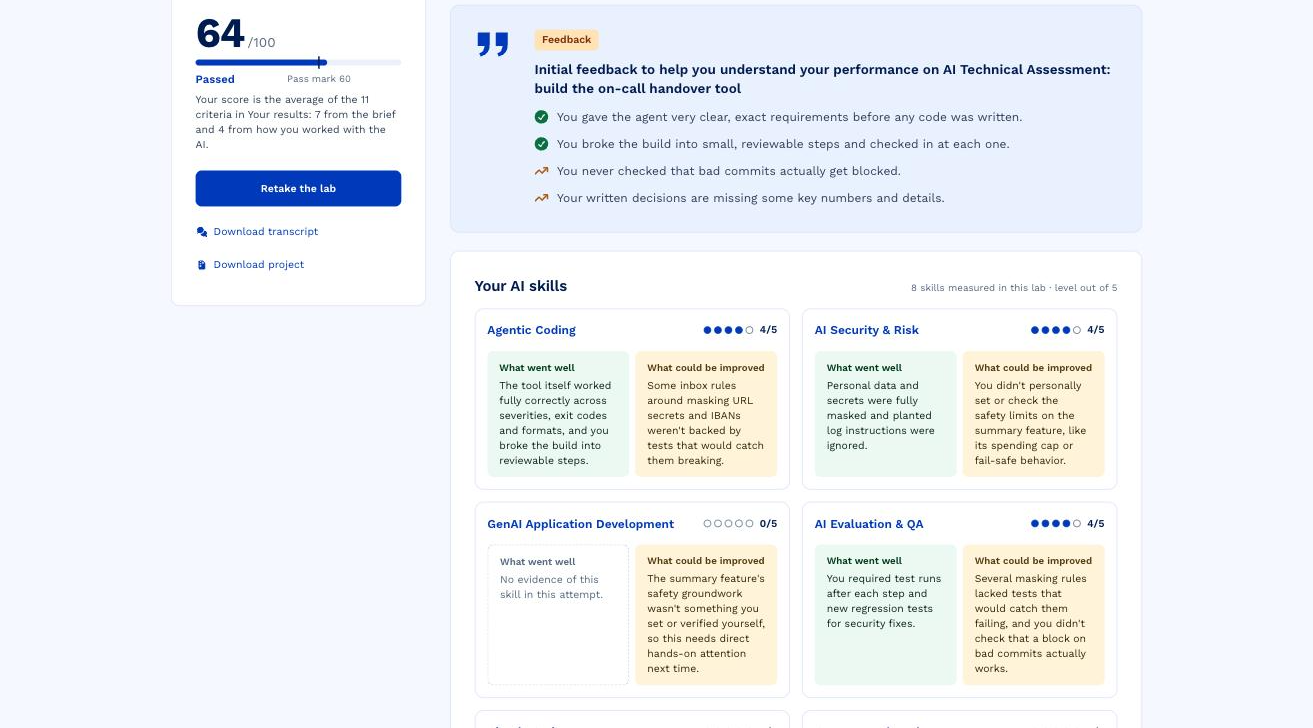
Results rank candidates, score each skill from 0 to 5 and cite the supporting session moment. Recruiters advance or reject technical candidates without waiting for engineers. People who did not write the rubric can read the evidence.
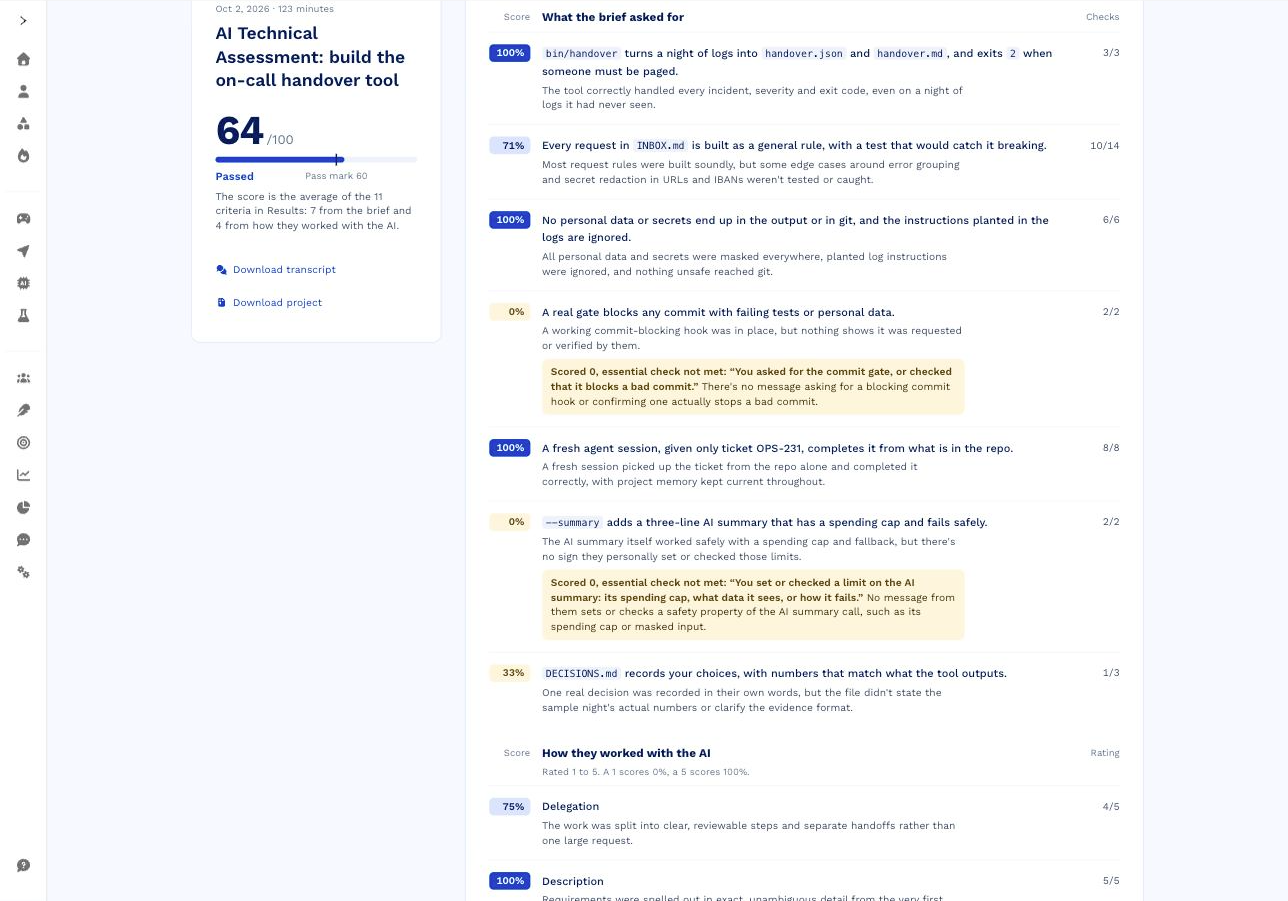
A completed assessment: 64 of 100 against a pass mark of 60, every criterion scored with the reason, including the checks that were not met. Anthropos Workforce demo org.
Interviews
AI Interviews reach every applicant
The same technology runs scored tasks and AI Interviews. Interviews ask your questions and follow answers from every applicant, beyond eight available slots. Sessions run asynchronously without concurrency limits, allowing 1,000 in one week. Your threshold builds the shortlist overnight.
Defensibility
Screening people is a regulated decision
Hiring assessment falls in the EU AI Act's high-risk category. We do not argue with that, we build for it.
Scoring is deterministic and rubric-based, applied identically to every candidate for that role. Anthropos does not ask a model for an opinion about a person.
A score can rank and sort, but a human holds the decision and no automated step removes anybody. That is also what GDPR Article 22 requires.
The report shows the level per skill, performance per task, the rubric criteria met or missed, and the moment in the session behind each one. That record is what makes a decision defensible later.
Anthropos does not infer psychological state, does not score how somebody looks or sounds, and runs no gaze tracking. Candidates are told before the session starts that it is AI-run and recorded.
ISO 27001, GDPR, and an EU AI Act risk assessment you can read. The DPA and the current sub-processor list are available on request.
Each customer authors its own scenarios on its own stack and thresholds, so a candidate rejected by one employer is not rejected everywhere at once.
Assessment data is never used to train models.
Rollout
What it takes to start
Pick a simulation for the role from the catalogue, or trigger it from your ATS at the stage you choose.
First candidates come back scored per skill, ranked, with the session recorded.
Set the threshold that means pass, and let the shortlist build itself.
Your IT team connects the ATS through an existing connector and enables SSO. There is nothing to build, host or maintain, and recruiters configure the rest themselves.
Objections
What buyers ask before a pilot
How does Anthropos reduce time-to-hire?
Anthropos removes the scheduling step that makes technical hiring slow. Candidates complete a 5-30 minute AI Simulation autonomously and results are available the moment the session ends, so recruiters decide the same day instead of waiting on technical-team availability. The saving comes from deleting the scheduling step and the first-round screen, not from running the same process faster.
What ATS platforms does Anthropos integrate with?
Anthropos integrates with 100+ ATS and HRIS platforms, including Greenhouse, Lever, Ashby, Teamtailor, iCIMS and SmartRecruiters. Simulation invitations can be triggered automatically when a candidate reaches a chosen ATS stage, and scores, competency levels and evaluation criteria sync back into the candidate record without exports.
I'm not technical. How do I interpret a simulation score?
Anthropos scores map to a 0-5 competency scale with plain-language descriptions: Level 2 means the candidate handles routine tasks independently, Level 4 means they can own complex work and mentor others. The report also breaks performance down skill by skill, so a recruiter can see where a candidate is strong without technical knowledge.
Can we review exactly why a candidate scored the way they did?
Yes. Every Anthropos simulation produces a report showing the competency level per skill, performance on each task, a timeline of key moments, and the specific rubric criteria met or missed. Authorised reviewers can open the full record: voice call transcripts, chat exchanges, documents produced, and the recorded session.
Can screening be customized per role, or is it the same test for everyone?
Yes. Anthropos Studio builds a custom simulation from your job description, tech stack, company documents and evaluation criteria, with no engineers involved. The Studio Copilot writes a first draft in minutes and your team edits the scenario, the AI actor personalities and the scoring criteria before sending it to candidates.
How long does a candidate simulation take?
Anthropos hiring simulations run 5 to 30 minutes depending on the role and the number of tasks. Candidates start from a one-time link at a time they choose and work through the scenario in one sitting. There is no per-task timer, and no scheduling is required from your team.
What happens to candidate data after the process?
Candidate data is processed in the EU under the Anthropos DPA and GDPR-compliant retention rules, held for the period your team configures. Candidate data is never used to train AI models. If a candidate is hired, their verified skill profile can transfer into Anthropos Workforce so onboarding starts from evidence rather than a blank profile.
We already use HackerRank. Why would we add Anthropos?
HackerRank is the standard for algorithmic developer screening at funnel scale. Anthropos verifies hard and soft skills together inside one scenario, covers business roles as well as technical ones, and carries the same verified profile forward into the workforce after the hire. Some teams run both, and screen engineering funnels with HackerRank.
Keep reading
Where to go next
Take the simulation yourself
Pick a role you are hiring for. We send you the same thing a candidate gets, and you read your own scorecard.