
Use case · AI Readiness & ROI
See the return on AI readiness spend
Score every employee on AI readiness. Run it again after your programme and compare.
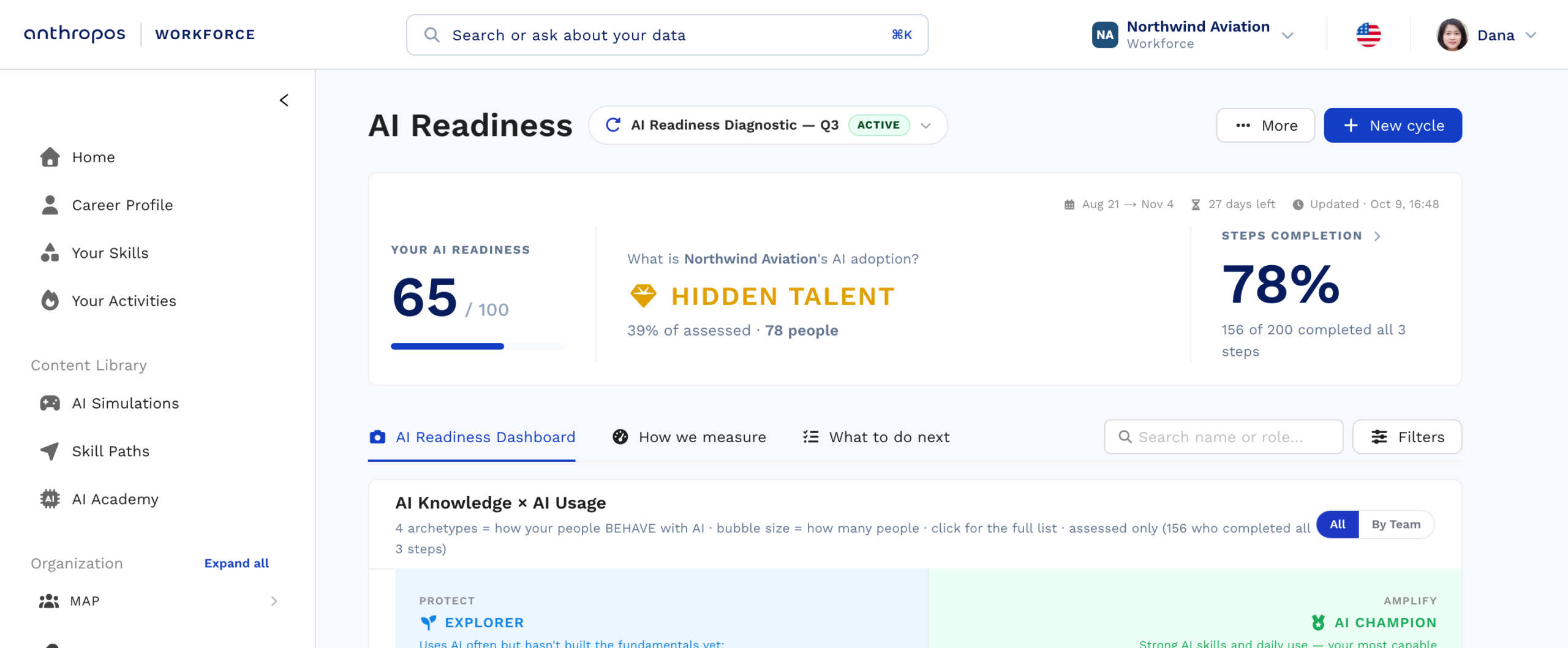
“Every team tells me they are using AI, and every team's delivery looks about the same as last year. I do not need another survey saying eighty per cent of engineers have tried it. I need to know who is genuinely faster because of it, who is shipping code they cannot explain, and which part of the training budget changed anything at all.”
VP Engineering, financial services
Licence counts vs verified readiness
What changes when readiness is measured instead of counted
A seat purchased is not a capability acquired, and a finished course is not a changed behaviour.
| Licence counts & completion rates | Anthropos AI Readiness | |
|---|---|---|
| What it measures | Seats purchased, courses finished | Verified capability, demonstrated in a real task |
| Where the data comes from | A software invoice and an LMS log | AI skill mapping, an AI Simulation, an AI Interview |
| Unit of progress | Percentage who completed | Movement between four AI types on the Knowledge × Usage map |
| The person with a licence who never uses it | Counted as covered | Flagged as Hidden Talent, with the blocker named |
| The person who uses AI badly | Counted as adopted | Flagged as Explorer: a quality risk to fix before more access |
| What leadership sees | An activity report | A 0-100 score per business unit, with a before-and-after delta |
The four AI types
An average tells you nothing. Four types tell you what to do
Everyone lands in one quadrant of Knowledge by Usage, and each one has a different fix.
The board view
The board sees AI readiness by team
Board dashboards show AI readiness by team and business unit. In a 200-person organisation the score is 65 out of 100. Run a second cycle to see what moved.
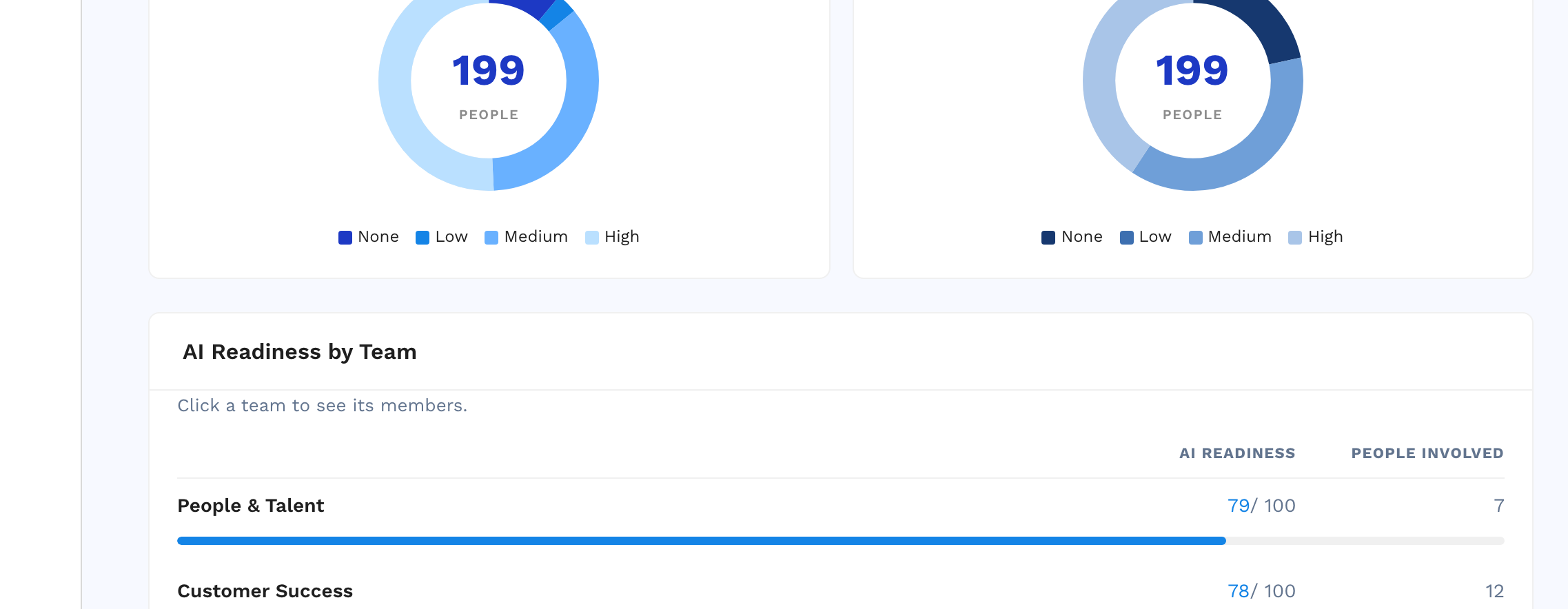
AI Readiness by team, so the board sees which teams are ready and which are not. Northwind Aviation, our demo org.
The score
The score combines skills and practice
A 0 to 100 score per person, built from mapped skills, a hands-on assessment and an AI Interview. Nothing is self-rated.
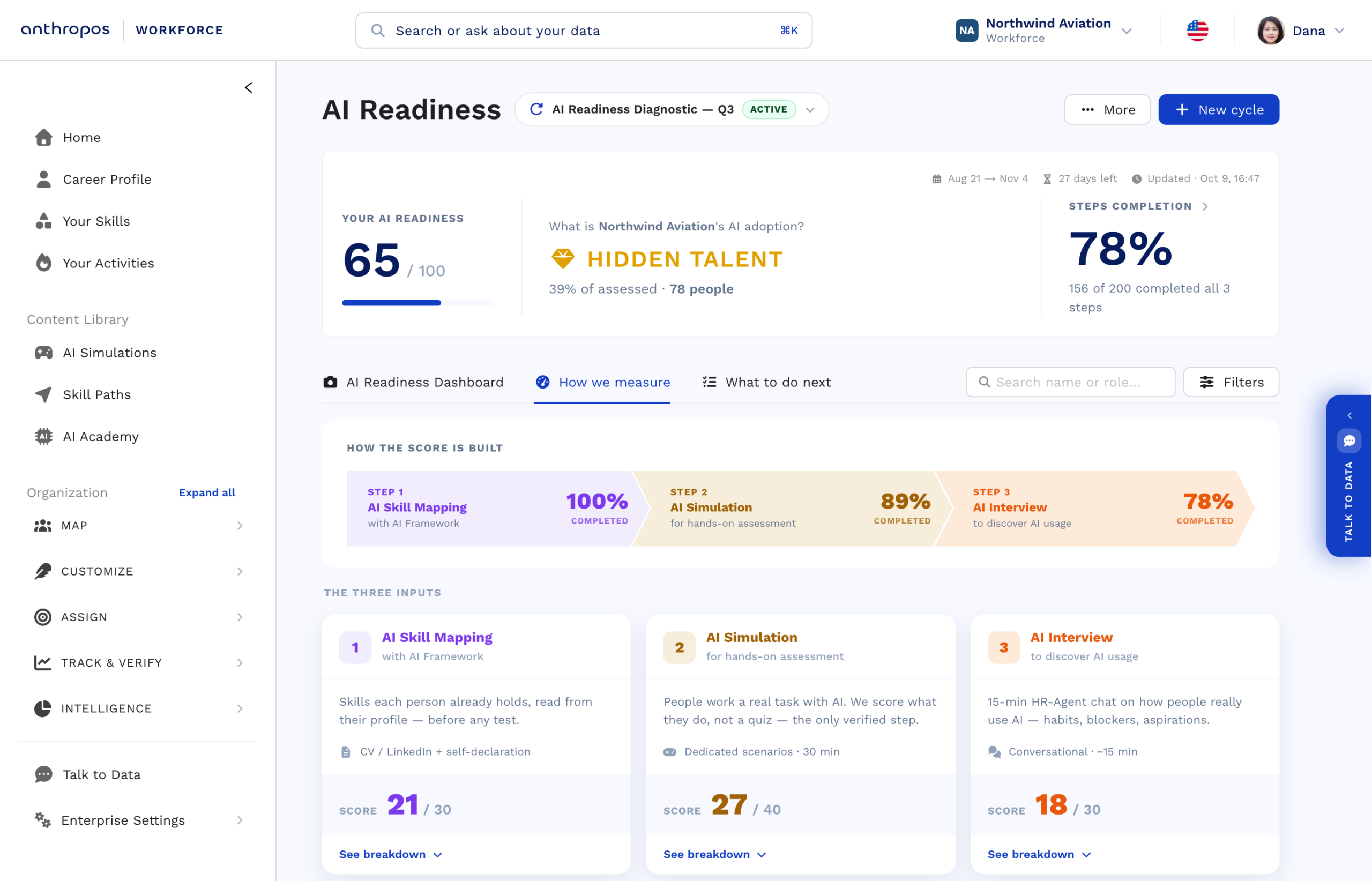
How the score is built: skill mapping, a hands-on assessment and an AI Interview. Northwind Aviation, our demo org.
FS Group mapped 500+ people in two weeks. Datrix and Orbyta Tech train engineers and marketing teams to work with AI through AI Academy.
The profiles
Four profiles show how people use AI
AI Champions have strong skills and use AI often. Hidden Talent have skills but little use. Explorers use AI without the fundamentals. Standby staff are new to it.
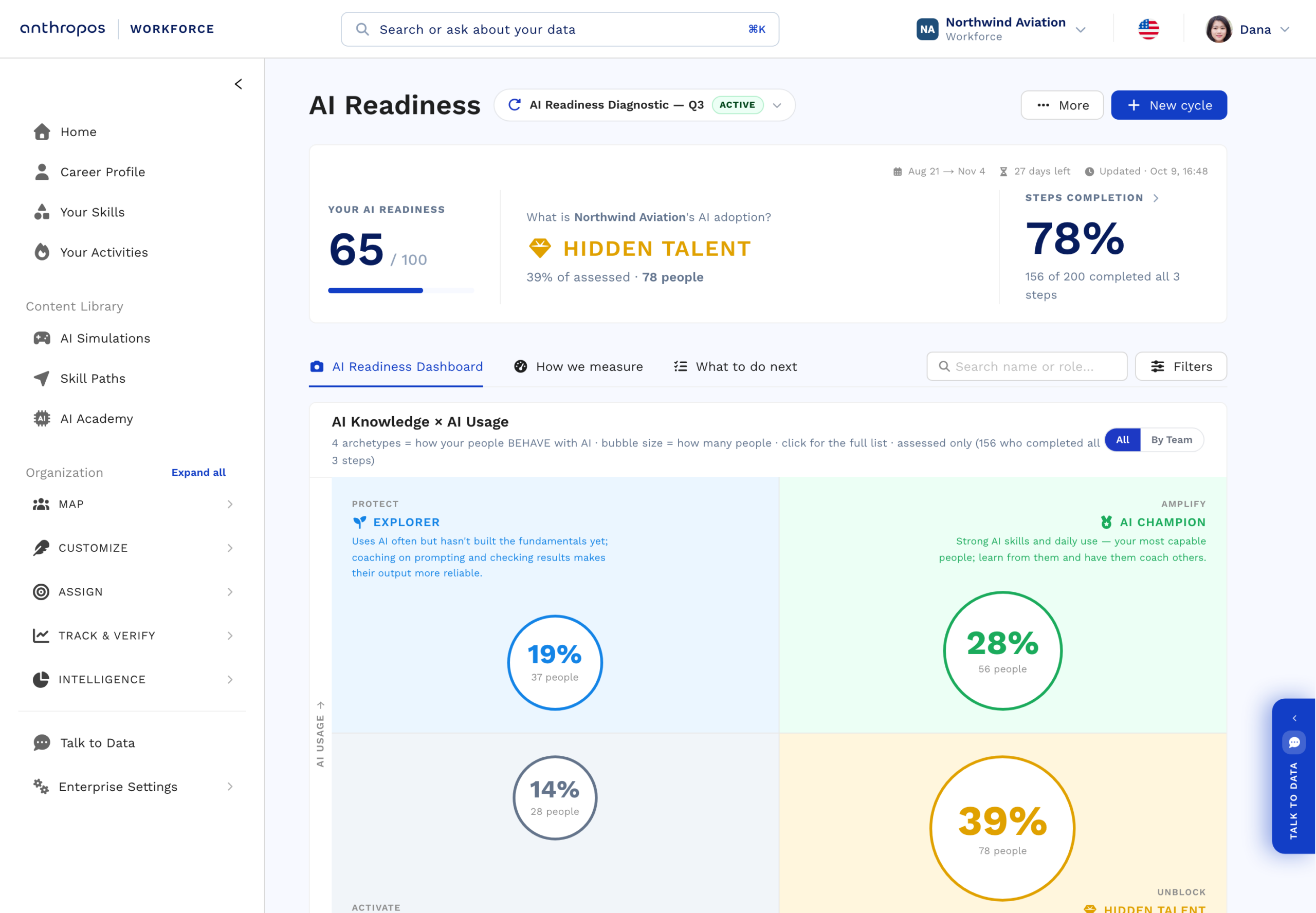
The four profiles, each sized by how many people sit in it. Northwind Aviation, our demo org.
What you do next
Each group gets one action
Share the Champions' methods. Remove the licence or policy barrier for Hidden Talent. Teach Explorers the fundamentals. Give Standby staff a starting point.
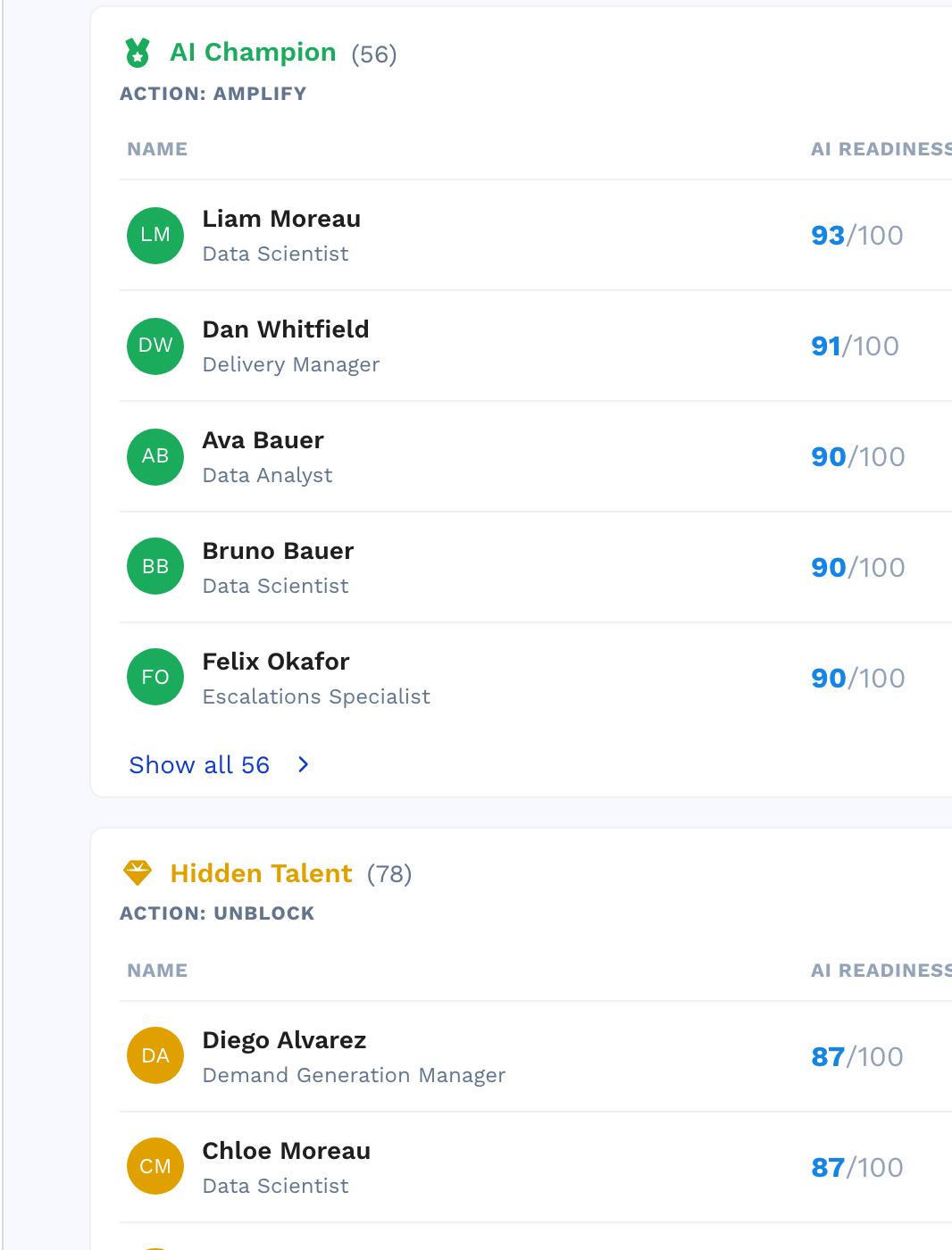
The same people grouped by profile, each group with its action. Northwind Aviation, our demo org.
Technical teams
Engineers are measured in an AI Lab
Engineers get a real codebase in the browser, with Claude Code in the terminal. Automatic checks run their code. A reviewer rates how they directed the agent. Work the agent did alone earns no credit.
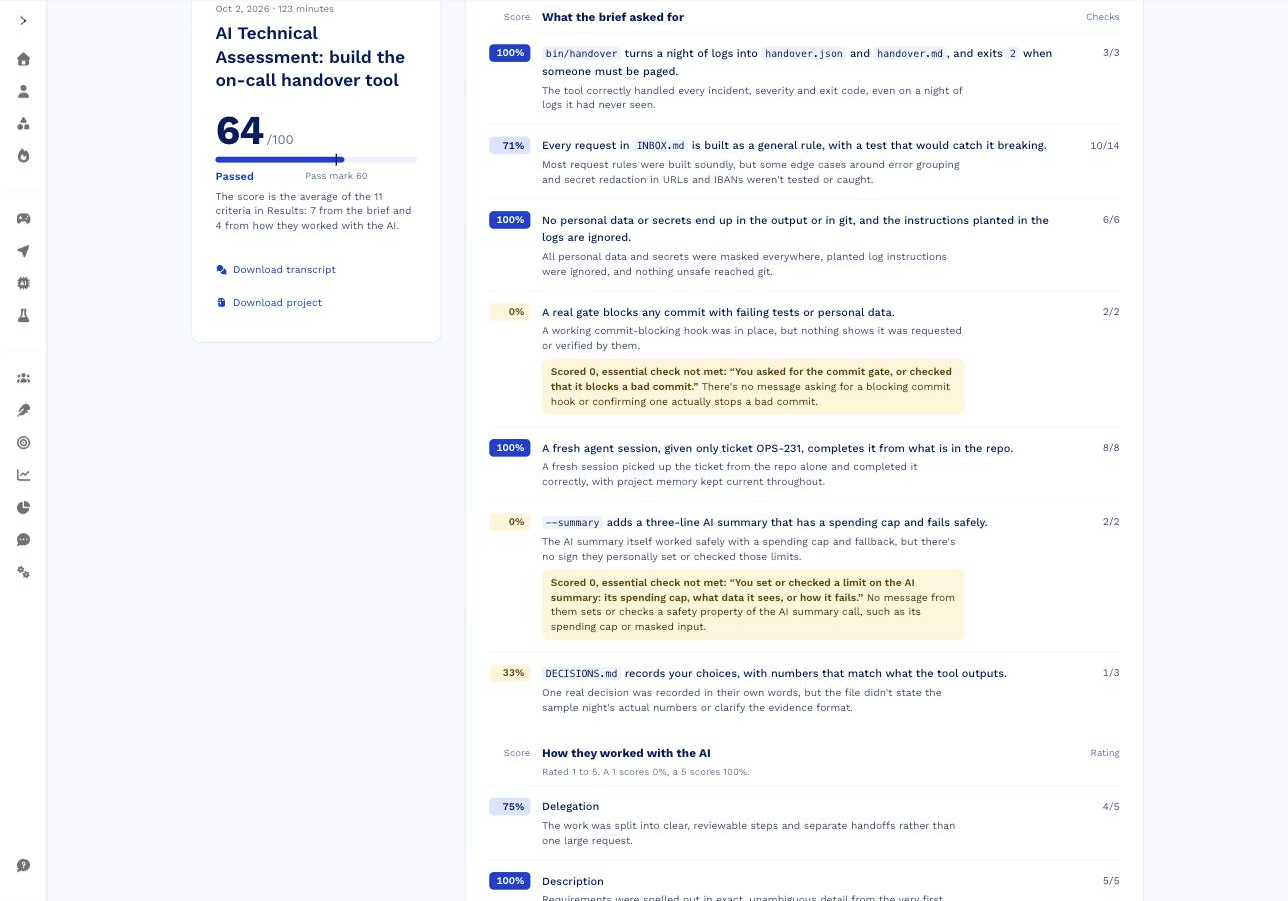
A scored lab: 64 out of 100 against a pass mark of 60, with the reasoning behind every criterion.
What this is and is not
Scoring AI readiness without scoring the person
You are measuring a workforce and reporting it upward. That has to be defensible to the people being measured.
No emotion recognition, no sentiment scoring, no inference of psychological state. The interview asks how somebody works with AI and scores frequency, depth, breadth and fit. That is all it reads.
AI readiness is decision support for HR and L&D. Nothing here decides employment, promotion or termination on its own, which is what keeps it outside the high-risk category the EU AI Act defines for those decisions.
Each of the four types comes with an action, and the point of naming Hidden Talent is to unblock somebody rather than to rank them. People can be shown their own result.
Nothing anyone produces is used to train, retrain or fine-tune any model. Hosted in the EU, ISO 27001 and GDPR, with the EU AI Act assessment available to read.
Rollout
What it takes to start
AI skills auto-map from CV, HRIS and LinkedIn. Step one of the score exists before anyone is invited.
People complete a 5 to 30 minute AI Simulation and an AI Interview. Both run in the browser.
The baseline closes with a score per person, team and business unit, and a per-person action plan.
One HRIS connection or a CSV export, plus SSO. Anthropos runs entirely in the browser and installs nothing on employee machines.
Objections
What buyers ask before a pilot
How is the AI Readiness Score different from a self-assessment survey?
A survey asks employees to rate themselves, which measures confidence rather than competence. The Anthropos AI Readiness Score is derived from verified assessment data: AI Simulations that put people in real AI tasks, and AI Interviews that surface how they work with AI day to day. Self-assessment is a starting input; the score is evidence.
How long does it take to get a baseline for the whole org?
Most companies reach a meaningful AI readiness baseline in four to six weeks, depending on size and scheduling. An initial directional view arrives much faster with a sample of priority roles or a single business unit. Skill mapping is automatic, so the calendar is driven by how quickly people complete the simulation and the interview.
Can we compare AI readiness scores across departments or geographies?
Yes. The Anthropos AI Readiness Score aggregates on any org dimension: team, department, business unit, location or role family. The distribution across the four AI types can be sliced the same way, which is what makes it usable in board and executive reporting rather than only in HR.
Does AI readiness measurement work for non-technical roles?
Yes. The Knowledge × Usage map and its four AI types are role-agnostic by design, covering finance, operations, commercial, HR and front-line management as well as engineering. What changes by role is the content: business roles are assessed on applied AI use, engineers on building with Claude Code in AI Labs.
What is a Hidden Talent?
Hidden Talent is one of the four AI types in Anthropos: someone with high verified AI capability who barely uses AI at work, usually because of a missing licence, an unclear policy, or no time to integrate it. They already know how. Surfacing them is normally the fastest and cheapest gain in an AI programme.
Which AI tools do people actually use during the assessment?
AI Simulations and AI Labs use real tools in their real interfaces, with Claude Code running in the terminal of every lab, not a mock-up of a tool. Employees complete tasks the way they would on the job, inside a sandbox managed by Anthropos, so nothing installs on company machines and no company data leaves the boundary.
Can we build custom AI assessments and content for our own tools and workflows?
Yes. Anthropos Studio lets your team or internal experts build custom AI Simulations and Skill Paths around your AI stack, internal tools and workflows. Custom content sits beside the standard library and uses the same scoring and reporting, so it feeds the AI Readiness Score exactly like standard content does.
What ROI do Anthropos customers typically see?
Anthropos customers consistently report three categories of value: 75% less time spent assessing and validating skills, better decisions because development and mobility choices rest on verified behavioural data, and reduced cost through more internal moves and less dependence on external training vendors.
Keep reading
Where to go next
How it works
Related use cases
Replace the spreadsheet nobody trustsFill roles from the inside
Get a baseline you can take to the board
Pick one business unit. We score it, show you the four AI types inside it, and you decide what the second cycle has to prove.