
Every workforce decision you make is only as good as your skills data
Most organisations don’t know what their people can actually do. They have job titles, tenures, and HRIS tags — not skills. Anthropos maps your workforce capability automatically, so planning, mobility, and development start from something real.
Why most organisations are flying blind on workforce capability
HRIS systems tell you who people are and what roles they hold. They don’t tell you what people can do. That gap shows up every time you try to make a talent decision.
Your HRIS holds roles, not skills
Job titles and org structure tell you where someone sits — not what they can do. The data you have for workforce planning is structural, not capability-based. Every decision made from it is an assumption.
Self-assessments don’t aggregate
When you ask employees to rate their own skills, you get answers that reflect confidence, culture, and recency bias — not consistent, comparable capability data. You can’t make decisions from it at scale.
No structured taxonomy means no insights
Even when skills are captured, they’re free-text tags with no hierarchy or framework. “Python” and “python3” and “Python scripting” are three different things in your system. You can’t search, filter, or aggregate.
Two phases that build a complete, structured skills picture
Skills mapping combines automatic extraction from existing data sources with structured employee input — so you get coverage without burdening your team.
Auto-extraction from existing sources
Anthropos ingests CVs, HRIS data, and LinkedIn profiles. AI parses the text and maps it to the 60K+ skills taxonomy — no manual tagging, no spreadsheet work. Skills are normalised and structured from the start.
Guided employee self-evaluation
Employees review their auto-extracted profile and rate proficiency on each skill using a structured 0–5 scale with anchor descriptions. They can add skills the system missed. The process takes under 15 minutes.
Structured skills inventory — ready to act on
The result: every employee has a structured skills profile tied to a shared taxonomy. You can filter by skill, by role, by team, by gap. Workforce Intelligence turns the inventory into aggregated insights.
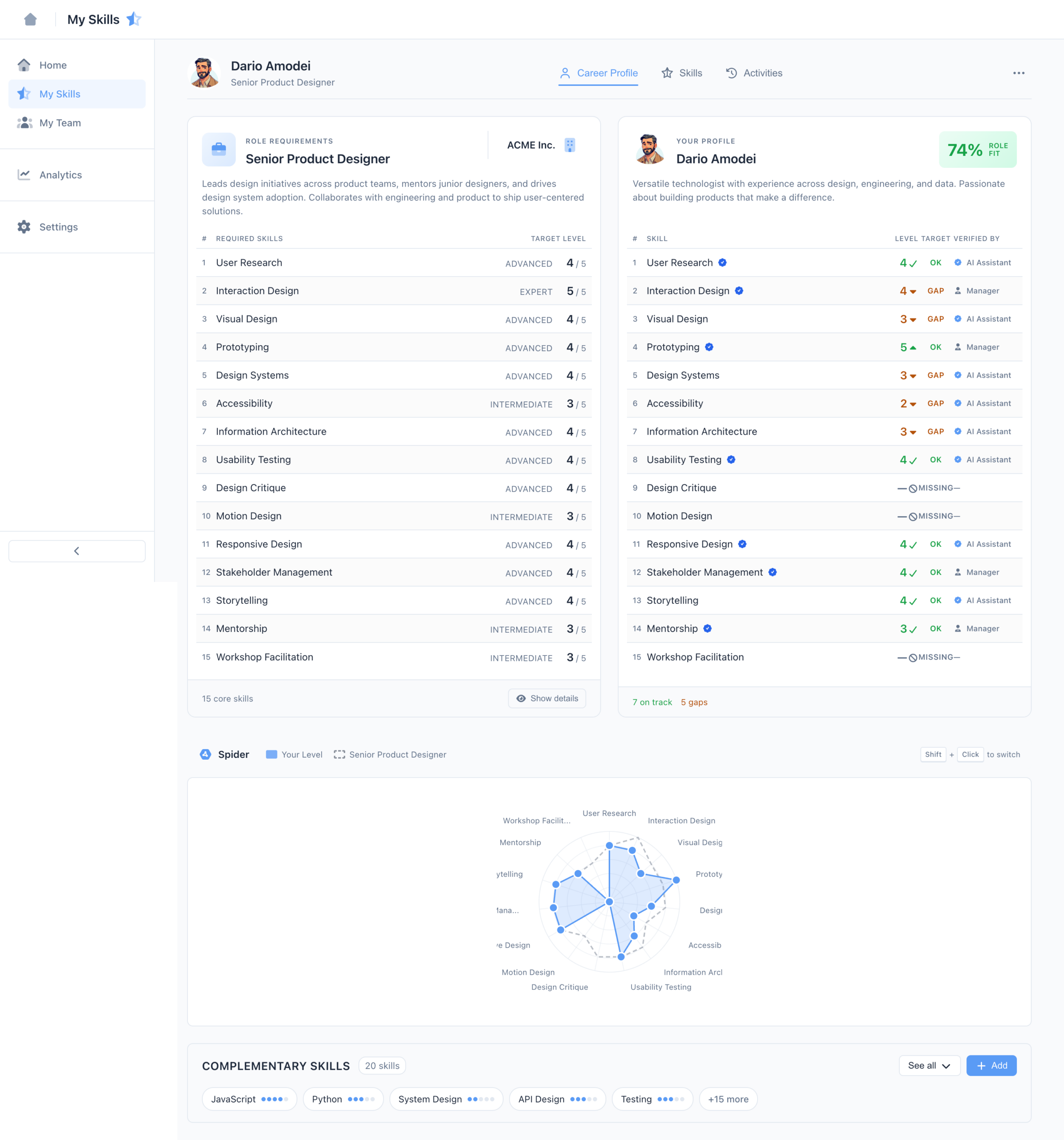
Built on a taxonomy that covers your entire workforce
Not a generic skills library — a structured, hierarchical taxonomy across every role category your organisation operates in.
What becomes possible when you know what your workforce can do
Skills mapping doesn’t just answer a data question. It changes the quality of every downstream talent decision.
Where skills mapping makes the biggest difference
Skills mapping is the foundation — but the value shows up in specific talent decisions and programmes.
Critical skill coverage by function
Identify concentration risk — where critical skills are held by one or two people — and plan hiring or development before it becomes a business problem.
Where is your workforce on AI skills?
Map the current AI capability baseline across every function. Identify who’s ready to work with AI tools today, who needs development, and where the exposure risk is highest.
Know your bench — not your best guess
Identify succession candidates based on verified skills proximity to critical roles — not tenure and performance ratings. Know exactly what each candidate needs to close the gap.
Match open roles to internal candidates first
Before posting externally, search the skills inventory for employees whose verified capabilities match the role requirements. Reduce time-to-fill and improve retention in one move.
Training budgets tied to real gaps
Map the delta between where your workforce is and where your business strategy requires them to be. Allocate development investment to the skills that actually need closing.
Map acquired team capabilities fast
When you acquire a company or integrate a new team, skills mapping gives you a structured picture of the incoming capability — in days, not months of manual HR work.
Phases 1 and 2 of the 5-Phase Workforce Methodology
Skills mapping is where everything begins. Without it, verification, interviews, and development programmes have no foundation to build on.
Trusted by leading enterprises



Frequently asked
What CHROs and HR leaders ask before starting a skills mapping programme.
Start building a workforce picture based on something real
Book a demo and see how Anthropos maps your workforce skills in under 30 days — and what becomes possible once you have structured capability data.