
Many organizations today face the same uncomfortable question: are our teams actually ready for what’s coming next?
Markets are changing quickly. Artificial intelligence is transforming workflows. Customer expectations evolve constantly, and new tools appear faster than teams can adopt them. In this environment, simply having talented people on staff is not enough. What matters is whether those people have the right capabilities to perform in the roles and contexts that the business requires.
This is where workforce readiness assessment becomes essential.
Unlike traditional performance evaluations, which look backward at past results, workforce readiness assessment focuses on something different: future capability. It helps companies understand whether their people are equipped to handle upcoming challenges, new technologies, and evolving responsibilities.
For leaders trying to plan the next phase of growth, this insight is invaluable. Without it, decisions about hiring, training, restructuring, or internal mobility are often made based on incomplete information.
TL;DR
-
Workforce readiness assessment helps organizations understand whether employees have the skills and capabilities needed for current and future roles.
-
Traditional methods like performance reviews and training records often fail to reveal real readiness or potential.
-
Simulation-based assessments allow companies to observe how employees solve problems, collaborate, and make decisions in realistic work scenarios.
-
Platforms like Anthropos help organizations identify skill gaps early, support internal mobility, and prepare teams for evolving challenges such as AI adoption.
What Is a Workforce Readiness Assessment?
A workforce readiness assessment is the process of evaluating whether employees have the skills, behaviors, and decision-making abilities needed to perform effectively in current or future roles.
This workforce assessment goes beyond checking credentials or reviewing past performance. It examines how people operate in situations that resemble real work scenarios. It asks questions such as:
-
Can employees adapt to new technologies or tools?
-
Are they able to collaborate across teams and functions?
-
Do they communicate effectively under pressure?
-
Are they prepared to take on more strategic responsibilities?
In many companies, these questions are difficult to answer with traditional HR tools. Surveys, competency frameworks, or course completion metrics may indicate what employees have been exposed to, but they rarely show how those employees apply their knowledge in practice.
As a result, organizations often struggle to identify who is truly ready for the next step and who might need additional development.
Why Traditional Assessments Often Fall Short
Historically, workforce readiness has been inferred from a combination of manager feedback, performance reviews, and tenure. While these signals provide useful context, they are inherently subjective and often incomplete.
Manager evaluations can be influenced by personal perception or limited visibility into how employees behave outside of their immediate team. Performance reviews tend to focus on past achievements rather than future potential. Certifications and training records show participation, but not necessarily competence.
In fast-moving environments, these limitations become even more problematic. Roles evolve rapidly, and employees are expected to operate in situations that did not exist when they were originally hired. A software engineer may suddenly need to collaborate closely with product managers and data scientists. A sales representative may need to interpret analytics dashboards and engage with more technical buyers.
If readiness is evaluated only through static metrics, companies risk promoting people who are not fully prepared or overlooking employees who have the potential to excel in new roles.
A New Approach: Assessing Readiness Through Real Work Scenarios
Modern workforce readiness assessment is shifting toward a more dynamic and evidence-based model. Instead of asking employees to describe their skills, companies are increasingly evaluating how those skills appear in action.
Anthropos enables organizations to do this through AI-powered job simulations. These simulations recreate realistic work environments where employees must solve problems, interact with stakeholders, and make decisions similar to those they would encounter on the job.
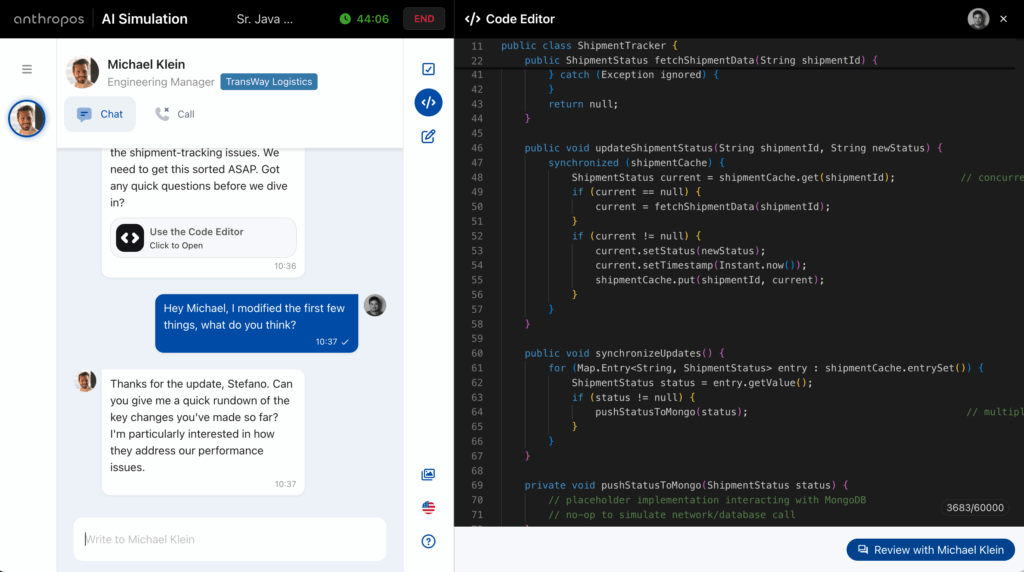
For example, a customer success manager might need to respond to a complex client escalation. A product manager may be asked to prioritize competing feature requests. A developer could be tasked with debugging a system while explaining their reasoning to a technical lead.
By observing how individuals navigate these scenarios, companies gain a much clearer understanding of readiness. They can see how employees analyze information, communicate with others, and adapt to changing circumstances. These insights are far more predictive of future performance than theoretical tests or surveys.
Identifying Skill Gaps Before They Become Business Risks
One of the biggest advantages of workforce readiness assessment is its ability to reveal capability gaps early.
Organizations often discover these gaps only when a project fails, a new initiative stalls, or a key leader leaves unexpectedly. At that point, the cost of addressing the issue is much higher.
With Anthropos, readiness assessments can highlight these risks before they impact the business. Leaders can identify where teams lack strategic thinking, communication skills, or technical expertise, and take targeted action to address those gaps.
This insight is particularly valuable when companies adopt new technologies such as generative AI. Many organizations assume that employees are adapting quickly to these tools, but the reality can vary significantly across teams. Simulations allow companies to observe how people actually use AI in problem-solving situations and whether they apply it effectively.
Supporting Internal Mobility and Career Growth
Workforce readiness assessment also plays a key role in enabling internal mobility. Companies frequently aim to promote from within, but they hesitate when they lack reliable information about an employee’s readiness for a new role.
Simulation-based assessments reduce this uncertainty. Instead of relying on assumptions, organizations can observe how candidates perform in scenarios that resemble the responsibilities of the target role.
This approach benefits both the organization and the employee. Leaders gain confidence in their promotion decisions, while employees receive transparent feedback about what they need to improve in order to advance.
Over time, this creates a culture where career growth is tied to demonstrated capability rather than tenure alone.
Turning Readiness Insights into Action
A workforce readiness assessment is most valuable when it leads to meaningful action. The insights generated through Anthropos simulations can be used in several ways.
Human resources teams can, i.e., run a workforce skills gap analysis and design targeted development programs that address specific capability gaps. Managers can identify employees who are ready for expanded responsibilities or leadership opportunities. Learning and development teams can track how readiness evolves over time as employees complete training or take on new challenges.
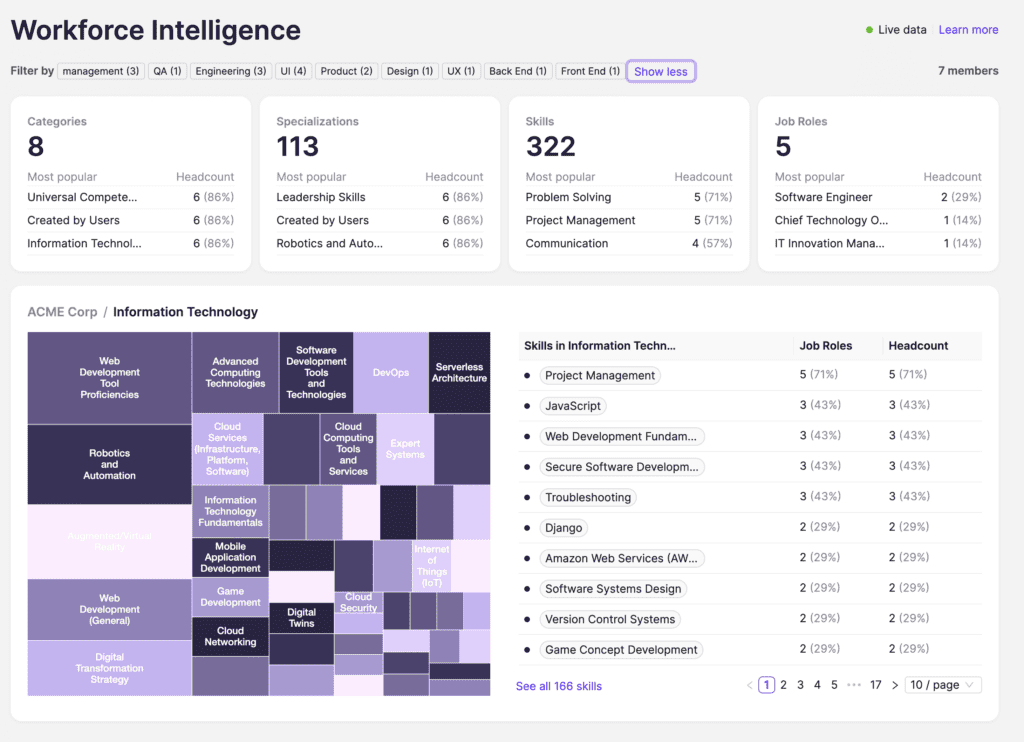
An example of what Anthropos shows in real time inside your company. All the skills mapped inside a team and the ability to find the employees that have them.
Because Anthropos organizes assessment results into structured skill maps, these insights become accessible to multiple stakeholders across the organization. Leaders gain a clear view of how talent is distributed and where investments in development will have the greatest impact.
Building a Workforce Ready for the Future
Organizations today are under constant pressure to evolve. New technologies, new business models, and new customer expectations require teams that can adapt quickly.
Yet adaptability cannot be assumed. It must be measured, developed, and supported.
Workforce readiness assessment provides the framework to do exactly that. By evaluating how employees perform in realistic situations, companies gain a deeper understanding of their strengths, their risks, and their opportunities for growth.
Anthropos enables this new approach by turning assessment into an active, engaging process rather than a static evaluation. Through AI-powered simulations, organizations can see how their people think, collaborate, and solve problems—long before those abilities are tested in the real world.
For companies seeking to navigate change with confidence, this visibility is no longer a luxury. It is the foundation of a workforce that is truly ready for what comes next.
It may also interest you

March 5, 2026
Recent post
Related Posts
Most organizations don’t realize they have a workforce capability problem until it begins to affect performance. A major project slows down because teams lack the right technical expertise. A new product launch struggles because customer-facing teams are not ready to handle complex conversations. A digital transformation initiative stalls because employees are unsure how to adopt ...

Artificial intelligence is not just changing the tools employees use. It is changing the very definition of work itself. Across industries, AI is accelerating tasks that once required hours of manual effort. Software developers can now write code with AI assistance. Marketing teams generate campaign ideas with large language models. Sales representatives rely on predictive ...
For a long time, workforce decisions were made based on manager input, tenure, or simple performance reviews. Who’s ready for promotion? Who needs support? Who’s at risk of burnout or churn? These questions were often answered by what someone “felt,” not what the data showed. But as companies grow, reorganize, and integrate AI into more ...