
Organizations today are navigating an environment defined by continuous change. New technologies are reshaping how work is performed, industries are evolving faster than traditional talent models can support, and business leaders are under increasing pressure to ensure their workforce remains capable of delivering results.
In this context, the concepts of upskilling and reskilling have moved from learning and development terminology into strategic boardroom discussions. Companies are recognizing that workforce capability is no longer static. Employees must continuously evolve their skill sets to remain effective, and organizations must provide structured pathways to support that evolution.
However, many leaders still struggle to distinguish clearly between upskilling and reskilling, leading to development initiatives that lack focus or fail to address the most pressing capability needs.
Understanding the difference between these two approaches is essential for designing talent strategies that support both short-term performance and long-term competitiveness.
TL;DR – Upskilling vs Reskilling: What Companies Need to Know to Stay Competitive
- Upskilling enhances employees’ existing capabilities to improve performance in current or evolving roles.
- Reskilling prepares employees to transition into entirely new roles as business needs change.
- Both approaches are essential for building a resilient workforce and reducing reliance on external hiring.
- Platforms like Anthropos help organizations assess real capabilities and design targeted development pathways.
What Workforce Upskilling Really Means
Workforce upskilling refers to the process of enhancing employees’ existing capabilities so they can perform more effectively in their current roles or prepare for incremental responsibilities. It is typically associated with deepening expertise, improving efficiency, or enabling individuals to work with new tools and technologies.
For example, a sales professional may be upskilled to use AI-driven analytics tools to identify customer opportunities more effectively. A software engineer may develop advanced architectural skills to handle more complex system design challenges. A customer success manager may strengthen communication strategies to manage high-value accounts.
Upskilling is therefore closely tied to performance optimization. It helps organizations maximize the potential of their existing workforce by ensuring employees can meet evolving expectations without requiring significant role changes.
Understanding When Reskilling Is Required
Reskilling, by contrast, involves preparing employees to transition into entirely new roles or functions. This approach becomes necessary when business priorities shift significantly or when certain capabilities become obsolete due to technological disruption or organizational restructuring.
For instance, a company adopting automation technologies may need to reskill operational staff into data analysis or process optimization roles. Similarly, organizations expanding into digital products may reskill traditional marketing professionals into growth or product marketing positions.
Reskilling often requires more extensive learning journeys and a stronger emphasis on foundational capability development. It is typically linked to workforce transformation initiatives, internal mobility programs, or long-term strategic planning.
While more complex to implement, reskilling can help organizations retain valuable institutional knowledge while adapting to changing market conditions.
Upskilling vs. Reskilling: Why Companies Need Both Approaches
In practice, upskilling and reskilling are complementary components of a modern talent strategy. Upskilling enables continuous improvement and helps employees remain productive as their roles evolve. Reskilling supports more substantial shifts in workforce structure, allowing organizations to redeploy talent where it is most needed.
Companies that rely solely on hiring to acquire new capabilities often face increased costs and slower adaptation. Conversely, organizations that invest in both upskilling and reskilling can respond more quickly to change, strengthen employee engagement, and build a more resilient workforce.
The challenge lies in identifying which approach is appropriate for each situation. This requires a clear understanding of current workforce capabilities and future business requirements.
The Role of Real Capability Assessment
Determining whether employees need upskilling or reskilling cannot be based on assumptions alone. Organizations must observe how individuals perform in realistic scenarios to understand their readiness for new responsibilities.
Simulation-based assessment provides valuable insight into this decision-making process. Through Anthropos, companies can evaluate how employees solve problems, collaborate with stakeholders, and apply technical knowledge in complex situations. These observations help leaders identify whether capability gaps can be addressed through targeted skill enhancement or whether more substantial role transitions are necessary.
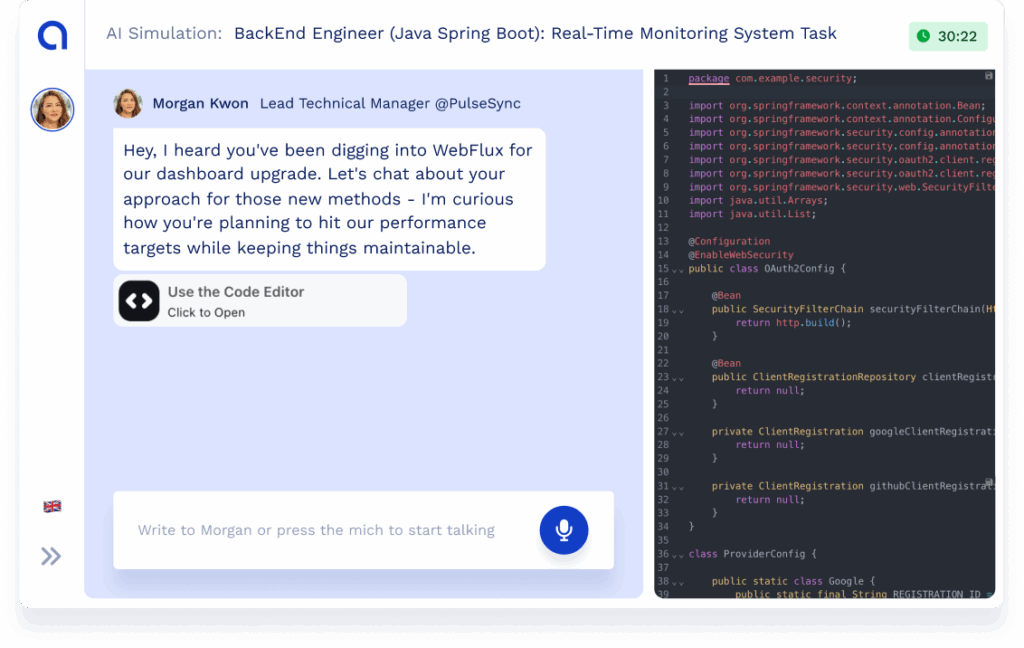
By grounding development decisions in real performance data, organizations reduce the risk of investing in ineffective training programs and increase the likelihood of successful talent transformation.
Supporting Skill Development in an AI-Driven Workplace
Artificial intelligence is accelerating the need for both upskilling and reskilling across many functions. Employees must learn how to work alongside intelligent systems, interpret data-driven insights, and adapt to new workflows that redefine traditional roles.
In some cases, upskilling initiatives may focus on helping teams integrate AI tools into existing responsibilities. In others, reskilling may be required to prepare employees for entirely new types of work created by technological advancement.
Anthropos Workforce enables organizations to support both pathways through structured skill paths and immersive simulations. Employees can develop practical experience in safe environments, while leaders gain visibility into how capabilities evolve over time.
This approach ensures that workforce development efforts remain aligned with strategic priorities and technological change.
Upskilling & Reskilling: Creating a Workforce Ready for Continuous Evolution
Ultimately, the distinction between upskilling and reskilling reflects a broader shift in how organizations think about talent. Workforce capability is no longer defined by static job descriptions or fixed career trajectories. Instead, it is shaped by the ability to learn, adapt, and contribute to new challenges.
Companies that invest in structured development pathways are better positioned to navigate uncertainty and maintain competitive advantage. They can redeploy talent efficiently, support innovation initiatives, and foster a culture where continuous growth is expected.
Anthropos helps organizations operationalize this vision by turning skill development into an observable and measurable process. Through AI-powered simulations and data-driven insights, leaders can design upskilling and reskilling strategies that prepare their workforce for the future.
In an era of rapid change, understanding when to enhance existing capabilities and when to enable role transitions is essential. Organizations that master this balance will build teams capable of sustaining performance while embracing transformation.
FAQ – Upskilling vs Reskilling
What is the difference between upskilling and reskilling?
Upskilling focuses on strengthening existing skills to improve performance in current roles, while reskilling involves preparing employees for new roles or career paths.
Why do companies need both upskilling and reskilling strategies?
Organizations face both incremental skill evolution and structural workforce changes. Combining both approaches helps maintain productivity while enabling transformation.
How can companies decide whether to upskill or reskill employees?
Leaders can observe performance in realistic scenarios to understand readiness levels. Simulation-based assessments provide insight into whether capability gaps are minor or require role transitions.
How does AI influence upskilling and reskilling needs?
AI changes how work is performed, requiring employees to learn new tools and workflows. Some roles evolve through upskilling, while others may require reskilling into new functions.
How does Anthropos support upskilling and reskilling initiatives?
Anthropos provides AI-powered simulations and structured skill paths that help organizations measure capability development and guide workforce transformation decisions.
Best simulations for workforce upskilling:

April 7, 2026
Most read about
Recent post
Related Posts
As organizations invest more heavily in workforce development, a fundamental question continues to surface at leadership level: how do we know if upskilling is actually working? Traditional learning metrics often provide only a partial answer. Companies can track how many employees enroll in training programs, how many complete courses, and how many certifications are obtained. ...
Organizations today are operating in an environment where talent challenges are no longer limited to hiring. Retaining skilled employees, ensuring teams remain productive, and enabling internal mobility have become equally critical priorities. As roles evolve and new technologies reshape workflows, employees expect opportunities to grow and adapt rather than remain confined to static responsibilities. Workforce ...

Workforce upskilling has become a priority for organizations facing rapid technological change and evolving business demands. Yet despite significant investments in training platforms, online courses, and development programs, many companies struggle to see tangible improvements in performance. Employees complete learning modules but continue to face challenges when applying new skills in real situations. Managers dedicate ...