
As organizations invest more heavily in workforce development, a fundamental question continues to surface at leadership level: how do we know if upskilling is actually working?
Traditional learning metrics often provide only a partial answer. Companies can track how many employees enroll in training programs, how many complete courses, and how many certifications are obtained. While these indicators demonstrate activity, they rarely reveal whether workforce capability is improving in ways that impact performance.
This lack of clarity creates uncertainty around the return on learning investments. Leaders may struggle to justify continued funding for development initiatives or to understand which programs deliver meaningful outcomes. In some cases, upskilling efforts become disconnected from business priorities because their effectiveness cannot be measured reliably.
Developing a structured approach to measuring upskilling effectiveness is therefore essential for organizations seeking to build future-ready teams.
TL;DR – Measuring Upskilling Effectiveness: From Course Completion to Real Capability
- Traditional learning metrics such as course completion do not accurately reflect workforce capability development.
- Measuring upskilling effectiveness requires linking skill progression to real performance outcomes.
- Simulation-based learning provides structured insights into how employees apply new capabilities in realistic scenarios.
- Platforms like Anthropos help organizations track skill growth over time and align development investments with business priorities.
The Limits of Traditional Learning Metrics
Most organizations rely on learning management systems to monitor development activity. These platforms offer valuable insights into participation and content consumption, but they often fall short when it comes to evaluating skill application.
Completing a course does not necessarily mean that employees can use new knowledge in complex situations. High engagement rates do not guarantee improved decision-making or productivity. Even post-training assessments may focus on theoretical understanding rather than real-world performance.
As work becomes more dynamic and technology-driven, these limitations become more pronounced. Companies need to understand not only whether employees are learning, but whether they are becoming more capable of contributing to strategic initiatives.
This requires moving beyond activity-based metrics toward performance-based indicators that reflect actual capability development.
Connecting Skill Development to Business Outcomes
Measuring upskilling effectiveness becomes more meaningful when it is linked to tangible business outcomes. Organizations can evaluate whether development initiatives contribute to improvements in project delivery speed, customer satisfaction, operational efficiency, or innovation capacity.
For example, an upskilling program designed to strengthen data literacy should ultimately enable teams to make faster and more informed decisions. Similarly, training initiatives focused on customer communication should translate into higher retention rates or improved service quality.
Establishing these connections requires collaboration between learning leaders and business stakeholders. Together, they can define the indicators that matter most and track how capability development influences performance over time.
This alignment ensures that workforce upskilling is perceived not as a standalone activity but as a driver of organizational success.
Using Simulation-Based Insights to Measure Capability Growth
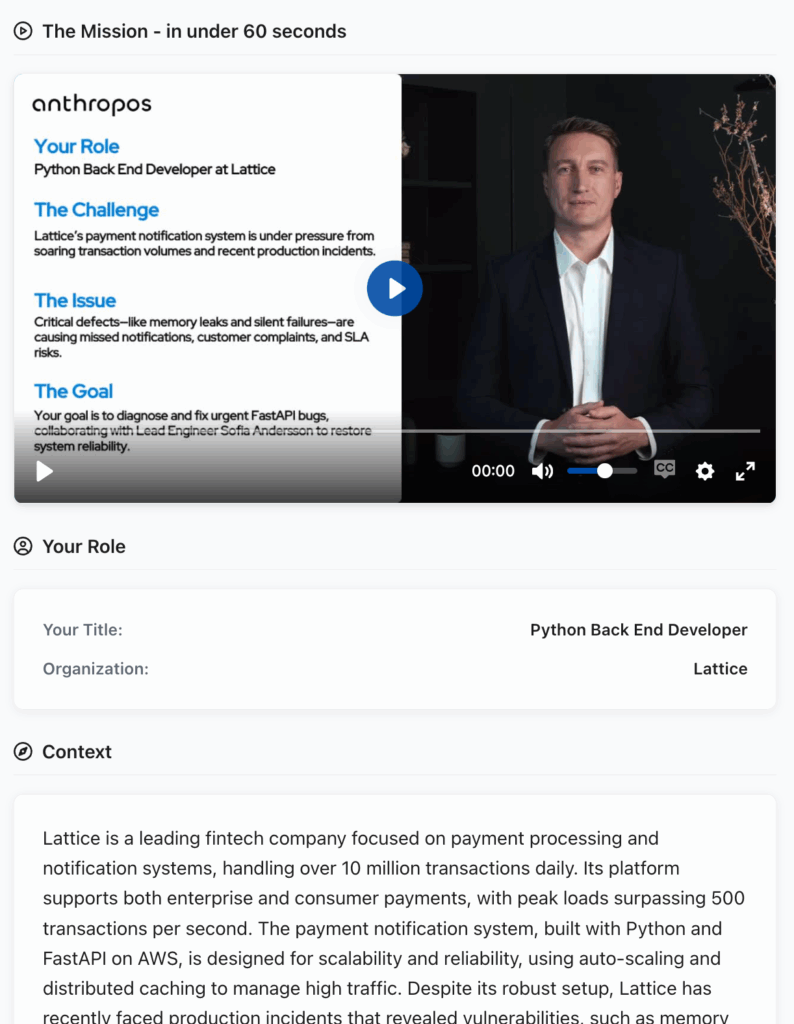
Simulation-based learning models offer a powerful way to measure upskilling effectiveness because they generate structured data about how employees behave in realistic scenarios. Through Anthropos Workforce, participants engage in tasks that mirror their daily responsibilities, allowing leaders to observe skill progression directly.
These simulations provide insight into how individuals prioritize competing objectives, collaborate with stakeholders, and integrate new tools into their workflows. By repeating similar scenarios over time, organizations can track improvements in decision quality, adaptability, and confidence.
This approach creates a continuous feedback loop. Employees receive guidance on how to refine their skills, while leaders gain visibility into the areas where development initiatives are producing measurable results. Upskilling effectiveness becomes an observable process rather than an assumption based on participation metrics.
Building Skill Maps That Reflect Real Progress
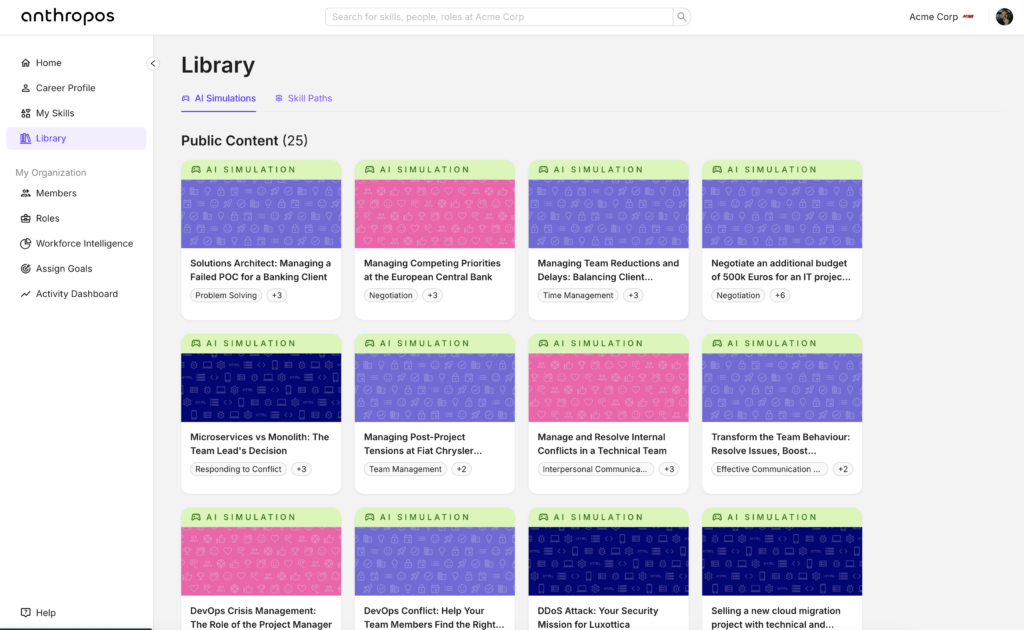
Aggregating simulation insights into skill maps helps organizations understand how capability evolves across teams and functions. These visual representations provide a clear overview of strengths, development areas, and emerging leadership potential.
With Anthropos, skill maps are updated dynamically as employees complete simulations and development paths. Leaders can identify patterns that influence workforce readiness, such as improvements in analytical thinking, communication effectiveness, or technological adaptability.
This visibility supports more informed decisions about talent allocation, internal mobility, and future learning investments. It also helps ensure that upskilling efforts remain aligned with strategic priorities rather than becoming isolated initiatives.
Creating a Culture of Accountability in Learning
Measuring upskilling effectiveness also contributes to a broader cultural shift within organizations. When development outcomes are visible and linked to performance, employees and managers alike become more accountable for skill progression.
This transparency encourages individuals to approach learning with greater intention. Instead of completing courses simply to meet requirements, employees focus on building capabilities that enhance their impact. Managers, in turn, are better equipped to support development conversations and recognize progress.
Anthropos facilitates this culture by providing actionable insights that can be integrated into performance discussions and career planning. Workforce upskilling becomes a shared responsibility, supported by data and aligned with organizational goals.
From Training Metrics to Workforce Capability Intelligence
Ultimately, measuring upskilling effectiveness requires organizations to rethink how they define success in learning. Rather than focusing on participation or content delivery, they must evaluate whether employees are gaining the skills needed to thrive in evolving roles.
By combining simulation-based insights with performance indicators, companies can transform workforce development into a strategic capability. Anthropos enables this transformation by offering immersive learning experiences and structured data that reveal real progress.
In a business environment where adaptability and innovation are essential, the ability to measure and refine upskilling initiatives will distinguish organizations that build lasting competitive advantage.
FAQ – Measuring Upskilling Effectiveness
Why is it difficult to measure upskilling effectiveness?
Traditional metrics focus on training participation rather than real capability development, making it hard to understand whether employees can apply new skills effectively.
What indicators can organizations use to measure upskilling success?
Companies can track performance improvements, productivity gains, internal mobility rates, and enhanced decision-making quality.
How do simulations help measure skill progression?
Simulations replicate realistic work scenarios, allowing leaders to observe how employees apply knowledge, adapt to challenges, and improve over time.
What are skill maps and why are they useful?
Skill maps visualize workforce capability across teams and functions, helping organizations identify strengths, development areas, and readiness for new responsibilities.
How does Anthropos support measuring upskilling effectiveness?
Anthropos provides immersive simulations and structured insights that enable organizations to track capability growth and refine their learning strategies.
Best simulations for workforce upskilling:

April 7, 2026
Most read about
Recent post
Related Posts
Organizations today are navigating an environment defined by continuous change. New technologies are reshaping how work is performed, industries are evolving faster than traditional talent models can support, and business leaders are under increasing pressure to ensure their workforce remains capable of delivering results. In this context, the concepts of upskilling and reskilling have moved ...

Organizations today are operating in an environment where talent challenges are no longer limited to hiring. Retaining skilled employees, ensuring teams remain productive, and enabling internal mobility have become equally critical priorities. As roles evolve and new technologies reshape workflows, employees expect opportunities to grow and adapt rather than remain confined to static responsibilities. Workforce ...

Workforce upskilling has become a priority for organizations facing rapid technological change and evolving business demands. Yet despite significant investments in training platforms, online courses, and development programs, many companies struggle to see tangible improvements in performance. Employees complete learning modules but continue to face challenges when applying new skills in real situations. Managers dedicate ...