Across industries, companies are facing a growing realization: the skills that made teams successful in the past are no longer sufficient to support future growth. Technological disruption, new business models, and evolving customer expectations are reshaping how work gets done. In this environment, workforce upskilling is no longer a learning initiative owned exclusively by HR or L&D. It has become a strategic priority that directly influences productivity, innovation, and long-term competitiveness.
Organizations are increasingly aware that hiring alone cannot solve capability gaps. Talent markets are competitive, specialized roles are difficult to fill, and the cost of external recruitment continues to rise. As a result, leaders are turning their attention inward, seeking ways to develop the potential that already exists within their workforce.
A well-designed workforce upskilling strategy helps companies prepare employees for new responsibilities, accelerate transformation initiatives, and ensure that business performance does not slow down due to capability shortages.
TL;DR – What this blog is about:
- Workforce upskilling is becoming a strategic priority as companies face rapid technological and market changes.
- Traditional training programs often fail to translate learning into real capability and measurable performance improvements.
- Simulation-based approaches help employees practice skills in realistic scenarios and accelerate readiness for new responsibilities.
- Platforms like Anthropos enable organizations to align upskilling with business goals, track skill progression, and build future-ready teams.
Moving Beyond Traditional Training Models
For many years, workforce upskilling was associated with structured training programs, online courses, and certification paths. While these approaches provided foundational knowledge, they often struggled to translate learning into measurable performance improvements.
Employees might complete multiple training modules without gaining confidence in applying new skills. Managers might invest in learning platforms without clear visibility into whether teams were becoming more effective. This disconnect between training activity and real capability development has led many organizations to question the effectiveness of traditional learning models.
Today, the focus is shifting from content consumption to skill application. Companies are increasingly interested in understanding not just what employees know, but what they can actually do when faced with real challenges. Upskilling strategies must therefore evolve to include methods that allow employees to practice, experiment, and demonstrate their abilities in realistic contexts.
Aligning Upskilling With Business Objectives
An effective workforce upskilling strategy begins with a clear understanding of business priorities. Organizations must identify the capabilities required to support strategic initiatives, whether that involves adopting artificial intelligence technologies, expanding into new markets, improving customer experience, or optimizing internal processes.
When upskilling efforts are closely aligned with these objectives, they become more than development programs. They become enablers of execution. Leaders can invest in building the skills that will have the greatest impact on revenue growth, operational efficiency, and innovation.
This alignment also helps create stronger engagement among employees. When individuals see how new capabilities connect directly to meaningful outcomes, they are more likely to embrace learning opportunities and take ownership of their professional development.
Workforce upskilling then becomes a shared responsibility across the organization, supported by leadership and embedded into everyday workflows.
The Role of AI in Reshaping Workforce Skills
Artificial intelligence is accelerating the need for workforce upskilling across nearly every function. Employees are expected to collaborate with intelligent systems, interpret data-driven insights, and adapt to rapidly changing tools and processes.
This shift is redefining what it means to be skilled. Technical expertise remains important, but it must now be complemented by adaptability, problem-solving ability, and effective communication. Employees need to understand how to guide AI tools, evaluate outputs critically, and integrate technology into decision-making processes.
Organizations that fail to develop these capabilities risk falling behind competitors that are better prepared to leverage emerging technologies. Workforce upskilling strategies must therefore include targeted initiatives that help employees build confidence in working alongside AI.
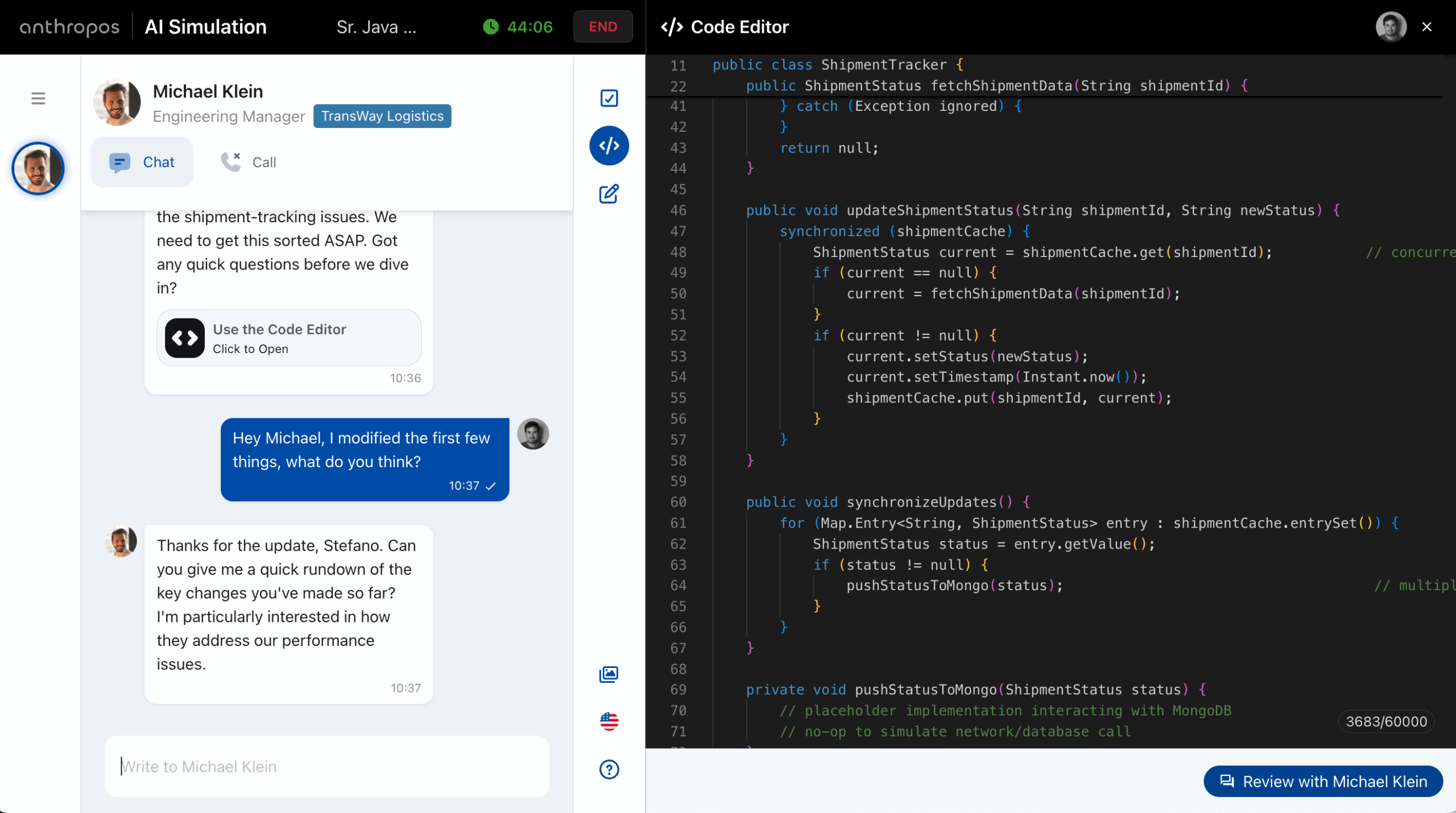
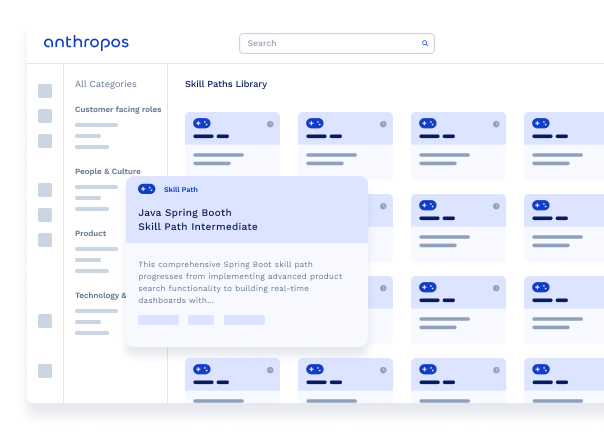
Anthropos Workforce supports this transition by offering structured skill paths and immersive simulations that allow teams to practice AI-enabled workflows in realistic scenarios. This approach helps organizations move from theoretical awareness of AI to practical readiness.
Simulation-Based Upskilling: From Learning to Capability
One of the most significant developments in workforce upskilling is the adoption of simulation-based learning models. Unlike traditional training formats, simulations allow employees to engage with scenarios that closely resemble their day-to-day responsibilities.
Through Anthropos, organizations can design experiences where participants respond to customer interactions, solve operational challenges, or collaborate with virtual stakeholders. These simulations generate structured insights into how individuals apply knowledge, manage complexity, and adapt under pressure.
This level of realism helps bridge the gap between learning and performance. Employees gain hands-on experience in a safe environment, while leaders gain visibility into skill progression and readiness for new responsibilities.
Simulation-based upskilling also enables organizations to personalize development pathways. Rather than offering identical training programs to everyone, companies can tailor learning experiences based on demonstrated strengths and areas for improvement.
Measuring the Impact of Workforce Upskilling
For workforce upskilling to deliver meaningful value, organizations must be able to measure its impact. Traditional indicators such as course completion rates or training hours provide limited insight into whether capabilities are improving.
Modern upskilling strategies rely on performance-based metrics. These may include improvements in project delivery speed, increased customer satisfaction, or greater success in internal mobility initiatives. By connecting skill development to tangible business outcomes, leaders can evaluate the effectiveness of their investments and refine their approach over time.
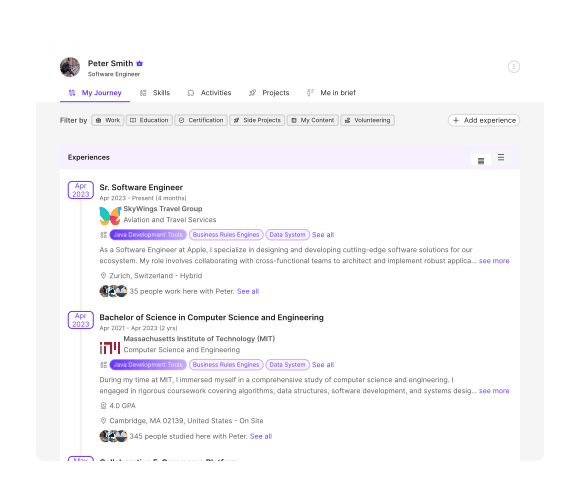
Anthropos supports this measurement process by capturing behavioral and skill data during simulations. This data can be aggregated into skill maps that provide a clear view of workforce capability across teams and functions. Such visibility allows organizations to track progress, identify emerging leaders, and anticipate future skill requirements.
Building a Culture of Continuous Development
Ultimately, workforce upskilling is not a one-time initiative. It is an ongoing process that requires commitment from both leadership and employees. Organizations that succeed in building a culture of continuous development are better equipped to navigate uncertainty and seize new opportunities.
This culture is reinforced when learning becomes integrated into everyday work. Employees feel empowered to experiment with new approaches, seek feedback, and pursue growth aligned with organizational goals. Leaders, in turn, gain confidence that their workforce can adapt to changing demands.
Anthropos enables this cultural shift by making skill development engaging, practical, and data-driven. By combining immersive simulations with structured skill paths, companies can create development experiences that feel relevant and impactful.
In a business landscape defined by rapid change, workforce upskilling is a strategic capability that determines how effectively organizations can execute their vision and remain competitive.
FAQ – Workforce Upskilling Strategy
What is workforce upskilling?
Workforce upskilling refers to the process of developing employees’ existing skills so they can perform more effectively in their current roles or prepare for new responsibilities.
Why is workforce upskilling important for business performance?
Upskilling helps organizations close capability gaps, support transformation initiatives, improve productivity, and reduce reliance on external hiring.
How can companies design an effective workforce upskilling strategy?
Organizations should align skill development initiatives with business priorities, use realistic learning methods such as simulations, and measure progress through performance-based indicators.
How does AI influence workforce upskilling needs?
AI is changing how work is performed across many functions. Employees need to learn how to collaborate with intelligent tools, interpret data insights, and adapt quickly to new technologies.
How does Anthropos support workforce upskilling?
Anthropos provides immersive AI-powered simulations and structured skill paths that help employees practice real tasks, enabling organizations to measure capability development and prepare teams for evolving challenges.
It may also interest you

March 26, 2026
Most read about
Recent post
Related Posts
Hiring the right software engineer is just the beginning. Today that means finding someone that has great coding skills but also the ability to pick up Cursor, Claude Code or other AI-based solutions to make their productivity 2x/3x the one of a normal engineer. Still, it doesn't change the fact that once they’re in, the ...