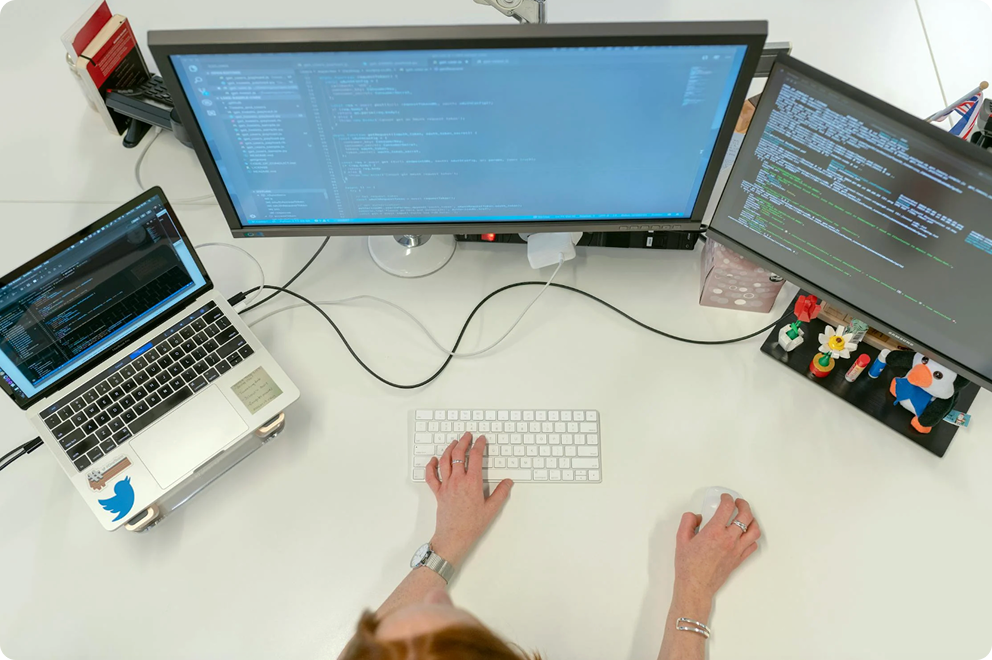
For a long time, workforce decisions were made based on manager input, tenure, or simple performance reviews.
Who’s ready for promotion? Who needs support? Who’s at risk of burnout or churn? These questions were often answered by what someone “felt,” not what the data showed.
But as companies grow, reorganize, and integrate AI into more roles, the risks of relying on subjective views are growing too. It’s now clear: intuition alone doesn’t scale. It can lead to missed opportunities, slow reaction times, and even hidden biases. That’s why many organizations are shifting toward data-driven workforce assessment — an approach that uses real behavioral data to map skills, identify gaps, and drive smarter people decisions.
The key difference? It’s not just about measuring what people know, but instead about seeing how they apply that knowledge in realistic work situations.
That’s where traditional surveys or course completion stats fall short — and where Anthropos is changing the game.
TL;DR – What we are going to cover in this article:
-
Traditional workforce decisions based on intuition and reviews don’t scale — data-driven assessment provides clearer, fairer insights.
-
Simulation-based evaluation reveals how employees actually perform in real scenarios, not just what they claim on paper.
-
Skill maps help leaders identify strengths, gaps, and internal mobility opportunities across teams.
-
Anthropos turns workforce assessment into actionable intelligence — supporting upskilling, promotions, and strategic talent planning.
Skills Gap Analysis: What a Data-Driven Workforce Assessment Looks Like
Running a data-driven assessment means grounding talent conversations in observable, real-world performance. The goal isn’t to remove human judgment, but to inform it with better inputs.
With Anthropos, the process begins by designing or selecting simulations that match the actual roles or skill sets you want to evaluate.
These AI-powered job simulations might involve decision-making under pressure, stakeholder communication, handling an internal project handoff, or even using AI tools to complete a workflow. They’re not generic, they reflect how work happens in your business.
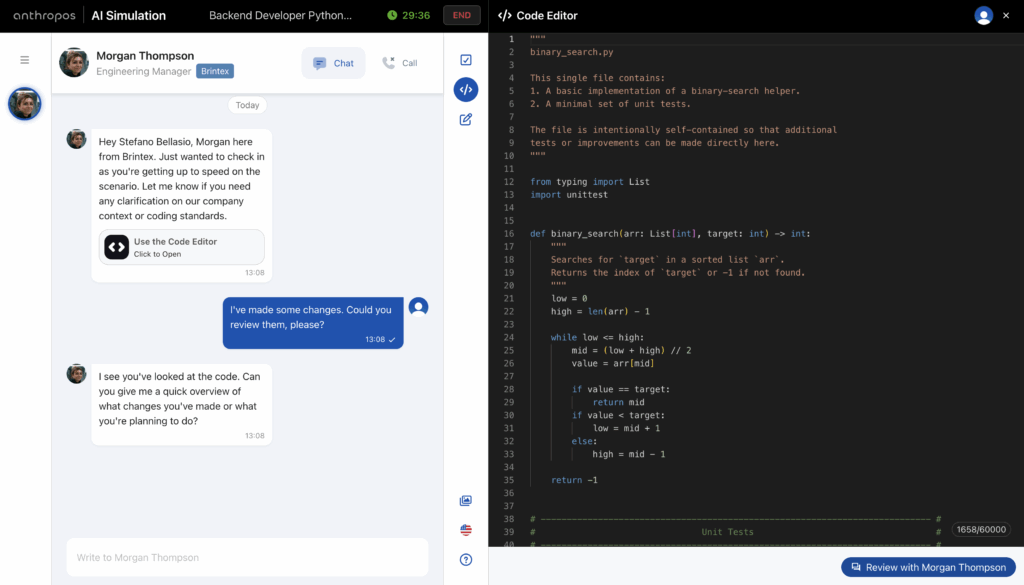
As employees complete AI simulations, Anthropos captures how they behave: how they analyze a problem, how they communicate, how they make trade-offs, and how they adapt. The platform doesn’t just generate a score — it builds a skill map that reflects both strengths and development areas across technical, cognitive, and soft skills.
This becomes the foundation for conversations about readiness, potential, and learning — all based on shared evidence.
Why Skill Maps Matter More Than Scores
What separates Anthropos from traditional assessments is the fact that the platform creates actionable insights — not just pass/fail outcomes.
Skill mapping and verification help leaders visualize capability across a team, function, or organization. They can show which sales team is best equipped to handle strategic accounts, or which developers are already collaborating effectively with AI.
They also help identify gaps that could become costly — like a lack of leadership potential in fast-growing departments or underdeveloped analytical skills in customer-facing roles.
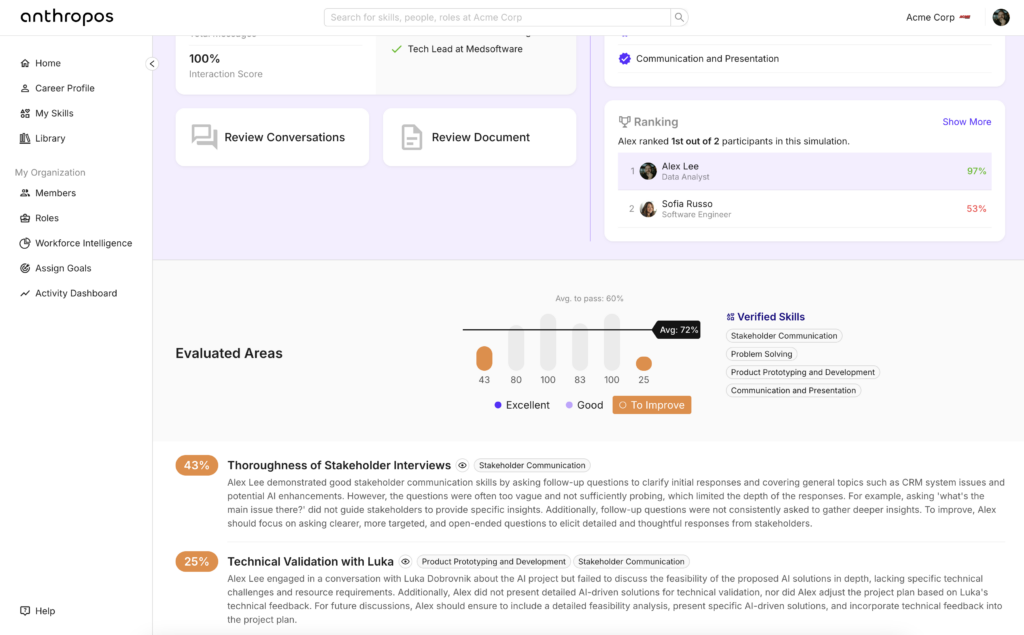
For HR teams, this allows more strategic planning, while for managers, it creates clarity on where to invest time and resources.
And for employees, it builds trust in the process. People don’t want to be judged on checkboxes or outdated assumptions. They want to be evaluated fairly — and given a chance to grow.
Workforce Skills Gap Analysis: From Assessment to Impact
Data alone doesn’t create change. But when combined with the right tools and intent, it can transform how companies manage and develop talent.
Once skills are mapped, Anthropos makes it easy to turn insights into action. You can create targeted upskilling paths, evaluate internal candidates for open roles, or track the progress of entire departments over time. Because simulations can be customized, they stay aligned with your evolving tools, processes, and priorities.
And the best part? The data generated isn’t limited to HR. Business unit leaders can use it to make team decisions. L&D teams can refine training programs. Talent partners can identify succession gaps. It becomes shared intelligence that supports business agility.
A Smarter, Fairer, More Scalable Way Forward
The pressure on organizations to adapt has never been higher. New technologies, new expectations, and new ways of working are challenging how we think about talent.
But you can’t build a future-ready workforce on gut feeling alone.
Data-driven workforce assessment — especially when powered by real-world simulations — gives companies a way to move from guesswork to confidence. It gives employees a clearer path forward. And it gives leadership the visibility they need to allocate talent where it matters most.
Anthropos makes this shift possible. Not by adding complexity, but by giving you better ways to see your people, support their growth, and match them to the challenges ahead.
It may also interest you

March 2, 2026
Most read about
Recent post
Related Posts
Organizations today operate in an environment where skills determine competitiveness more than ever before. Technology evolves quickly, customer expectations shift continuously, and new roles emerge faster than traditional job frameworks can keep up. In this context, companies are realizing that understanding what their workforce is truly capable of doing is no longer optional. This growing ...

Most organizations don’t realize they have a workforce capability problem until it begins to affect performance. A major project slows down because teams lack the right technical expertise. A new product launch struggles because customer-facing teams are not ready to handle complex conversations. A digital transformation initiative stalls because employees are unsure how to adopt ...

Artificial intelligence is not just changing the tools employees use. It is changing the very definition of work itself. Across industries, AI is accelerating tasks that once required hours of manual effort. Software developers can now write code with AI assistance. Marketing teams generate campaign ideas with large language models. Sales representatives rely on predictive ...