Organizations today operate in an environment where skills determine competitiveness more than ever before. Technology evolves quickly, customer expectations shift continuously, and new roles emerge faster than traditional job frameworks can keep up. In this context, companies are realizing that understanding what their workforce is truly capable of doing is no longer optional.
This growing awareness has pushed workforce skills assessment to the forefront of talent strategy. Leaders are asking not just who is performing well today, but who has the skills to contribute to future initiatives. They want to know where hidden strengths exist within teams and where capability gaps could limit growth.
Yet answering these questions is far from simple. Many organizations still rely on fragmented data, self-reported competencies, or outdated evaluation processes. As a result, they struggle to build a clear and reliable view of workforce capability.
TL;DR – What we are going to cover in this article:
- Workforce skills assessment helps organizations understand employees’ real capabilities and readiness for evolving roles.
- Traditional methods such as certifications or performance reviews often fail to capture how skills are applied in real work situations.
- Simulation-based assessment provides deeper insight into technical and soft skills, including adaptability and collaboration.
- Platforms like Anthropos enable companies to build skill maps, support AI adoption, and align talent development with strategic priorities.
What Is Workforce Skills Assessment?
Workforce skills assessment refers to the systematic evaluation of employees’ abilities, knowledge, and behaviors to determine how effectively they can perform in their roles and adapt to new demands. Unlike traditional performance reviews, which often focus on past achievements, skills assessment aims to measure current capability and future potential.
At its best, workforce skills assessment helps organizations answer practical questions. Are employees equipped to take on more complex responsibilities? Do teams have the expertise required to support strategic initiatives? Which individuals are ready for promotion or cross-functional moves?
When done well, this process becomes a powerful tool for workforce planning, enabling leaders to align talent development with business priorities.
Why Traditional Skills Assessment Methods Fall Short
Historically, skills assessment has been approached through certifications, training completion metrics, and manager evaluations. While these methods offer some insight, they rarely capture how employees apply their skills in real-world contexts.
For example, completing a course on data analytics does not necessarily mean someone can interpret complex datasets under pressure. Holding a certification in cloud infrastructure does not guarantee the ability to troubleshoot issues in a production environment. Similarly, strong communication ratings in performance reviews may not reflect how someone handles high-stakes stakeholder conversations.
These limitations are amplified in modern workplaces, where employees must collaborate across functions, adapt to new technologies, and integrate AI tools into their workflows. Skills are no longer static assets. They are dynamic capabilities that must be continuously developed and validated.
Organizations need workforce assessment methods that reflect this reality — methods that observe behavior in context rather than relying solely on theoretical indicators.
Measuring Real Capabilities Through Simulation
One of the most effective ways to conduct workforce skills assessment today is through simulation-based evaluation. This approach allows employees to demonstrate their abilities in realistic scenarios that mirror the challenges they face in their daily work.
Anthropos enables companies to design and deploy these simulations at scale. Participants may be asked to analyze a business case, respond to a client escalation, collaborate with virtual stakeholders, or solve technical problems using AI-assisted tools. These experiences provide a rich source of data about how individuals think, communicate, and make decisions.
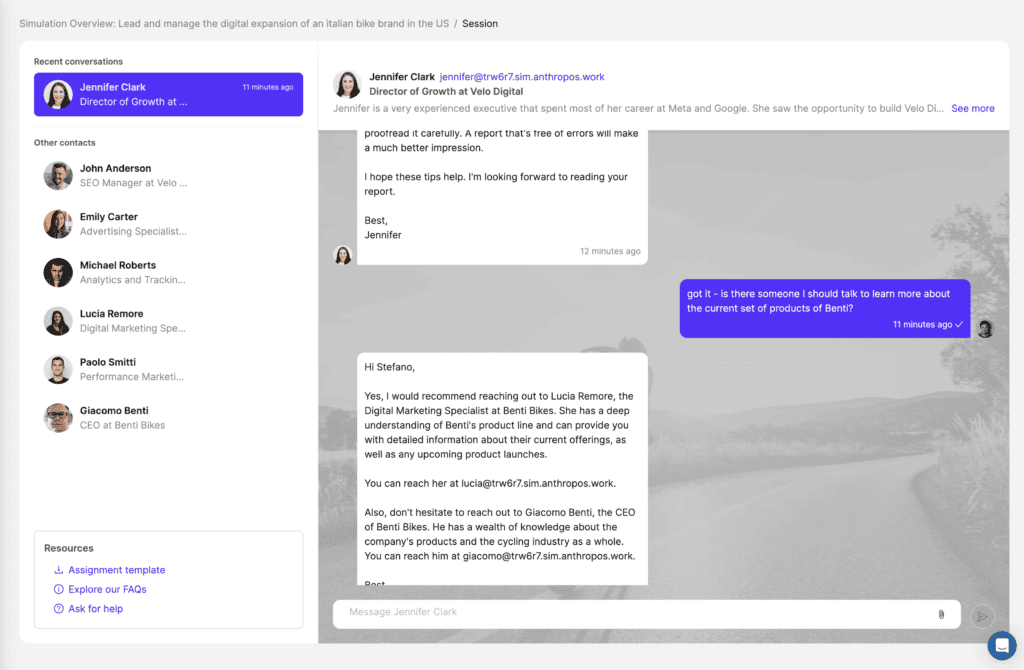
An example of the interaction you will have with customers and stakeholders in the Job simulations.
Unlike traditional tests, simulations capture not only technical knowledge but also soft skills such as adaptability, prioritization, and collaboration. They reveal how employees perform when conditions are uncertain or when multiple objectives must be balanced.
This deeper understanding helps organizations move beyond assumptions and build a more accurate picture of workforce capability.
Creating Skill Maps That Support Strategic Decisions
Workforce skills assessment becomes particularly valuable when its insights are aggregated into skill maps. These visual representations of capability allow leaders to understand strengths and gaps across teams, functions, and locations.
With Anthropos, skills mapping is generated from structured simulation data. Leaders can see which departments demonstrate strong analytical skills, which teams excel in customer communication, and where leadership potential is emerging. They can also identify areas where targeted development is required.
This visibility supports more informed decision-making. Instead of relying on generalized training programs, organizations can focus on the specific skills that will have the greatest impact on performance. Instead of recruiting externally for every new capability, they can explore internal mobility opportunities with greater confidence.
Over time, skill maps help create a more agile workforce — one that can respond quickly to new business demands.
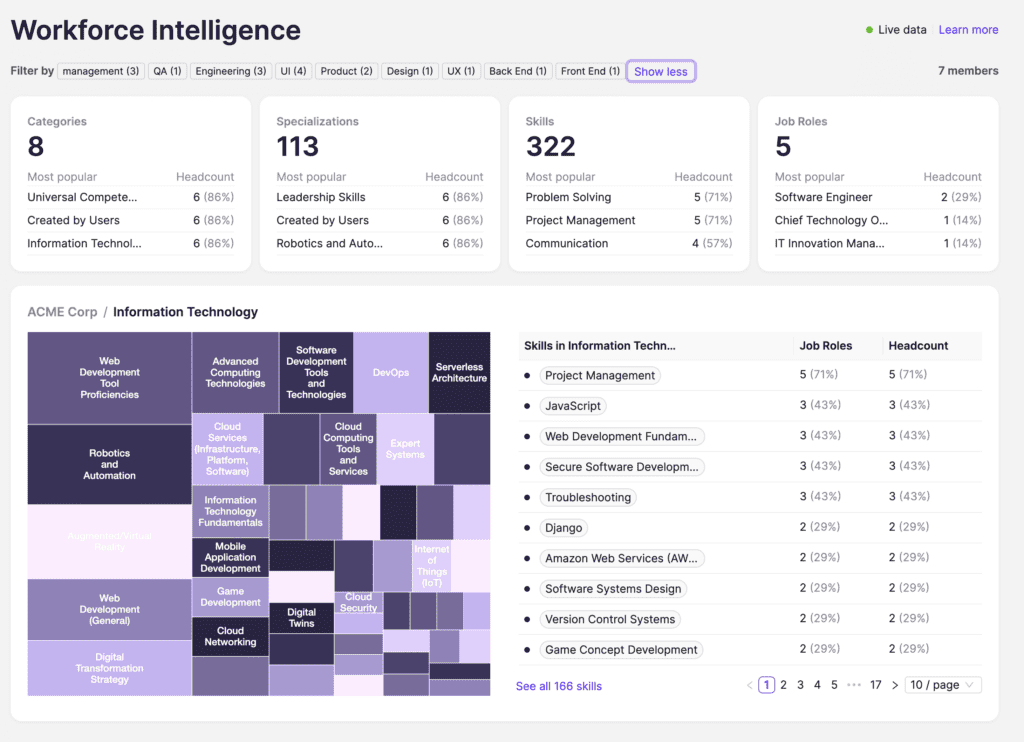
An example of what Anthropos shows in real time inside your company. All the skills mapped inside a team and the ability to find the employees that have them.
Aligning Skills Assessment With AI Adoption
As artificial intelligence becomes embedded in everyday workflows, workforce skills assessment must also evolve to reflect this shift. Employees are increasingly expected to use AI tools to enhance productivity, analyze information, and support decision-making.
However, AI adoption is rarely uniform. Some individuals quickly integrate new technologies into their work, while others struggle to adapt or apply them effectively. Without structured assessment, these differences can remain hidden.
Anthropos simulations can incorporate AI interactions directly into assessment scenarios. This allows organizations to evaluate not only whether employees are aware of AI tools, but how they use them in practice. Leaders can observe how individuals prompt AI systems, validate outputs, and incorporate insights into broader strategies.
These observations provide a clearer understanding of digital workforce readiness and help guide targeted upskilling initiatives.
Turning Skills Insights Into Workforce Advantage
The ultimate goal of workforce skills assessment is not simply to measure capability, but to enable action. When organizations understand the real strengths and development needs of their people, they can design more effective learning programs, accelerate career progression, and align talent strategy with business objectives.
Workforce upskilling platforms like Anthropos support this transformation by making assessment an ongoing process rather than a one-time event. As employees participate in simulations and complete development paths, organizations gain a continuously updated view of workforce capability.
This visibility helps leaders anticipate change rather than react to it. They can prepare teams for new responsibilities, support innovation initiatives, and ensure that critical skills are in place before they become bottlenecks.
In a business landscape defined by uncertainty and rapid technological progress, the ability to measure and develop workforce skills is a defining competitive advantage. Companies that invest in modern assessment approaches will be better positioned to adapt, grow, and succeed.
FAQ – Workforce Skills Assessment
What is workforce skills assessment?
Workforce skills assessment is the process of evaluating employees’ abilities and behaviors to understand how effectively they can perform in their roles and adapt to future challenges.
Why is workforce skills assessment important?
It helps organizations identify skill gaps, plan training initiatives, support internal mobility, and ensure that teams are prepared for strategic initiatives such as digital transformation.
How does workforce skills assessment differ from performance evaluation?
Performance evaluation focuses on past achievements and goals, while skills assessment measures current capability and potential for future roles or responsibilities.
How can companies assess workforce skills more accurately?
Organizations can use realistic simulations and structured performance data to observe how employees apply their skills in real-world scenarios rather than relying solely on theoretical tests or surveys.
How does Anthropos support workforce skills assessment?
Anthropos provides AI-powered job simulations that generate detailed insights into technical, cognitive, and soft skills, helping leaders make informed decisions about hiring, training, and talent development.

March 26, 2026
Most read about
Recent post
Related Posts
Most organizations don’t realize they have a workforce capability problem until it begins to affect performance. A major project slows down because teams lack the right technical expertise. A new product launch struggles because customer-facing teams are not ready to handle complex conversations. A digital transformation initiative stalls because employees are unsure how to adopt ...

Artificial intelligence is not just changing the tools employees use. It is changing the very definition of work itself. Across industries, AI is accelerating tasks that once required hours of manual effort. Software developers can now write code with AI assistance. Marketing teams generate campaign ideas with large language models. Sales representatives rely on predictive ...
Many organizations today face the same uncomfortable question: are our teams actually ready for what’s coming next? Markets are changing quickly. Artificial intelligence is transforming workflows. Customer expectations evolve constantly, and new tools appear faster than teams can adopt them. In this environment, simply having talented people on staff is not enough. What matters is ...