Artificial intelligence is not just changing the tools employees use. It is changing the very definition of work itself.
Across industries, AI is accelerating tasks that once required hours of manual effort. Software developers can now write code with AI assistance. Marketing teams generate campaign ideas with large language models. Sales representatives rely on predictive tools to prepare client conversations. Even leadership roles increasingly require familiarity with data-driven decision-making systems.
In this environment, companies are discovering that traditional ways of evaluating their workforce are no longer sufficient. Job titles do not capture how people collaborate with AI. Certifications do not reveal whether employees can apply new tools effectively. Even strong past performance does not guarantee workforce readiness for a rapidly evolving workplace.
This is why many organizations are beginning to rethink workforce assessment. Instead of focusing only on past results or theoretical knowledge, they are asking a new question: how capable are our teams of working in an AI-enabled environment?
Understanding that capability is becoming a central priority for leaders trying to navigate digital transformation.
TL;DR – What this article is about:
-
AI is changing how work gets done, making traditional workforce assessment methods less reliable.
-
Companies now need to evaluate how employees apply skills in real scenarios, especially when working with AI tools.
-
Simulation-based assessment provides deeper insight into workforce readiness, adaptability, and decision-making.
-
Platforms like Anthropos help organizations understand AI adoption, identify skill gaps early, and align talent development with business strategy.
The Limits of Traditional Workforce Assessment in an AI-Driven Workplace
For decades, workforce assessment relied on a familiar set of signals. Managers evaluated performance through annual reviews. Employees completed training programs and obtained certifications. HR teams maintained competency frameworks to describe the skills required for each role.
While these tools provided structure, they were built for a more stable world. Roles evolved slowly, and the skills required for success were relatively predictable.
AI has disrupted that stability.
Today, employees must combine technical knowledge with adaptability, problem-solving, and the ability to collaborate with intelligent systems. The value of a skill often lies not in the knowledge itself, but in how effectively it can be applied with the support of AI tools.
Traditional assessments struggle to capture this nuance. They can indicate whether someone has completed a course on machine learning or prompt engineering, but they rarely reveal whether that person can use AI responsibly in real work situations. They do not show how someone evaluates AI-generated output, how they adjust their thinking when technology produces unexpected results, or how they communicate those outcomes to colleagues.
As a result, many companies are operating with incomplete visibility into their workforce’s real capabilities.
AI Is Changing What Companies Need to Measure
One of the most significant impacts of AI on workforce assessment is that it shifts the focus from static knowledge to applied capability.
Organizations are beginning to evaluate skills differently. Instead of asking whether employees understand a concept, they want to see how individuals use that knowledge to solve problems, collaborate with others, and make decisions in complex situations.
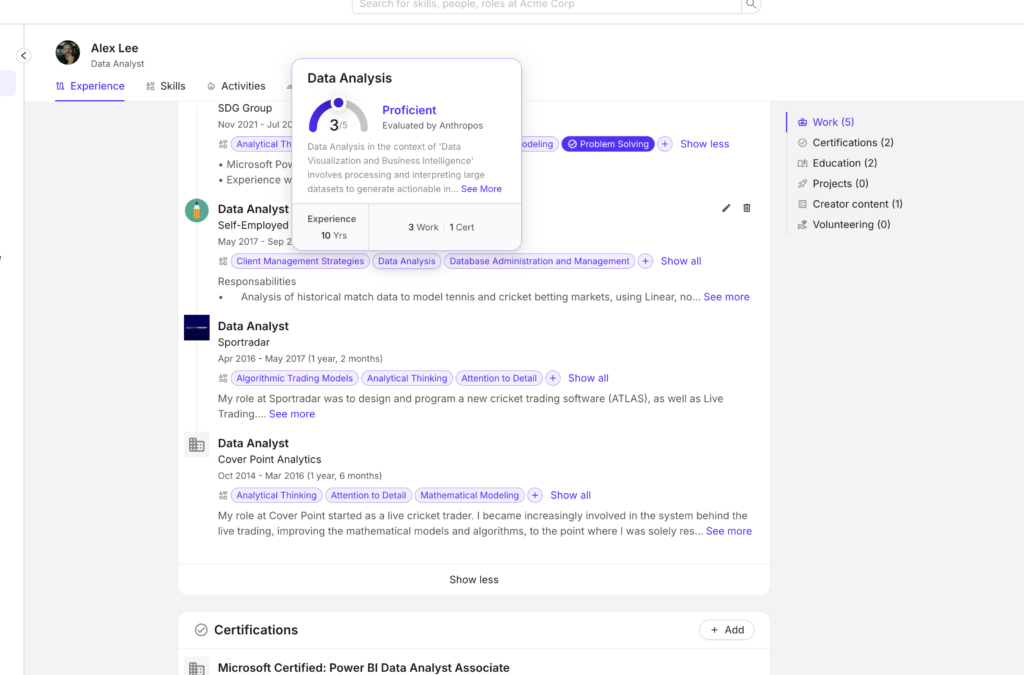
For example, a marketing professional today might rely on AI tools to analyze campaign data or generate content variations. The relevant skill is not simply knowing that these tools exist. It is the ability to guide the AI effectively, interpret its output, and refine the results to meet business objectives.
Similarly, developers increasingly rely on AI-assisted coding tools. Their value is no longer defined solely by how quickly they write code from scratch, but by how well they review, improve, and integrate AI-generated code into larger systems.
This shift requires a different kind of assessment framework—one that observes how people behave in realistic work scenarios rather than measuring theoretical knowledge alone.
Simulation-Based Assessment in the Age of AI
To address this challenge, many companies are turning to simulation-based workforce assessment. Instead of asking employees to describe what they would do in a situation, simulations place them directly inside realistic scenarios where they must act, decide, and communicate.
Anthropos was designed specifically for this new environment.
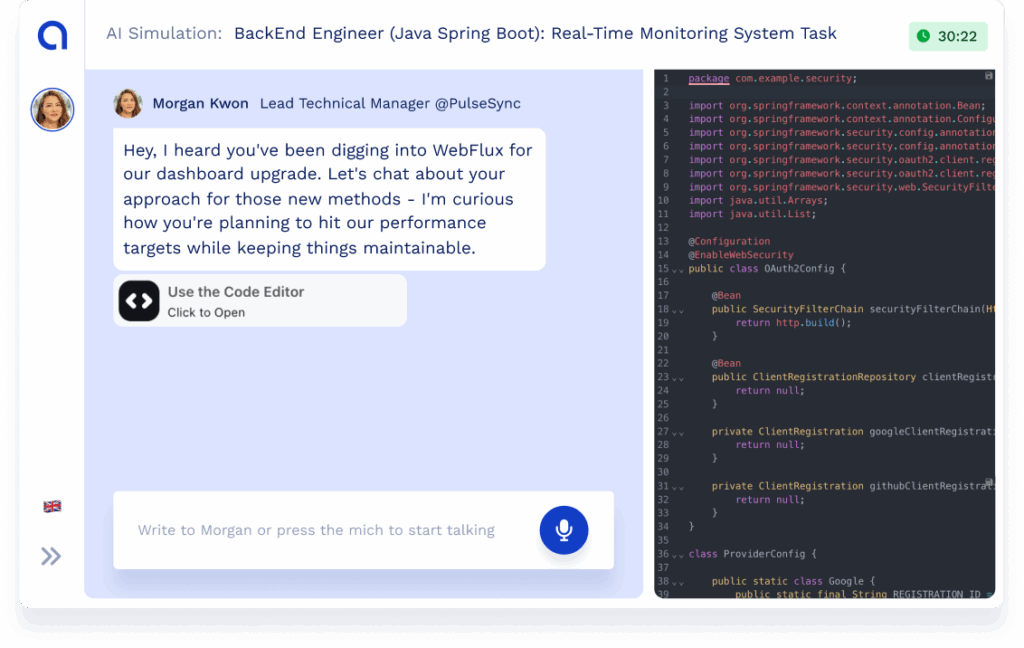
Through AI-powered job simulations, organizations can recreate the types of situations employees encounter in their daily work. Participants might need to respond to a client request, analyze data, collaborate with a virtual colleague, or decide how to use AI tools to solve a problem.
These simulations reveal far more than a traditional test. They show how individuals structure their thinking, how they balance efficiency with accuracy, and how they interact with AI systems when making decisions.
This provides a much richer understanding of workforce readiness. Leaders gain visibility into not only what employees know, but how they apply that knowledge when technology becomes part of the workflow.
Understanding AI Readiness Across the Organization
Another advantage of simulation-based assessment is that it allows companies to evaluate AI readiness across different teams and functions.
In many organizations, AI adoption happens unevenly. Some teams quickly integrate new tools into their workflows, while others struggle to adapt or rely on outdated processes. Without structured assessment, these differences can remain hidden until they begin to affect productivity or collaboration.
Anthropos simulations help surface these dynamics early. By observing how employees interact with AI systems in realistic tasks, companies can identify where adoption is working well and where additional support is needed.
This insight helps organizations design more effective training programs. Instead of offering generic AI courses to everyone, leaders can focus development efforts on the teams and capabilities that matter most.
Over time, this leads to a more confident and capable workforce—one that sees AI as a partner in problem-solving rather than a disruptive force.
Aligning Workforce Assessment With Business Strategy
Perhaps the most important impact of AI on workforce assessment is strategic. The ability to measure workforce readiness now plays a direct role in shaping how companies plan for the future.
Organizations investing heavily in digital transformation need to know whether their people are prepared to support that transformation. They must understand whether internal talent can adapt to new technologies or whether additional hiring will be necessary.
Workforce assessment provides the evidence needed to make those decisions with confidence.
With Anthropos, leaders can map capabilities across teams and functions, run skills gap analysis identifying where strengths already exist and where development is required. These insights help guide hiring strategies, training investments, and internal mobility programs.
Instead of reacting to change after it happens, companies gain the ability to anticipate and prepare for it.
The Future of Workforce Assessment in an AI Economy
As AI continues to reshape the workplace, the importance of workforce assessment will only grow. Organizations will need clearer visibility into how their people think, collaborate, and adapt in increasingly complex environments.
The companies that succeed will be those that move beyond static metrics and embrace more dynamic forms of evaluation. They will treat workforce assessment not as a compliance exercise, but as a continuous source of intelligence about their talent.
Anthropos enables this shift by turning assessment into an active, engaging process. Through AI-powered simulations, organizations can observe real behavior, understand real capabilities, and build a workforce prepared for the future.
In an economy defined by rapid change, the ability to measure readiness is no longer optional. It is the foundation for building teams that can thrive alongside the technologies transforming their industries.
FAQ – AI Impact on Workforce Assessment
How is AI changing workforce assessment?
AI is shifting workforce assessment from static evaluations of knowledge or past performance toward dynamic evaluations of real capability. Companies now focus more on how employees use AI tools, solve complex problems, and adapt to new workflows in realistic scenarios.
Why are traditional workforce assessment methods becoming less effective?
Traditional methods such as performance reviews, certifications, and surveys often fail to capture how employees behave in real work situations. In an AI-driven workplace, success depends more on adaptability, collaboration, and applied judgment than on theoretical knowledge alone.
What is AI readiness in workforce assessment?
AI readiness refers to how prepared employees are to work effectively with AI tools and technologies. This includes their ability to use AI responsibly, interpret outputs, integrate insights into decision-making, and collaborate with both human and digital stakeholders.
How can companies assess workforce readiness for AI adoption?
Organizations can assess readiness by observing employees in realistic simulations that mirror daily work challenges. These assessments reveal how individuals solve problems, communicate, and make decisions when AI is part of the workflow.
How does Anthropos help with AI workforce assessment?
Anthropos enables companies to run AI-powered job simulations that replicate real work environments. These simulations generate structured insights into skills, behaviors, and AI usage patterns, helping leaders make informed decisions about hiring, training, and internal mobility.

March 11, 2026
Most read about
Recent post
Related Posts
Organizations today operate in an environment where skills determine competitiveness more than ever before. Technology evolves quickly, customer expectations shift continuously, and new roles emerge faster than traditional job frameworks can keep up. In this context, companies are realizing that understanding what their workforce is truly capable of doing is no longer optional. This growing ...

Most organizations don’t realize they have a workforce capability problem until it begins to affect performance. A major project slows down because teams lack the right technical expertise. A new product launch struggles because customer-facing teams are not ready to handle complex conversations. A digital transformation initiative stalls because employees are unsure how to adopt ...

Many organizations today face the same uncomfortable question: are our teams actually ready for what’s coming next? Markets are changing quickly. Artificial intelligence is transforming workflows. Customer expectations evolve constantly, and new tools appear faster than teams can adopt them. In this environment, simply having talented people on staff is not enough. What matters is ...